


By the time the minivan began its final climb into the folds of the mountains east of Chiang Mai, my bag was sliding across the floor and everyone had gone quiet. The asphalt narrowed to a single lane, hairpinning through forest so dense the air cooled several degrees in minutes. Somewhere beyond the last bend was Mae Kampong, the now-famous community-based tourism village. Like most visitors, I had seen the photos of streamside cafes and dramatic viewpoints. Unlike most, I had booked a night in a local homestay to see what happened after the last day-trippers drove back to the city.
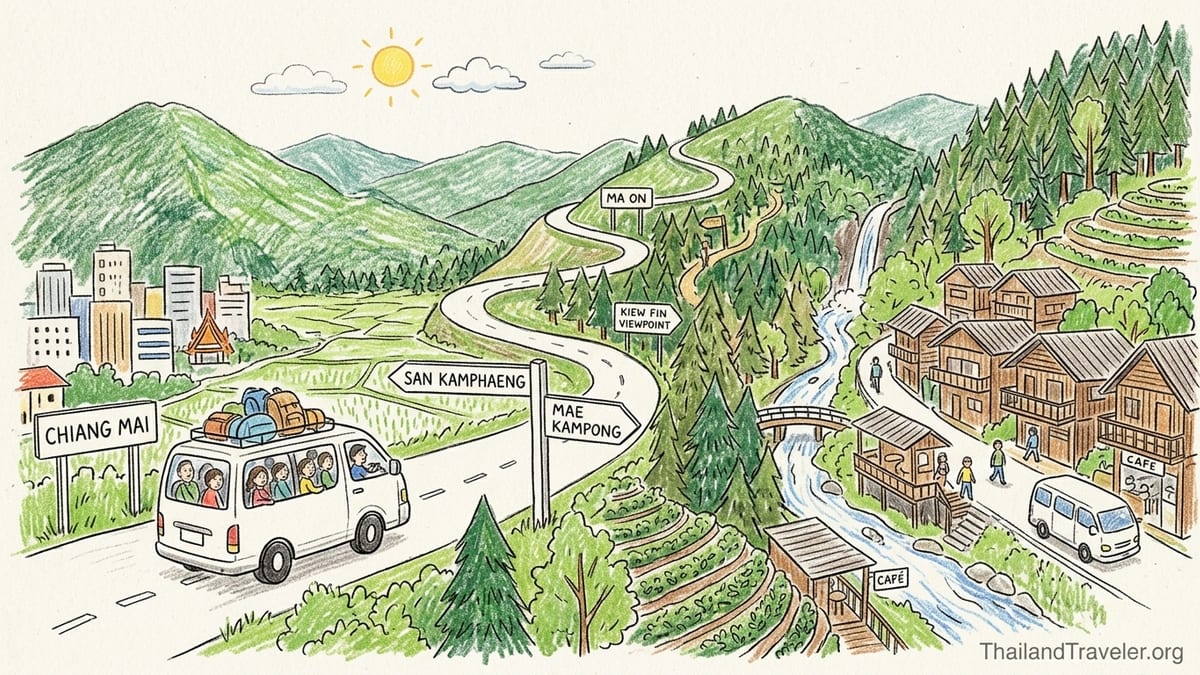
Getting to Mae Kampong from Chiang Mai
Mae Kampong sits about 50 kilometers east of Chiang Mai, in Mae On district, reached by a steep mountain road that peels off the San Kamphaeng route. Travel time by road is usually around 1 hour 15 minutes in light traffic, but the final 15 to 20 minutes feel much longer as the road narrows, climbs and coils around the hillside. The difference between gliding past rice paddies near San Kamphaeng and edging along a forested ravine is dramatic enough that it shapes your mood before you even see the village.
I chose to travel the way most locals and budget travelers do, using the shared minivan that connects Chiang Mai’s Warorot Market area with Mae Kampong. Seats are sold per person, with recent fares in the region of 80 to 100 baht one way, paid directly to the driver in cash. The morning departures are the most reliable, typically leaving between about 7:30 and late morning, and you are expected to arrive early, put your name on a handwritten list and wait until the van fills or the departure time comes. There is no luggage compartment, so backpacks go on laps and larger suitcases on the floor or in the narrow aisle.
As we left the city, the route passed Bo Sang’s umbrella workshops and then the low-rise sprawl of San Kamphaeng town before giving way to green hills. After Mae On, the driver turned onto a steeper local road which quickly reduced everyone to silence. The van swung through tight switchbacks, often slowing almost to a crawl to negotiate oncoming pickup trucks. Anyone used to wide highways will find this last stretch intense, especially in the rainy season when fallen leaves and mist can reduce grip and visibility. If you are prone to motion sickness, this is where you will feel it.
Arriving in Mae Kampong itself is slightly chaotic the first time. The driver dropped villagers and visitors at different points along the main lane, a narrow strip of concrete flanked by houses, cafes and small shops. Day-trippers usually disembark near the lower car park, where the streamside cafes begin. Overnight guests are often carried a little higher into the village, but communication is basic. Homestay hosts commonly share the van’s plate number and approximate arrival time by message and either meet you at the drop-off point or tell you which corner to stop at. With no sidewalks, everyone steps onto the edge of the road and squeezes against timber balconies whenever a pickup passes.
Booking a Community Homestay: How It Really Works
Unlike resort areas that run on big booking platforms, Mae Kampong’s accommodation is still dominated by community-run homestays coordinated through a village cooperative. The most straightforward way to book is via the official village information site or by contacting the cooperative line published on local tourism pages, which then assigns a homestay according to availability, group size and any special needs. Another option is to message individual homestay owners who advertise rooms with Thai-language posts and photos on social media. English is usually simple but functional, and response times can vary, especially on weekdays when hosts are working in the tea gardens or looking after family.
For this visit, I booked directly through a homestay host whose house number appeared on a local owner’s guide to accommodation in the village. Our conversation unfolded over a series of short messages in Thai and English. I provided my dates, number of people, whether we needed separate beds and confirmed that we were arriving by minivan from Warorot Market rather than self-driving. The host replied in brief but clear messages: price per person, whether dinner and breakfast were included and a reminder that the bathroom was shared with the family.
The total cost for my stay was 700 baht per person per night, which included a simple private room, hot shower access, dinner and breakfast. This amount sits in the middle of the range usually quoted for Mae Kampong’s homestays, often around 500 to 800 baht per person depending on the house, whether meals are included and if rooms have en-suite bathrooms. Payment was in cash on arrival. When I asked how the money was divided, my host explained that for bookings made through the cooperative, a portion is kept for village funds and shared projects, while direct bookings like mine send almost the entire amount to the household, with only small community contributions collected periodically. It is a reminder that “community-based tourism” can involve different channels, each with its own balance between household income and shared benefits.
The reservation itself was refreshingly low-tech. There was no deposit, no online confirmation page and no automated reminder. Instead, my host sent a photo of the house exterior, a note of the van times that usually reached the village and a simple promise: “I wait you at the road.” In an era when most trips are planned through apps, trusting that a stranger will be standing on a narrow mountain lane when your crowded van rattles into view felt surprisingly personal.
First Impressions of the Village: Lanes, Streams and Cafes
Stepping off the minivan into Mae Kampong, the first impression is vertical. Houses lean against the hillside above and below the concrete lane, their wooden balconies stacked almost on top of each other. A cold stream slices along one edge of the road, slipping under bridges and feeding narrow channels beneath homes. Sound travels easily in the valley: a rooster crowing two houses away, a kettle whistling, the low murmur of a cafe espresso machine, and the occasional shout between neighbors.
My homestay sat slightly above the main lane, reached by a short but steep concrete staircase. The house was a classic northern Thai timber structure raised on stilts, with the family living area and open kitchen downstairs and simple guest rooms upstairs. From the balcony, I could see a strip of the main road, café signs hanging over the stream and, beyond them, dense forest climbing to the ridge where Kiew Fin viewpoint sits. When a pickup truck rolled by below, everyone on the balcony instinctively shifted a few centimeters back from the railing, a reminder of how narrow the lane is and how closely traffic and daily life coexist.
It did not take long to notice the contrast between community life and curated tourist aesthetics. Several cafes along the stream have carefully designed photo corners with swings, netted platforms over the water and chalkboard menus touting hand-drip coffee from beans roasted “in the village.” In between these, there are laundry lines, garages with parts of motorbikes scattered on the floor and older houses whose weathered planks look untouched by the Instagram era. For every latte being photographed on a rope bridge, a grandmother is walking past with a basket of greens harvested from a garden further up the valley.
Walking toward the waterfall entrance, the village reveals its layered character. A small temple sits just above the main lane, its bright-orange roof tiles and naga staircases contrasting with the dark wood of the surrounding houses. Further along, tea bushes grow on carefully terraced slopes, reflecting Mae Kampong’s history as a tea-producing community long before tourists arrived. The stream grows louder as you approach the lower tiers of Mae Kampong Waterfall. Access to the first levels is via concrete and packed earth paths that are uneven but manageable for most visitors, and the air grows cooler and damp under the canopy. It feels, briefly, like the village and its cafes are far away, even though they are only a few minutes downhill.
Inside the Homestay: Room, Facilities and Evening Atmosphere
My room was simple but more comfortable than its bare photographs suggested. Two single beds with firm mattresses sat side by side under a low wooden ceiling, each with thick blankets and a neatly folded towel. At around 1,300 meters above sea level, Mae Kampong is often several degrees cooler than Chiang Mai city, especially between November and February, so these blankets are not decorative. A stand fan, a small shelf and a curtain dividing my room from the next completed the furnishings. There was no air conditioning, but in the cool season it would have been unnecessary.
The bathroom was downstairs, accessed via an external staircase under the eaves. It was shared with the family and at least one other guest room. Facilities consisted of a western-style toilet, a large basin of water with a scoop and a basic electric shower. Hot water was not limitless, but there was enough for an evening rinse, and the water pressure was better than expected for a mountain village. The host kept a large bottle of refillable drinking water and glasses on a low table near the stairs, and guests were encouraged to refill their own bottles rather than buying plastic.
Communication with my host family relied on short English phrases, translation apps and smiles. The adult daughter spoke the most English and became the bridge between her parents and guests, explaining meal times, showing how to adjust the water heater and pointing out where to leave shoes before coming upstairs. In the late afternoon, as the day-trip cafes began to close, the house also grew quieter. The constant sound of passing vehicles softened, replaced by the low hiss of gas stoves lighting for dinner and the chatter of neighbors who had been busy catering to visitors all day.
One thing that stood out was how much of my payment stayed within the household. When I asked gently about income, the host explained that, for direct bookings, around 600 baht of my 700 baht fee went to the family. The remaining portion would informally support temple donations and cooperative activities that were settled between households rather than through a visible service charge. It was not a scientific breakdown, but it was clear that paying in cash, directly to the homeowner, meant most of the money did not pass through intermediaries. For travelers seeking to support community-based tourism meaningfully, this distinction between direct and agency bookings is important.
Home-Cooked Meals and Miang Traditions
Dinner was served around a low table on the downstairs veranda, with guests and family members sitting together on thin cushions. The meal was a spread of northern Thai dishes that reflected both practicality and pride: a mild gaeng hung lay pork curry rich with ginger and tamarind, stir-fried local greens, a plate of crispy fried egg topped with chili and herbs, steamed pumpkin and, of course, baskets of warm sticky rice. Most ingredients had come from the family’s garden or nearby plots, supplemented by items from the market on the main road down the hill.
What made the meal feel different from a restaurant was the pacing and conversation. Between bites, my host’s daughter explained that her parents had grown up when Mae Kampong survived mainly on tea cultivation and miang, a traditional fermented tea leaf eaten as a snack. She fetched a small basket from the kitchen and unwrapped parcels of miang from banana leaves, revealing glossy, dark green tea leaves that had been steamed and fermented. Eaten with sliced shallots, peanuts and a dab of chili, the flavor was both sour and astringent, more like a pickled green than a drinkable tea. She explained that older villagers still chew miang when working in the fields or chatting in the afternoons, but that younger people now see it more as a cultural symbol than a daily habit.
Breakfast the next morning was equally homely: congee with minced pork and ginger, hard-boiled eggs, slices of seasonal fruit and a pot of tea made from local leaves rather than commercial bags. Coffee came in a chipped enamel mug, brewed in a simple cloth filter. It was not the precision pour-over style served in the design cafes down the lane, yet it tasted more connected to the slopes behind the house where coffee shrubs have been planted in the shade of larger trees.
Sitting on the veranda during and after meals, it was impossible to forget that I was in someone’s home, not an anonymous guesthouse. Children ran in and out, occasionally stopping to practice a word of English. A neighbor dropped by with a basket of greens to trade. When I took photos, I kept the lens pointed away from faces unless invited, focusing instead on hands arranging dishes, the texture of the wooden table and the steam rising from the pot. Hosts here are used to cameras, but there is a fine line between documenting and intruding, and it felt right to err on the side of caution.
Daytime Crowds vs Overnight Calm
Mae Kampong’s dual identity becomes most obvious when you compare the midday hours with early morning and evening. Around late morning, especially on weekends and during the cool season, the main lane fills with day-trip groups arriving in minibuses and private cars. Parking is limited and the concrete space near the lower bridge quickly becomes crowded with vehicles, forcing pedestrians to hug the walls. The village’s steep, narrow street network was never designed for modern traffic, and at busy times it can feel like a continuous shuffle between parked cars, motorbikes and visitors lining up for selfies on streamside platforms.
By contrast, I woke before sunrise to a village that felt almost empty. Mist hugged the valley, and the only movement on the lane was a woman carrying a basket of vegetables and a couple of monks on their alms round. The cafes were still shuttered, their wooden doors closed over the Instagram corners that had been crowded the day before. The stream sounded louder without the competing noise of engines and conversations. It was easy to understand why villagers encourage visitors to stay overnight if they want to experience Mae Kampong as more than a backdrop.
In the late afternoon and early evening, the crowd thins again as day-trippers begin the drive back to Chiang Mai. By dusk, only a few vehicles remain and the main sources of light are homestay porches, simple lamps above doorways and the occasional glow from a small shop. It was then that my host pointed out the silhouette of Kiew Fin’s ridge line against the fading sky and told stories of walking up before dawn to watch a “sea of clouds” form below, a reward for early risers who stay the night.
This difference in atmosphere matters if you are weighing an overnight stay against a day trip. A half-day visit can give you coffee with a view, a quick walk to the lower tiers of the waterfall and plenty of photos, but almost all of that experience will be shared with dozens, sometimes hundreds, of other visitors. Only by staying overnight did I hear how quiet the valley becomes, how clear the forest sounds are and how the village functions when it is no longer performing for a constant flow of customers.
Kiew Fin Viewpoint, Waterfall Walks and Side Trips
Kiew Fin viewpoint, sometimes spelled Kew Fin, sits on the ridge above Mae Kampong at an elevation of around 1,500 meters. The viewpoint is roughly 3 to 4 kilometers beyond the village by road and offers wide views across forested hills that stretch toward Lampang province. There is no formal entrance fee collected at a grand gate, but there may be a national park checkpoint nearby where contributions support trail maintenance and ranger activities. Access is via a steep, narrow road that continues beyond the upper end of Mae Kampong, and travelers can either hire a local pickup, ride a motorbike if they are confident or, for the fit, hike along trails that wind through the forest.
On this particular stay, the weather stayed stubbornly grey, and thick cloud meant there was little point in chasing sunrise at the viewpoint. Instead, I focused on the areas I could explore on foot from the village. The walk to the higher tiers of Mae Kampong Waterfall followed a trail that alternated between earth and concrete steps, bordered by moss-covered rocks. As you climb, the sound of water grows more intense and the air noticeably cooler. The upper levels are not suitable for everyone, as some sections are slippery and require a degree of balance, but the accessible lower viewpoints still allow visitors to feel embedded in the forest without a strenuous hike.
Many travelers combine a visit to Mae Kampong with a soak at San Kamphaeng Hot Springs, which lie on the route back toward Chiang Mai, roughly 35 to 40 minutes’ drive from the village in the direction of Mae On. Adult foreign visitor entry is currently around 100 baht, with additional fees for private baths or larger pools. Families boil eggs in the hot stream, rent mats and spend a few hours picnicking under trees. On the day I left Mae Kampong, my return minivan did not stop at the springs, so I visited them on a separate trip by private car. For visitors wondering whether to add the springs, the most efficient option is usually to hire a private driver for a combined day or overnight itinerary, especially if you want flexibility to stop at viewpoints and caves along the way.
Coffee shops in the village itself range from basic counters pouring local drip coffee into enamel mugs to photogenic cafes with suspended seating above the stream. I stopped at one of the quieter spots on the edge of the village, where a small roaster whirred in the corner and the owner talked about buying green beans from farmers in Mae Kampong and neighboring villages. Prices for a hot Americano hovered around 60 to 70 baht, comparable to Chiang Mai city’s specialty coffee scene, but the setting, with mist curling through the trees opposite, felt distinctly mountain-bound.
Tourism Congestion, Community Benefits and Changing Character
Mae Kampong is often held up as a model of community-based tourism in Thailand, and there is real substance behind that label. The village cooperative structure means many homestays, tea houses and small shops are run by local families, with profits feeding back into shared infrastructure, temple maintenance and environmental projects. However, the visible reality on the ground is more complex. On busy weekends, congestion in the main lane reaches the point where local residents struggle to park near their own houses, and commercial signs for cafes and souvenir stalls dominate some stretches of the street.
The narrow roads magnify every extra vehicle. When a convoy of private cars arrives, drivers frequently edge into tight makeshift parking spaces that partially block the lane or encroach on areas once used for daily chores. Residents I spoke with expressed pride that their village had become well-known and that young people did not have to leave for work as quickly as in the past, but they also mentioned noise, litter and the strain on water and waste systems when visitor numbers surge. The romantic image of a secluded mountain hamlet has already given way to a more hybrid landscape where wooden houses share the valley with selfie platforms and streams sometimes carry the remnants of single-use coffee cups.
From a traveler’s point of view, one of the most important questions is how much of the money you spend actually reaches local residents. Homestay fees paid directly in cash are the clearest example of income staying in the village. In my case, the host estimated that more than four-fifths of my overnight payment went straight to the household, with an informal share supporting wider community needs. By contrast, some day-trippers arrive in package tours where van rental, fuel, guide fees and agency margins consume the bulk of what they pay, leaving only a few cafe orders and small souvenir purchases in the village itself.
The rise of souvenir-driven cafes also complicates the equation. While many are owned or co-owned by locals, the focus on photo spaces and sugary drinks can tilt the village economy toward quick, high-volume transactions rather than longer stays and deeper engagement. It is still possible to find tea houses and kitchens where the menu is short, prices are reasonable and the pace is unhurried, but they compete with venues designed primarily as backdrops. As a visitor, choosing where to spend your money becomes a subtle way of voting for the kind of tourism you want Mae Kampong to sustain.
The Takeaway
Spending a night in Mae Kampong changed my understanding of the village in ways that a half-day cafe crawl never could. The journey from Chiang Mai, with its final steep approach, underlined how physically tucked away this valley is despite its growing fame. Dragging a medium suitcase up a concrete lane while minivans squeezed past was not glamorous, but it was a small price to pay for the calm that followed once traffic thinned and homestay life took over.
The homestay itself, with its shared bathroom, firm mattresses and family kitchen, felt closer to staying with distant relatives than booking a boutique hotel. The home-cooked meals, the explanation of miang and the unhurried conversations about weather, tea harvests and children’s schooling grounded the experience in real lives. Knowing that the bulk of what I paid went directly to the family made each bowl of curry and each cup of strong village coffee feel less like a transaction and more like participation in a local economy that still retains some collective ethos.
At the same time, it would be dishonest to pretend that Mae Kampong remains a hidden gem. By midday on weekends, the narrow lane clogs with vehicles, souvenir-oriented cafes and visitors repeating the same photo poses over the stream. For travelers who dislike crowds, that period of the day may feel more like a theme park than an off-the-beaten-path village. The key difference, and the reason I would still recommend an overnight stay, is that these crowds are temporary. They recede with the sun, leaving behind a quieter, cooler, more intimate version of Mae Kampong that only homestay guests see.
If I returned, I would choose another overnight visit rather than limiting myself to a day trip, but I would be more selective about timing, aiming for a weekday outside of peak cool-season holidays and confirming transport options carefully. I would pack lighter, accept that hot water could run lukewarm on cold mornings and bring a little extra cash specifically to spend at truly local kitchens and tea houses instead of the most theatrical cafes. For travelers who value atmosphere over amenities and who are curious about how community-based tourism actually feels at ground level, a night in Mae Kampong is very likely worth the winding road and a bit of inconvenience.
FAQ
Q1. How do I get from Chiang Mai to Mae Kampong without a car?
Shared minivans leave from the Warorot Market area in Chiang Mai and run toward Mae Kampong several times a day, especially in the morning. Seats are paid in cash directly to the driver, and it is wise to arrive early to secure a place and confirm the latest departure times, which can change seasonally. If schedules are inconvenient, hiring a private driver or taxi from the city is another option and offers flexibility to stop at roadside viewpoints or hot springs en route.
Q2. How much does a Mae Kampong homestay usually cost per night?
Most community homestays in Mae Kampong charge a per-person rate. Recent examples commonly fall somewhere around 500 to 800 baht per person per night, depending on whether meals are included, the room type and whether there is a private bathroom. The price I paid was 700 baht per person including dinner and breakfast, paid in cash at the house. Always confirm exactly what is included before you commit.
Q3. Can I book a Mae Kampong homestay online in advance?
Online options are improving but remain simple. Some villages coordinate bookings through an official information site or a cooperative phone number, while a number of individual homestay owners use social media and messaging apps for reservations. Response times can vary, and there may be limited English, so allow a few days to finalize details. Large international booking platforms list only a handful of properties compared with what actually exists in the village.
Q4. What are the rooms and bathrooms like in village homestays?
Rooms are usually basic but solid, with wooden walls, mattresses on low frames or platforms, blankets suited to cool nights, and either a fan or, in a few newer places, simple heating. Many houses have shared bathrooms with western-style toilets and basic electric showers, while a smaller number offer en-suite facilities. Hot water is usually available, but pressure and temperature can fluctuate, especially when several guests shower at the same time.
Q5. Is Mae Kampong suitable for travelers who do not like crowds?
Mae Kampong alternates between busy and tranquil. Late mornings and early afternoons on weekends and in the cool season can feel crowded along the main lane, with minivans, private cars and day-trippers competing for space. Early mornings, evenings and weekdays are dramatically quieter. If you prefer to avoid crowds, plan an overnight stay on a weekday, explore narrow lanes and temples early, and retreat to your homestay or forest trails during peak midday hours.
Q6. How much of what I spend actually supports the local community?
Money paid directly to homestay owners for lodging and meals tends to keep the highest share in the village, with households contributing a portion to cooperative funds and local projects. Spending at locally owned tea houses and small shops also helps. By contrast, package tours run by outside companies may send a large share of what you pay toward transport, fuel and agency margins, with only a smaller amount reaching Mae Kampong itself. Asking politely who owns a business and choosing where to spend accordingly can make a real difference.
Q7. Can I visit San Kamphaeng Hot Springs on the same trip?
Yes, many visitors combine Mae Kampong with San Kamphaeng Hot Springs, which lies on the road between Chiang Mai and Mae Kampong. The springs are roughly 30 to 40 minutes’ drive from the village and about an hour from Chiang Mai city. Entry fees for foreign visitors are modest, with extra charges for private pools or special facilities. The most flexible way to include both stops in a single day is to hire a private car and driver, although you can also arrange separate minivan or taxi rides.
Q8. Is Kiew Fin viewpoint worth visiting when staying overnight?
Kiew Fin viewpoint offers wide views over forests and, on clear mornings, the chance to see a layer of clouds filling the valleys below. It is particularly rewarding at sunrise in the cool season, but access involves a steep road or a forest hike, and conditions can be windy and cold. If weather is heavily overcast, you may see little more than fog. Check the forecast with your host, dress warmly and only attempt the trip if you are comfortable with mountain roads or have arranged a local driver.
Q9. Are there any cultural or privacy considerations I should keep in mind?
Mae Kampong is a living village rather than a museum, so it is important to respect residents’ privacy. Ask before taking close-up photos of people, avoid pointing cameras directly into house interiors and keep noise low at night when sound carries easily. Modest clothing is appreciated around temples and in family homes, and simple gestures such as removing shoes when entering living areas are expected. Treating lanes and bridges as shared spaces rather than pure backdrops for photos helps keep relations with residents positive.
Q10. Is an overnight stay better than a day trip for most travelers?
An overnight stay offers a very different experience from a quick day trip. Day visitors can see the main sights, drink coffee by the stream and visit the lower tiers of the waterfall, but they encounter Mae Kampong at its most crowded and commercial. Staying the night reveals the early-morning mist, the quiet after cafes close, home-cooked meals and more meaningful interactions with residents. For travelers with the time and interest in community-based tourism, one or two nights typically provide far richer value than a rushed half-day visit.