


Khao Yai National Park is Bangkok’s closest big-jungle escape: real waterfalls, real wildlife, and enough distance from the city that logistics matter as much as scenery. Most bookable Bangkok tours run about 11 hours door-to-door, which can absolutely work, but only if you pick the right style of trip for your pace and priorities. This guide compares the four main ways people do Khao Yai: small-group day tours, private drivers, ranger-led park experiences, and overnight options that let you slow down for wildlife.
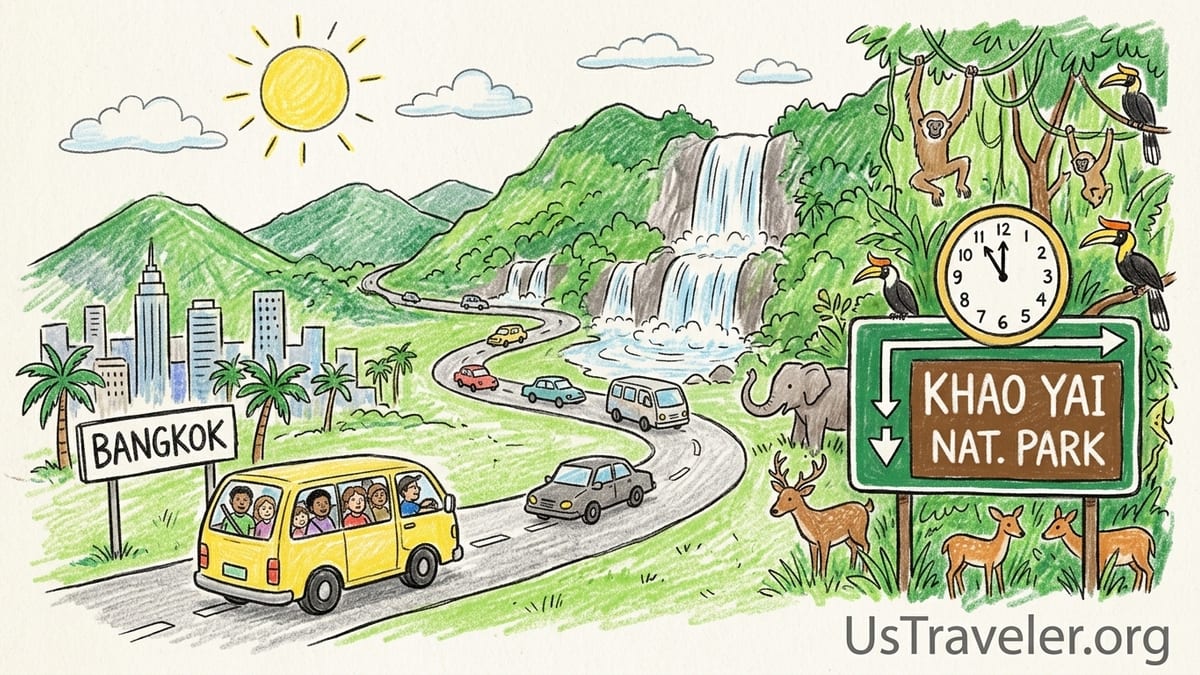
What a Bangkok to Khao Yai day trip really looks like (and why “11 hours” matters)
Most Bangkok departures are early, with hotel pickup in the city and a long drive northeast to Pak Chong and the park gates. On paper, an “11-hour” tour sounds generous. In reality, that number includes pickup rounds, highway time, gate formalities, and the return trip into Bangkok traffic. The practical result is that you usually get a focused highlight reel: one or two major stops inside the park, plus a short walk or guided nature segment.
That schedule is perfect for first-timers who want a taste of Khao Yai without changing hotels. It is less ideal for travelers who want long hikes, a relaxed waterfall swim-stop vibe, or serious wildlife watching. The park is large, and attractions like Haew Suwat and Haew Narok are not next-door neighbors. Choosing a day trip means accepting trade-offs: fewer stops, shorter walks, and a stronger emphasis on punctuality.
One under-discussed detail is park day-use timing. The park’s published opening hours are 06:00 to 18:00, which means day trippers are working within a firm daylight window. Even when tours advertise “full day,” you are still racing the clock to be out of the gates and back on the highway. If you want dusk wildlife, a night safari, or sunrise birdlife, you are already in overnight territory.
Small-group national-park day tours: the easiest booking, the tightest pacing
Small-group Khao Yai day trips from Bangkok are the simplest transactional option: you book once, get hotel pickup, and follow a fixed itinerary with a guide managing timing. In 2026, many of the most commonly booked products list an 11-hour duration and operate as join-in tours, which helps keep costs approachable compared with hiring a full private car for the day.
These tours typically focus on a few “high certainty” stops that fit the day-trip window, such as Haew Suwat Waterfall (the famous 25-meter curtain of water), a viewpoint or short trail near the park’s central zone, and a wildlife-oriented stop like Nong Phak Chi where guides look for signs of animals. What you gain is structure: the operator handles the park entry process and you do not have to navigate park roads or Thai signage.
What you give up is control. You move when the group moves, and the pace is often designed for broad appeal rather than hikers. If you want to spend extra time waiting quietly for wildlife, or you want to prioritize Haew Narok (which sits farther south and requires more time and stairs), a small-group Bangkok day trip may feel rushed. For many travelers, the best use of a small-group tour is as a “first day in Khao Yai” introduction, and then returning later for a slower overnight experience.
Hotel pickup is usually included within central Bangkok zones, but timing can be early and pickup can involve a short circuit of multiple hotels. If you are staying far outside the typical pickup areas, you may be asked to meet at a central point. When comparing products, look for clear wording on pickup locations and return timing because arriving back in Bangkok can vary dramatically with traffic.
Private drivers from Bangkok: best for families, photographers, and travelers who hate waiting
A private driver day trip is the “you set the tempo” option. You are paying for control: you can leave earlier, skip stops that do not interest you, and linger longer at the ones that do. This is especially valuable for families with kids who need flexible breaks, couples who want a quieter day, and photographers who prefer to chase light rather than follow a timetable.
Private drivers also make Khao Yai more comfortable if you are sensitive to heat and want to minimize walking between points. Haew Suwat is a great example: it is one of the least demanding major waterfalls to reach, with a short walk from the car park to the viewpoint and steps down toward the pool area. A driver can drop you close, wait, and move you on quickly, which is harder in a group format.
However, a private driver is not automatically a guide. Some drivers are highly experienced with Khao Yai routes, viewpoints, and wildlife hotspots; others are simply transport. If “wildlife interpretation” is the point of your trip, confirm whether you are hiring a driver only or a driver plus an English-speaking guide. For wildlife spotting, the difference matters: a trained guide knows what tracks, calls, and movement patterns to look for and can turn a quiet roadside stop into a real sighting.
For value comparison, private transport starts to make the most financial sense when costs are shared. A solo traveler may find join-in tours cheaper, while a group of three or four often finds a private car competitive once you account for comfort and flexibility. If you plan to add a night safari, overnight stays are typically easier with private transport because you are not forced to rush back to Bangkok before dark.
Park entry, QueQ e-tickets, and fees: what you will pay (and where surprises happen)
Khao Yai has a clear fee structure that can materially change your budget, especially for foreign visitors. The park collects entry fees for people and vehicles. As of the current published rates, foreign adults pay 400 THB and foreign children pay 200 THB at the main gates, while Thai pricing is significantly lower. Vehicle fees are additional, such as 30 THB for a four-wheel vehicle and 20 THB for a motorcycle. Entry tickets are valid for a single day only, meaning you cannot reuse the same ticket on a second day.
On top of the fee itself, the “how” has changed. Khao Yai uses the Department of National Parks e-ticket system through the QueQ app. In practical terms, many visitors now reserve and pay via QueQ and show a QR code at the gate for verification. Some tours and guides handle this for you, while independent travelers and private drivers may expect you to do it yourself. If you are booking a tour, confirm whether park entry is included or paid on the day. Do not assume.
There is also the on-the-ground reality: policies can be applied differently by entrance point and by the specific operational setup that day. If you are arriving with a tour operator, they often streamline the process. If you are self-driving, you may spend longer at the gate during peak periods. Either way, plan for some time overhead before you reach your first stop inside the park.
Finally, the park has restrictions that affect certain vehicles. For example, very large vehicles, including some tall double-decker buses, are not permitted to enter. Most travelers will never run into this, but it can matter if you are comparing different tour vehicle sizes or planning a custom group transport.
Waterfall priorities: Haew Suwat vs Haew Narok (and what the walks feel like)
If you are choosing a day trip based on “I want a waterfall,” decide which one. Haew Suwat is the most famous and commonly included on Bangkok day trips. It is a large waterfall around 25 meters high, reached with minimal walking compared with other park features. Many travelers recognize it from pop-culture references, but even without that, it is a crowd-pleasing stop because it delivers an immediate jungle payoff without a long trek.
Haew Narok is the opposite: bigger, wilder, and more physically demanding. It is the park’s tallest waterfall, a three-tier cascade with a total drop of over 150 meters. The viewpoint experience requires roughly a 1-kilometer walk from the car park, plus a steep staircase section descending about 50 vertical meters to the viewing deck area. Going down is easy; climbing back up in tropical humidity is what people remember.
For difficulty, think of Haew Suwat as an easy-to-moderate stop depending on whether you take the stairs and how long you linger. Haew Narok is moderate for most travelers, and can feel strenuous if you are out of shape, visiting in the hottest part of the day, or carrying camera gear. If your tour includes Haew Narok on a Bangkok day trip, expect a tighter schedule and less time elsewhere.
Season matters. Haew Narok is most dramatic in the rainy season when the flow is strong, while the dry season can make it less impressive. Haew Suwat tends to be more consistently photogenic across seasons, though conditions and safety rules can change. Pack shoes with grip for both: wet stone and muddy edges are where slips happen.
Wildlife spotting and ranger-led experiences: where the “real Khao Yai” starts
Khao Yai’s wildlife is the reason many travelers come: elephants, gibbons, deer, hornbills, and a long list of smaller mammals and birds. But wildlife is not a guaranteed show. Your chances improve with timing, silence, and knowledgeable eyes. This is where ranger-led experiences and professional guiding start to outperform a standard highlight-reel day trip.
The park offers an official night safari service that must be reserved at the Visitor Center before 18:00 on the day, with two evening slots: 19:00 to 20:00 and 20:00 to 21:00. The service charge is 600 THB per vehicle, with capacity capped (commonly listed as up to 8 people). The route is about 10 kilometers and lasts around one hour. Importantly, visitors are not allowed to take their own cars to look for animals at night; the park runs the activity with an official vehicle and a guide using a spotlight.
This has two big implications for trip planning. First, most Bangkok day trips cannot realistically fit the official night safari and still return to Bangkok the same night at a reasonable hour. Second, if you stay overnight near the park, the night safari becomes one of the best-value add-ons in Khao Yai because the cost is per vehicle, not per person. A couple pays the same 600 THB as a small group.
For daytime ranger-led hiking, rules vary by trail and season. Some areas can be visited independently, while others are commonly done with a guide for safety and wildlife awareness. If your priority is wildlife over waterfalls, consider a guided hike focused on habitats like grassland edges, salt licks, or quieter forest corridors rather than only the popular waterfall areas.
Day trip vs staying overnight: when Bangkok feels too rushed (and the smarter 2-day plan)
Whether a Bangkok day trip is “too rushed” depends on what you want Khao Yai to be. If your goal is to see a waterfall, breathe cooler forest air, and maybe catch a quick wildlife moment, an 11-hour day trip is a reasonable, time-efficient use of a Bangkok itinerary. It is especially attractive if you are only in Thailand for a few days and do not want to repack.
If your goal is wildlife, staying overnight is the clear upgrade. The park’s best wildlife windows are early morning and late afternoon into night. An overnight plan lets you do a slower day inside the park, return to your accommodation, then join the official night safari, and still wake up for a calm early visit the next day. It also reduces the stress of Bangkok traffic and the feeling of constantly watching the clock.
A practical two-day template that travelers actually enjoy is: Day 1 travel from Bangkok to Khao Yai, do a short waterfall stop like Haew Suwat or a viewpoint, check in near Pak Chong or the park’s access roads, then do the 19:00 or 20:00 official night safari. Day 2 start early for a guided wildlife-focused walk and finish with either another waterfall or a scenic viewpoint before heading back to Bangkok mid-afternoon. This itinerary spreads the effort across two days and makes the park feel like a destination rather than a detour.
Overnight options range from simple guesthouses around Pak Chong and Mu Si to higher-end resorts in the Khao Yai area. The key is location: staying closer to the park entrances reduces dead time in the car, and that extra hour can be the difference between a rushed stop and a satisfying one. If you are traveling on weekends or Thai holidays, book early because Khao Yai is a popular domestic getaway as well as an international day-trip target.
The Takeaway
Khao Yai from Bangkok is a logistics puzzle with a huge payoff if you match the tour style to your priorities. Small-group 11-hour day tours are the easiest one-click purchase and deliver the highlights efficiently. Private drivers win for flexibility and comfort, especially for families and travelers who dislike group pacing. Ranger-led and official park experiences, particularly the night safari, are where wildlife watching becomes more than luck. And if Haew Narok is on your wish list, or if wildlife is the main goal, an overnight stay turns a rushed checklist into a genuinely immersive national-park trip.
FAQ
Q1. Can you really visit Khao Yai National Park as a day trip from Bangkok?
Yes. Many bookable tours run about 11 hours with hotel pickup and cover one or two major park stops, typically including a waterfall and a short nature walk.
Q2. Is a Bangkok to Khao Yai day trip too rushed?
It can be if you want long hikes or serious wildlife watching. For waterfalls and a quick nature break, it is usually fine. For wildlife and slower pacing, staying overnight is better.
Q3. How much is the Khao Yai National Park entrance fee for foreigners?
The currently published gate rate is 400 THB per foreign adult and 200 THB per foreign child, plus a small vehicle fee (for example, 30 THB for a four-wheel vehicle).
Q4. Do I need the QueQ app to enter Khao Yai?
Khao Yai uses the Department of National Parks e-ticket system via the QueQ app. Some tours purchase and manage tickets for you, while independent travelers may need to reserve and pay in the app and show the QR code at the gate.
Q5. Which waterfall is easier: Haew Suwat or Haew Narok?
Haew Suwat is easier and more commonly included on day tours, with a short walk from the car park. Haew Narok is more demanding, with about a 1-kilometer walk plus a steep staircase section to the viewpoint.
Q6. How tall are Haew Suwat and Haew Narok waterfalls?
Haew Suwat is commonly listed at about 25 meters tall. Haew Narok is the park’s largest, dropping over 150 meters across three tiers.
Q7. Can you swim at Haew Suwat or Haew Narok?
Rules can change, but swimming is commonly listed as forbidden at both major waterfalls. Follow posted signs and ranger instructions on the day.
Q8. What is the official Khao Yai night safari, and how much does it cost?
The park runs an official night safari service booked at the Visitor Center before 18:00. It runs in two slots, 19:00 to 20:00 and 20:00 to 21:00, with a service charge of 600 THB per vehicle (capacity capped).
Q9. Can I drive my own car in the park at night to look for animals?
No. The park forbids self-guided night wildlife drives. Night wildlife viewing is done using the official night safari service vehicle with a guide.
Q10. What is the best way to do Khao Yai if wildlife is my priority?
Stay overnight and combine a guided daytime walk with the official night safari. This gives you access to the best wildlife hours and reduces the time pressure of returning to Bangkok the same day.