


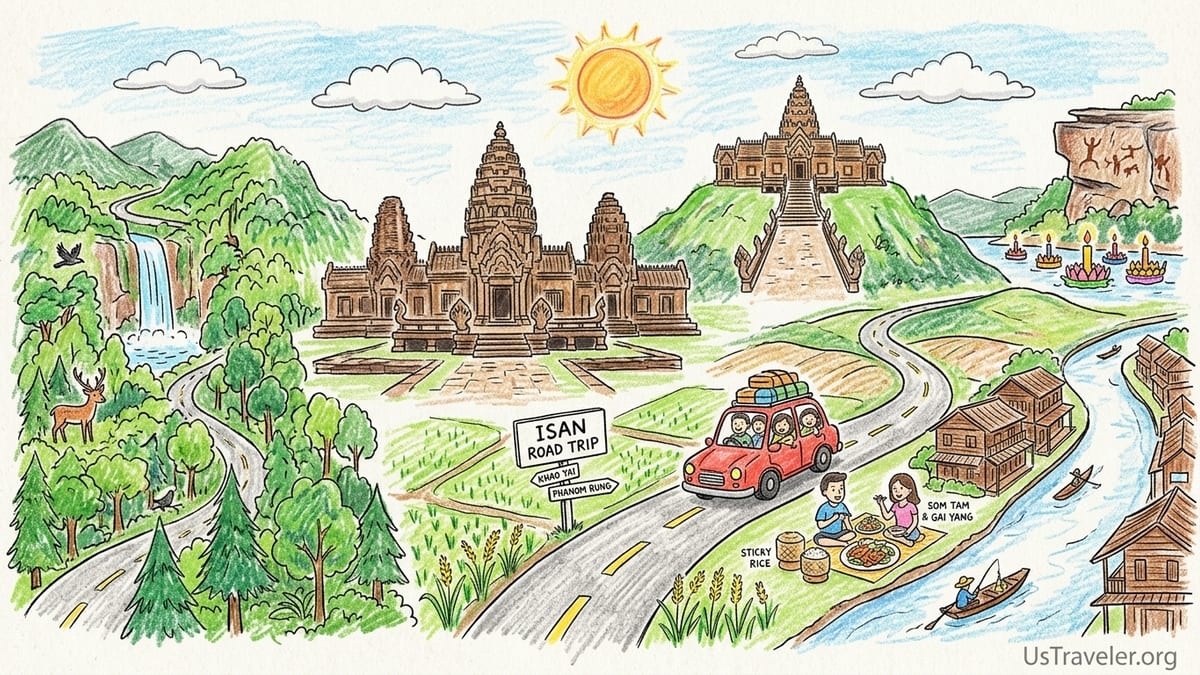
Isan, Thailand’s vast northeast, rewards travelers who like their highlights spread out, uncrowded, and rooted in everyday life. Think Khmer stone sanctuaries rising from farm country, museum towns built around prehistoric discoveries, and long riverfront promenades where the Mekong sets the pace. This selective guide focuses on a realistic north-to-south arc you can actually travel: Khao Yai and Korat (Nakhon Ratchasima), Phimai, Phanom Rung, Khon Kaen, Udon Thani and Ban Chiang, Nong Khai, Chiang Khan and Loei, Nakhon Phanom, Mukdahan, and Ubon Ratchathani with Pha Taem. Along the way, you’ll see which destinations are strongest for history, nature, archaeology, food, Mekong scenery, and slower cultural travel, with practical, current details to help you plan.
Khao Yai and Korat: Big-Nature Isan With An Easy Base
If you want classic Thailand nature without flying south, start at Khao Yai National Park, a lush, mountainous stretch of the Dong Phayayen Khao Yai Forest Complex. It’s one of the easiest “real” national parks to visit from Bangkok, and it works well as a two-night opener before you push deeper into Isan. The park’s headline is wildlife and scenery: forest trails, waterfalls, viewpoints, and the kind of roadside nature stops where a quick pull-off can become a half-hour of birdwatching.
Plan for a proper park fee rather than a token entry. The published foreigner entrance fee is 400 THB for adults and 200 THB for children, with separate vehicle charges depending on what you drive in. If you’re arriving in a rented sedan from Pak Chong, you’ll pay at the gate and then handle distances by car inside the park, since sights are spread out. If you’re the kind of traveler who likes to “just show up,” note that official communications around ticketing have emphasized app-based purchasing for foreigners in recent years, so it’s smart to check your entry method the night before and have mobile data ready.
Korat (Nakhon Ratchasima) is the practical base, not because it’s a tiny heritage town, but because it’s a transportation hub with plenty of places to sleep and eat before you branch out to Phimai or continue toward Buriram. Use it like a staging area: arrive, stock up at a convenience store for the road, and treat Khao Yai as your active, outdoors-first start before you pivot into temples and museums.
Phimai: Isan’s Most Satisfying Khmer Ruins For First-Timers
For history that feels immediate, Phimai Historical Park is one of Isan’s most rewarding stops. It’s an ancient Khmer temple complex set within a walled town plan, and it’s easy to appreciate even if you’re not a specialist. The best moment comes early: walking toward the sanctuary across the naga bridge, when the carved stonework and long causeway create that slow, cinematic reveal you usually associate with bigger-name sites.
Phimai is also one of the simplest “high impact, low stress” day trips in Isan. The park is typically open daily in the daytime (commonly listed around 7:30 AM to late afternoon), and foreigner admission is widely published at 200 THB, with a much lower Thai ticket. You can comfortably see the temple complex in a couple of hours, then add the nearby museum if you want context for lintels, sculptures, and the region’s broader archaeology rather than just taking photos and moving on.
Phimai is best for travelers who want a big heritage payoff without crowds and without needing a guide to understand what’s in front of them. It’s also great for “slower cultural travel” because you can pair the ruins with a simple town routine: a daytime temple visit, a late-afternoon coffee, then a casual evening meal without feeling like you’re racing between far-flung sights.
Phanom Rung (Buriram): Volcano-Top Drama And Khmer Geometry
If Phimai is your approachable introduction, Phanom Rung Historical Park is the “wow” temple for pure setting. The sanctuary sits on an extinct volcano, and the approach feels ceremonial: long stone walkways, processional alignment, and a summit atmosphere that changes with light and weather. It’s a destination where you’ll want to arrive early or late not only for photos, but to experience how quiet it can feel once day-trippers clear.
Phanom Rung is best for architecture lovers, photographers, and travelers building an Isan route around Khmer sites. While exact daily hours can vary by season and management, the park publishes an entrance fee schedule and typically operates as a daytime historical park, so you should plan to arrive with enough time to explore the upper sanctuary, viewpoints, and the route back down without rushing.
In practical terms, Phanom Rung often pairs well with other Buriram-area Khmer ruins in a single day if you have your own vehicle or driver, because the experience is about the broader landscape as much as the main sanctuary. This is also where Isan’s “distance reality” becomes obvious: the most memorable days are the ones where you accept a slower pace, stop for roadside grilled chicken or fruit, and treat the drive as part of the trip rather than dead time.
Khon Kaen: Food, Night Energy, And A Smart Transit Break
Khon Kaen is the Isan city that helps many itineraries breathe. It’s modern, university-influenced, and useful as a one- or two-night reset between the heritage corridor and the Mekong corridor. You come here less for a single monument and more for the overall travel quality of life: easier transport connections, a broad hotel range, and plenty of dinner options that make Isan’s flavors feel accessible even if you don’t speak Thai.
This is one of the best places in the region to lean into Isan food in a low-pressure way. If you’ve been cautious with som tam (papaya salad), this is a good city to try it properly: order it with grilled chicken and sticky rice, and ask for your preferred spice level. In real travel terms, Khon Kaen is where many visitors discover that “Isan food” isn’t one dish but a whole rhythm of char-grilled meats, fermented flavors, bright herbs, and sticky rice that functions like the region’s everyday staple.
Khon Kaen is best for food-focused travel, a little nightlife, and as a transit-friendly pause that prevents your itinerary from turning into an exhausting series of long drives. Treat it like a buffer: arrive, do laundry, eat well, and continue north toward Udon Thani when you’re ready.
Udon Thani and Ban Chiang: Archaeology You Can Actually Understand
Udon Thani is the most practical base for archaeology in this part of Isan because it connects easily to nearby attractions and makes Ban Chiang doable as a focused half-day or full-day outing. The city itself is comfortable for travelers who want convenience without the intensity of Bangkok: big malls, straightforward hotel choices, and lots of casual restaurants.
Ban Chiang is the essential stop here, and not as a “nice-to-have.” UNESCO describes Ban Chiang as the most important prehistoric settlement so far discovered in Southeast Asia, associated with early evidence and development of wet-rice culture in the region and widely regarded as foundational for understanding Southeast Asian prehistory. This is the kind of destination that changes how you see Thailand: suddenly the timeline stretches back far beyond the kingdoms most travelers learn first, and everyday village landscapes feel layered with deep history.
For a grounded visit, go to the Ban Chiang National Museum and combine it with a site-focused walk where you can see how the heritage is embedded in a living community rather than fenced off like a standalone monument. Museum hours and admission policies can change, and some national museums observe a lunch closure, so it’s worth planning around midday downtime. Ban Chiang is best for archaeology lovers, families traveling with curious teens, and anyone who wants a break from temple-hopping while still doing something genuinely significant.
Nong Khai, Chiang Khan, Nakhon Phanom, and Mukdahan: The Mekong Slow Lane
The Mekong corridor is where Isan turns scenic and unhurried. Nong Khai is the classic entry point: a riverfront town with an easy evening stroll culture and day trips that lean into views and temples. If you’re chasing a specific “Mekong panorama” shot, Wat Pha Tak Suea’s skywalk viewpoint is one of the more recognizable modern viewpoints in the area, combining cliff-edge elevation with river scenery. It’s the kind of place where you’ll see Thai families taking weekend photos while monks and local visitors move through at their own pace.
Chiang Khan in Loei province is the Mekong town for slower cultural travel. Its walking street scene is more about atmosphere than spectacle: old wooden shophouses, riverside cafes, and a nightly market rhythm that typically starts in the late afternoon and runs into the evening. A real-world way to enjoy it is simple: check into a guesthouse near Chai Khong Road, nap through the heat, then walk the riverfront at sunset and eat as you go rather than hunting for a single “best” restaurant.
Nakhon Phanom is one of the strongest Mekong stops for scenery plus local life. Its riverside promenade is a genuine public space, and its walking street is commonly scheduled on Friday, Saturday, and Sunday evenings, which makes it easy to time if you’re stitching multiple Mekong towns together. Mukdahan then adds a more “border commerce” flavor, with the Indochina Market along the riverfront known for goods and textiles that reflect cross-border trade with Laos and beyond. Together, these four destinations are best for Mekong scenery, slow evenings, and the kind of travel where you measure your day by sunset light and dinner rather than a checklist.
Ubon Ratchathani and Pha Taem: Rock Art, Clifftop Sunrise, And Festival Culture
Ubon Ratchathani is the southern anchor of this Isan route, and it offers one of the region’s best combinations: strong local identity, worthwhile day trips, and at least one signature event that can shape an entire itinerary. If you’re traveling for culture, the Ubon Ratchathani Candle Festival is the marquee. Official tourism communications have promoted the 125th-anniversary edition as a major Signature Thailand Event, with 2026 dates publicly promoted as 28 to 30 July 2026. If you visit at that time, expect crowds, road closures near key viewing areas, and hotels filling earlier than usual.
For nature and archaeology combined, Pha Taem National Park is the essential day trip. It’s known for Mekong-facing cliffs, sunrise viewpoints, and ancient rock art sites that make the landscape feel like an outdoor museum. Because it’s a national park, you should expect a formal entrance fee and a checkpoint system. If sunrise is your goal, confirm the checkpoint opening time with the park office before you commit, because arriving too early without access can turn a magical plan into a frustrating wait.
Ubon plus Pha Taem is best for travelers who want “nature with meaning” rather than nature alone: cliff scenery tied to ancient art, a river boundary that defines the horizon, and a city whose festival culture can be experienced as lived tradition rather than a staged show. It’s also a strong ending point for the route because it feels distinct from the Korat and Mekong sections, giving your Isan trip a clear final chapter.
The Takeaway
If you’re choosing where to spend limited time, Khao Yai is the best opener for nature; Phimai and Phanom Rung are the strongest history pairing for Khmer-era architecture; Ban Chiang is the must for archaeology, backed by UNESCO’s assessment of its regional importance; the Mekong towns from Nong Khai down to Mukdahan are best for scenery and slow cultural travel; and Ubon with Pha Taem is the best finale for cliff landscapes, rock art, and festival-scale tradition. Isan’s magic isn’t that everything is close. It’s that the distances force you to travel more deliberately, and that deliberate pace is exactly what makes the region feel so real.
FAQ
Q1. Which Isan destination is best for first-time visitors who want “a bit of everything”?
Start with Korat as a base, do Khao Yai for nature, then add Phimai for an easy, high-impact heritage day trip.
Q2. What’s the most impressive Khmer temple site in this itinerary?
Phanom Rung stands out for setting and drama, with the sanctuary perched on an extinct volcano and a long, ceremonial approach.
Q3. Is Phimai worth it if I’ve already been to Angkor Wat?
Yes, because it’s calmer, simpler to explore in a half-day, and still delivers striking Khmer stonework and town-wall context.
Q4. Which places are best specifically for Mekong River scenery?
Nong Khai, Chiang Khan, Nakhon Phanom, and Mukdahan are the most river-focused stops, with promenades and sunset-oriented routines.
Q5. Where should archaeology lovers go in Isan?
Ban Chiang is the priority: UNESCO considers it the most important prehistoric settlement so far discovered in Southeast Asia.
Q6. What’s the best Isan stop for slower, cultural travel without heavy sightseeing?
Chiang Khan is ideal for slow travel, with a nightly walking street vibe, riverside cafes, and a town scale that rewards wandering.
Q7. Do I need a car for this Isan itinerary?
A car helps most for Khao Yai, Phanom Rung, and Pha Taem. Cities like Khon Kaen, Udon Thani, and Nong Khai are manageable with local transport.
Q8. What are the current entrance fees travelers should budget for major stops?
Khao Yai’s published foreigner entrance fee is 400 THB for adults, and Phimai Historical Park is widely listed at 200 THB for foreigners, with separate pricing for Thai nationals.
Q9. When is the Ubon Ratchathani Candle Festival in 2026?
Official tourism communications have promoted the 2026 festival dates as 28 to 30 July 2026, and it’s wise to book accommodation early around that period.
Q10. If I only have one week, which stops should I prioritize?
Prioritize Khao Yai, Phimai, Udon Thani with Ban Chiang, one Mekong town (Nong Khai or Chiang Khan), and finish with Ubon and Pha Taem if time allows.