


Isan, Thailand’s broad northeast, rewards travelers who plan by experiences rather than by province lines. One day you can follow an ancient Khmer processional route into a sandstone sanctuary, the next you can listen for gibbons in Khao Yai, and by evening you might be eating grilled chicken with sticky rice on a Mekong promenade as the sun drops behind Laos. This guide organizes Isan’s essential sights around heritage, nature, food, and the Mekong, with practical details you can actually use, including real entry fees where they can be verified and seasonal timing for standout places like Udon Thani’s Red Lotus Sea, which is best roughly December through February.
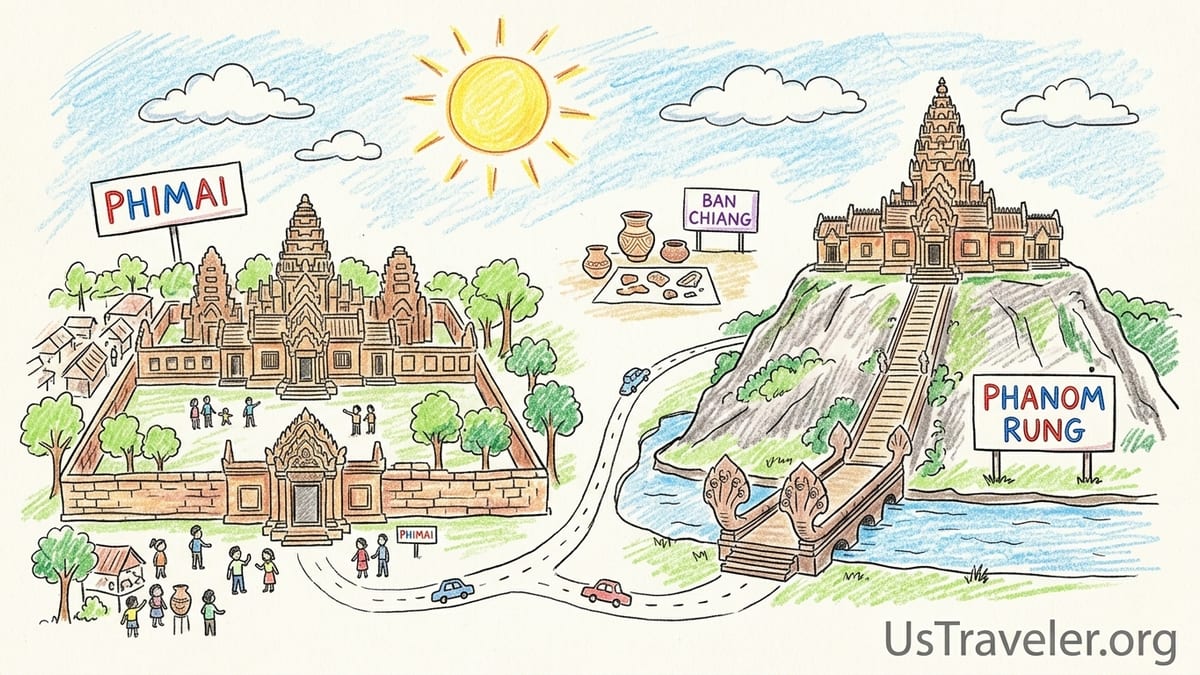
Heritage Highlights: Khmer Temples, Living History, And A UNESCO Archaeology Stop
If you only make time for two Khmer-era temple complexes in Isan, build the trip around Phimai and Phanom Rung and treat them as different moods of the same story. Phimai Historical Park feels like an entire sacred city set inside modern Phimai, with long galleries, carved lintels, and the sense that daily life never stopped around it. Phanom Rung, by contrast, is all about ascent and ceremony, a temple mountain on the rim of an extinct volcano where the approach itself is part of the experience.
At Phimai Historical Park, the Fine Arts Department lists daily hours of 07:00 to 18:00. The verified entry fee is 20 baht for Thai nationals and 100 baht for foreign visitors. If you arrive early, you’ll often have the sandstone corridors and gateways nearly to yourself, and the softer morning light makes the relief carvings easier to read even without a guide. Weekends can bring student groups and local families, so weekday mornings are best if you want quiet time to take photos and linger.
Phanom Rung Historical Park is the other must-see Khmer site, prized for its dramatic processional route, naga bridges, and the central sanctuary complex at the summit. A commonly published Fine Arts Department schedule has the park open daily from 07:00 to 18:00, and visitor guides consistently report the same headline entrance fee scale as other major Fine Arts Department historical parks: 20 baht for Thai visitors and 100 baht for foreigners. Try to arrive with enough time to walk the full approach slowly, because the best parts aren’t only at the top: the stairways, the bridges, and the framing of doorways along the axis are part of what makes the site memorable.
For a deep-time counterpoint to Khmer grandeur, add Ban Chiang, the UNESCO World Heritage archaeology site famous for its prehistoric burials and distinctive ceramics. The Ban Chiang National Museum is a practical, grounded stop that helps you understand why this area matters beyond temples and scenery. Official Fine Arts Department service information has historically listed the museum’s service hours as weekdays 08:30 to 16:30 with lunch break notes, and other current visitor resources commonly describe it as open midweek through Sunday during daytime hours and closed on some public holidays. Because museum schedules can shift, especially around Thai holidays, confirm the opening day locally before you commit to a long drive.