


Isan rewards travelers who plan like locals: early mornings, long distances, and a clear idea of what you can do independently versus what becomes dramatically easier with a driver. This guide compares the region’s most bookable day trips and short tours, from Khao Yai’s wildlife roads and night safaris to Phanom Rung’s Khmer-era stonework on a volcano, Udon Thani’s heritage stops and the seasonal Red Lotus Sea, Mekong experiences around Nong Khai, and the cliff-and-rock-art landscapes around Ubon Ratchathani and Pha Taem. Along the way, you’ll find concrete, on-the-ground examples of fees, travel times, and the small logistical details that can make a day feel either effortless or exhausting.
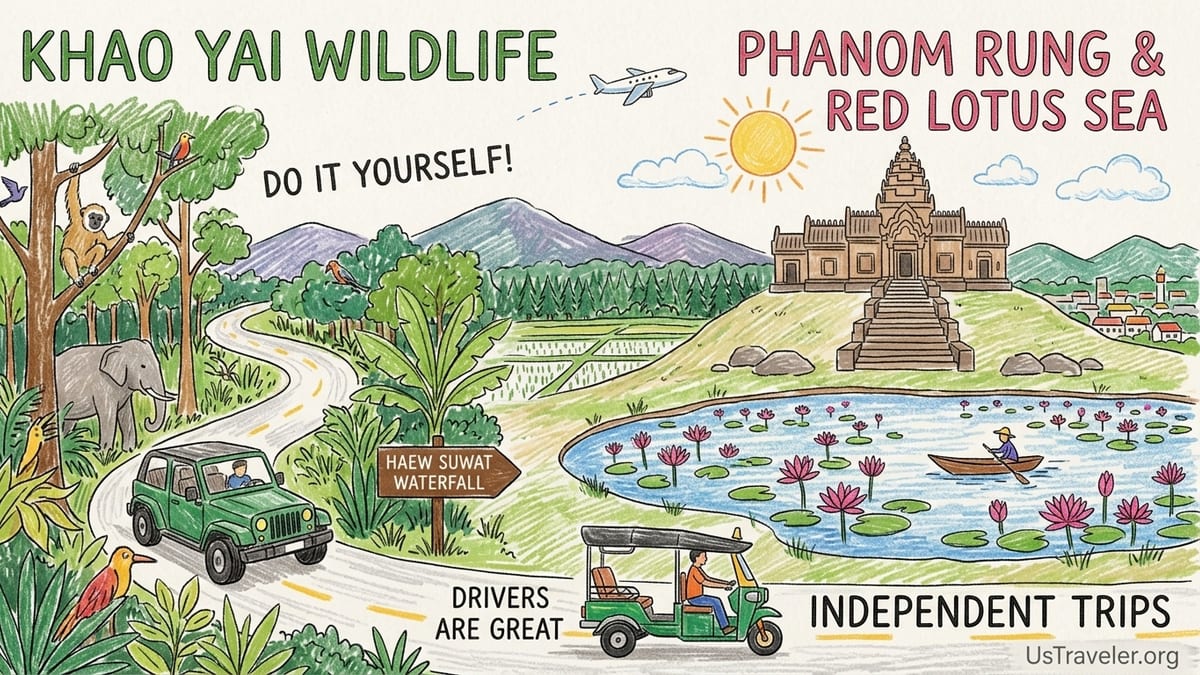
Khao Yai Wildlife Day Trips: What You Can Do Without a Tour
Khao Yai is often marketed as an “easy nature escape” from Bangkok, but it only feels easy if you understand one core truth: the park is huge, and the best wildlife viewing is car-based. Unlike many destinations where you can simply arrive and walk around, Khao Yai’s waterfalls, viewpoints, and trailheads are spread along long park roads with limited internal transport. If you do not have your own car or hired vehicle, you can still visit, but your day will likely narrow to a couple of accessible highlights rather than a full wildlife circuit.
Start with the costs you can verify before you go. Khao Yai’s foreigner entrance fee is currently listed at 400 baht for adults and 200 baht for children, and the park notes entry can be paid at the main gates or via the Department of National Parks e-ticket system on the QueQ app. If you are arriving on a tight timeline, that e-ticket option is a practical way to reduce uncertainty at the gate. This matters on weekends when queues can build, and it also matters for travelers trying to catch a morning wildlife window rather than spending that hour in a line.
Independently, the most realistic day plan is to base yourself in Pak Chong or the Khao Yai area the night before, then enter early with a hired driver for a fixed block of time. In real-world terms, that looks like agreeing on a morning pickup from your hotel, a circuit to a flagship waterfall such as Haew Suwat, a viewpoint stop, and one short trail if conditions allow. The key advantage is not luxury, it is compression: with a driver you are stacking far-apart stops into one day. Without one, you often end up paying for multiple separate songthaew or taxi legs, losing time and bargaining energy at each step.
One more practical note: Khao Yai has introduced entry rules and systems that can surprise first-timers, such as vehicle restrictions and digital ticketing. If you are traveling with a large van or a group, confirm your vehicle’s suitability and entry process before the day begins. A good wildlife-focused operator will also time your day around animal activity, for example concentrating on forest-edge roads and open grass areas near dusk, when chances for deer, gibbons, and other wildlife sightings tend to be better than at midday.
Phanom Rung and the Khmer Temple Circuit: Why a Driver Matters
Phanom Rung Historical Park is one of the strongest day trips in Isan for travelers who want a single, unforgettable cultural site. The challenge is not the temple itself, it is the rural geography. Phanom Rung sits well outside Buriram town, and public transport is limited and not designed for quick, sightseeing-style hop-ons. If you attempt this trip independently without your own vehicle, the day can turn into a chain of waiting, backtracking, and negotiating rides rather than a calm, story-rich visit.
On paper, it is straightforward: the Fine Arts Department’s official virtual park information lists Phanom Rung as open daily from 6:00 a.m. to 6:00 p.m., with admission fees shown at 20 baht for Thai nationals and 200 baht for other nationalities. There are also vehicle fees if you enter via the rear gate, with examples like 50 baht for a car. Those details are worth knowing because they shape how you plan: arriving early can beat heat and crowds, and knowing the fee structure helps you avoid confusion at the ticket point.
What a driver buys you here is not only transport, but a feasible circuit. A practical example is pairing Phanom Rung with Prasat Muang Tam on the same day, which many visitors want because it deepens the Khmer-era context. Doing both on a single loop is easy in a car, but difficult if you are relying on sparse rural connections. A driver also enables “timed” experiences that depend on weather and light, such as arriving when the site feels quiet and photographic, rather than landing at the hottest hour because that was the only workable bus or shared ride option.
If you are choosing between “hire a driver” and “hire a guide,” consider your priorities. A driver saves time and keeps the day smooth. A guide, if knowledgeable, adds interpretive value by connecting architectural elements, iconography, and the story of the site’s Khmer influence. For many travelers, the best compromise is a private driver for the day plus a short on-site guiding service, if available, or a self-guided visit with pre-downloaded context to avoid patchy rural data coverage.
Udon Thani Heritage: Easy Independently, With One Big Add-On
Udon Thani is one of Isan’s easiest bases for independent travelers because the city itself is legible: parks, temples, museums, and food areas are reachable with short rides. If you are the kind of traveler who likes walking a neighborhood, stopping for coffee, and building a day organically, Udon supports that style better than many provincial hubs. You can structure a satisfying day without pre-booking a tour, especially if you stay near the center.
A concrete example is the Udon Thani City Museum, which has become a popular anchor stop because it is centrally located and housed in the city’s historic old building. Recent visitor-facing information emphasizes that entry is free, with a donation box for those who want to contribute. For travelers, that “free museum” detail is not trivia: it means you can confidently include it in your plan even if the weather turns, and you are not risking a wasted ticket if you only have 45 minutes to spare between other stops.
The main “add-on” that changes the transport equation is Ban Chiang and the archaeology circuit outside the city. Once you leave the center, you are back in Isan’s rural spacing where a driver becomes more efficient than trying to stitch together local transport. Even when a site is famous, local buses do not necessarily align with tourist time windows. If you want a half-day that includes Ban Chiang plus a second rural stop, you will almost always spend less time waiting and negotiating if you hire a car for a fixed block.
Udon is also a strong base because it links naturally to two of this guide’s other headline experiences: the Red Lotus Sea and Nong Khai on the Mekong. That is why many travelers build a three-night plan here: one day for the city, one early morning for the lotus lake, and one day for the riverfront and cross-border atmosphere near Nong Khai. You can do this without tours, but strategically using a driver on the rural days can make the itinerary feel like a vacation rather than an endurance test.
Red Lotus Sea (Talay Bua Daeng): The Early-Morning Tour That Actually Makes Sense
The Red Lotus Sea, officially associated with Nong Han in Kumphawapi District, is a classic example of an attraction that is simple in concept and tricky in execution. You are going to a lake to see seasonal blooms, taking a small boat, and returning. But the success of the day depends heavily on timing, and timing is exactly what becomes fragile when you rely on public transport. If you want the experience that photos promise, hiring a driver or joining a small tour is often the difference between arriving at the right hour and arriving after the light and blooms have flattened.
In practical terms, the lake is around 45 kilometers from Udon Thani city, and the trip is typically close to an hour by road depending on where you start. Most boat trips begin very early because the best viewing is in the cool morning, when the water is calm and the light is soft. This is why so many itineraries involve leaving Udon before sunrise, something that is difficult to coordinate with standard bus schedules.
For budgeting, travelers often want a real number rather than vague “prices vary” language. What you can usually confirm on the ground is the boat fee at the pier, which is typically structured as a private boat by the hour rather than a per-person ferry. That means a couple can pay more per person than a group of six splitting the same boat. If you are traveling solo or as a pair, it can be smart to ask at your hotel the day before whether they can connect you with another small party heading out at the same time, so you share the boat cost without losing the early-morning schedule.
One more detail matters for accuracy: Thailand has multiple lakes marketed online as “Red Lotus Sea,” and travelers do sometimes get confused between the Udon Thani area lake and other provinces with similar seasonal blooms. This is where a reputable driver or tour operator adds practical protection. They will take you to the correct piers for Kumphawapi District, rather than a similarly named location that looks plausible on a map but leads to a completely different lake.
Nong Khai and the Mekong: Independent Riverfront Days, Guided Add-Ons
Nong Khai is a city where independent travel works well because the core appeal is right there on the riverfront: walking paths, evening food, and the Mekong atmosphere. If you are staying overnight, you can build a satisfying day without a guide by simply moving between the promenade, cafés, temples, and a couple of iconic stops. The city is also a natural “breather” after long road days elsewhere in Isan.
A standout independent attraction is Sala Kaeo Ku, the sculpture park on the outskirts of Nong Khai. Official tourism listings place it in Hat Kham Subdistrict, and practical visitor information commonly lists it as open roughly from 6:00 a.m. to 6:00 p.m., with some areas operating on slightly shorter hours. It is close enough to reach by local transport or a quick hired ride, and because it is a single-site visit, you are not trying to chain multiple rural points together. That is the sweet spot for DIY day planning.
Where guided experiences start to add value is on the Mekong itself. If you want a simple riverfront sunset, you can often arrange a basic boat outing locally. But if you are after a more curated experience, such as timing the cruise with a specific viewpoint or combining it with less-central riverside stops, a local operator can reduce friction. It is the same Isan principle: the farther your plan pushes into “spread-out” territory, the more a driver and a handler helps the day flow.
Another reason travelers hire help around Nong Khai is border-adjacent complexity. Even travelers who are not crossing into Laos can find the area’s transport patterns oriented around local routines rather than tourist circuits. A driver for half a day can be a very pragmatic purchase when your goal is not just to see one site, but to experience the river region across multiple small stops without spending the day negotiating rides.
Ubon Ratchathani and Pha Taem: The Case Study in Why Tours Exist
Ubon Ratchathani is a rewarding destination for travelers who want nature, rock art, and dramatic Mekong-edge scenery, but it is also one of the clearest examples in this guide of why day tours exist. Pha Taem National Park and its associated viewpoints are not “around the corner.” They are out in the far east of Thailand, where road travel is the norm and public transport is not designed for tourists hopping between cliffs, art panels, and sunrise viewpoints. If you are short on time, a driver is not optional, it is the itinerary.
Start with the on-the-ground costs you can plan around. Tourism listings for Pha Taem commonly show an entrance fee of 200 baht for adults and 100 baht for children for foreign visitors, consistent with the national-park style fee structure in Thailand. Once inside, the experience is about moving between multiple points rather than staying in one place: cliff viewpoints over the Mekong, rock-art areas, and specific named lookout points that are far apart by foot.
Pha Chana Dai, often described as the “first light” viewpoint, illustrates the timing issue. Thai news coverage of New Year’s events has described visitors gathering at the viewpoint to see the earliest sunrise in Thailand, with large crowds appearing around the turn of the year. That tells you two things that matter practically: it is a real, time-specific phenomenon people travel for, and it can be logistically busy during that period. If you want to see sunrise here at a quieter time, a local driver who knows the route and the practical access points can make an early start feel safe and straightforward rather than stressful.
For many travelers, the best real-world approach is to treat Ubon as a base and book one dedicated “Pha Taem day” with a driver, then keep your other day or two for Ubon city temples, food, and a slower pace. That split is usually more enjoyable than trying to self-drive an ambitious cliff circuit while also doing a full city day, especially if you are unfamiliar with rural Thai roads at night or pre-dawn when many sunrise tours begin.
The Takeaway
Isan is not hard, but it is spread out, and that changes what “independent travel” means in practice. Udon Thani and Nong Khai are the easiest places in this guide to do on your own because their best experiences cluster around the city center and riverfront. Khao Yai can be done independently only if you bring or hire wheels; without them, you will see a fraction of what makes the park special. Phanom Rung is absolutely doable as a day trip, but the rural spacing makes a driver the single biggest upgrade you can buy. The Red Lotus Sea is timing-dependent, so a prearranged early ride is often the difference between a highlight and a disappointment. And around Ubon and Pha Taem, tours are not a tourist trap, they are the most efficient way to reach multiple far-flung viewpoints and rock-art areas in one day.
If you want one simple rule: do the cities independently, hire help for the rural circuits. That approach keeps costs rational while protecting your limited vacation hours. It also matches how locals travel in these provinces: when the sights sit far apart and public transport is thin, a hired car for a half day is not indulgence, it is logistics.
FAQ
Q1. Is Khao Yai doable as a day trip without joining a tour?
Yes, but only if you have your own car or hire a driver, because waterfalls, viewpoints, and wildlife roads are spread far apart inside the park.
Q2. What is the current Khao Yai National Park entrance fee for foreign visitors?
Recent official visitor information lists 400 baht for adults and 200 baht for children, and entry can also be handled through the QueQ e-ticket system.
Q3. Do I need a guide at Phanom Rung, or just transport?
Transport is the priority because the site is rural. A guide is optional but valuable if you want deeper context on Khmer architecture and symbolism.
Q4. What are Phanom Rung’s official opening hours and foreigner ticket price?
The Fine Arts Department’s virtual park information lists it as open daily 6:00 a.m. to 6:00 p.m., with admission shown at 200 baht for other nationalities.
Q5. Can I see the Red Lotus Sea from Udon Thani using public transport?
It is possible in theory, but difficult in practice for the best viewing time. Most travelers hire a driver for the early morning to avoid missing peak light and blooms.
Q6. How far is the Red Lotus Sea from Udon Thani city?
It is commonly described as roughly 45 kilometers away in Kumphawapi District, usually close to an hour by road depending on traffic and your starting point.
Q7. Is Nong Khai easy to explore independently?
Yes. The riverfront, central sights, and nearby attractions like Sala Kaeo Ku are straightforward with short local rides and do not require a formal tour.
Q8. What is the Pha Taem National Park entrance fee for foreign visitors?
Tourism listings commonly show 200 baht for adults and 100 baht for children for foreign visitors, consistent with many Thai national park fee structures.
Q9. What is special about Pha Chana Dai near Pha Taem?
It is widely promoted as a “first light” viewpoint, and Thai New Year coverage has documented large crowds gathering there to watch the earliest sunrise in Thailand.
Q10. If I can hire a driver for only one Isan day trip, which destination benefits most?
Pha Taem and the Ubon Mekong-edge circuit usually benefit most because the attractions are far apart and public transport is limited, making a driver the key to seeing multiple sites in one day.