


Isan is big enough that “one base” rarely works. The smartest way to plan a Northeast Thailand trip is to choose 2 to 4 hubs that match how you want to move: flying between major cities, riding the Northeast rail line, or renting a car to reach national parks, Khmer ruins, and smaller Mekong towns. Below is a high-commercial-intent, real-world guide to where to stay across Khao Yai and seven key Isan bases, with a focus on transport connections, hotel supply, rental-car usefulness, and what you can realistically day-trip without turning your vacation into a daily long-haul drive.
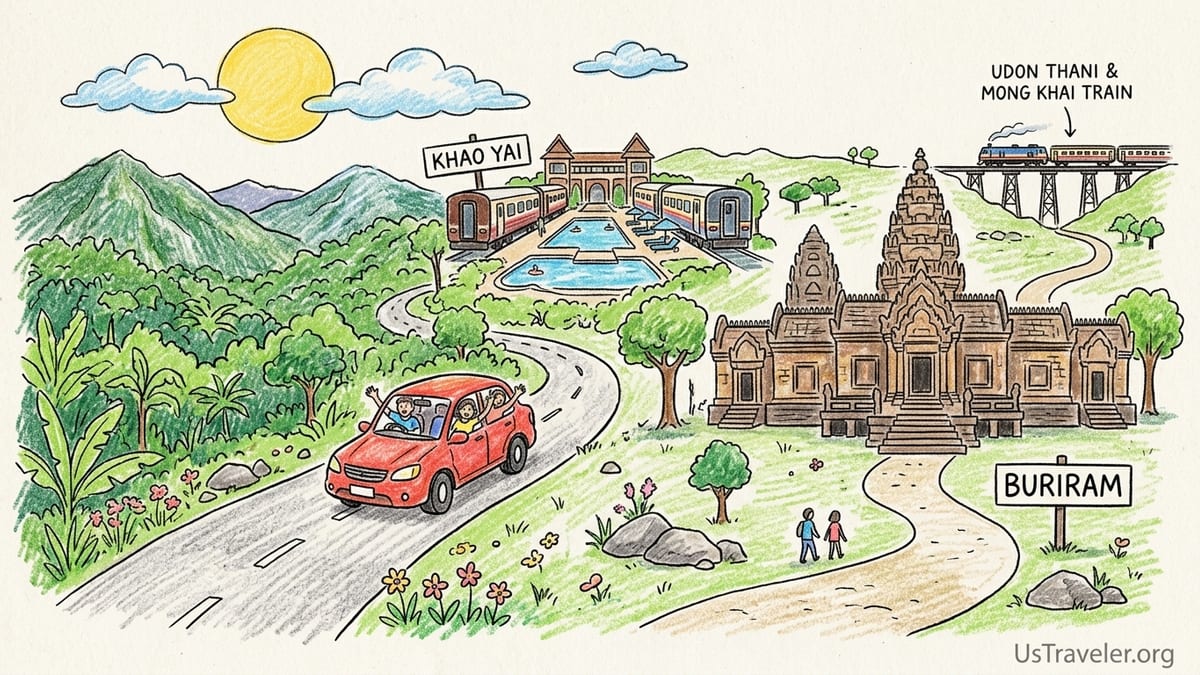
How To Choose Your Isan Base (And When A Car Actually Matters)
Think of Isan as three layers. First are the flight-connected city hubs (Nakhon Ratchasima area via road and rail, Khon Kaen, Udon Thani, Ubon Ratchathani, and Buriram) where you can land, check in, and have lots of dining and hotel options. Second are the purpose-built leisure zones (Khao Yai and Pak Chong) where the lodging supply is resort-heavy, the scenery is the point, and a car is close to essential. Third are the riverside border towns (Nong Khai and Chiang Khan) where the attraction is the Mekong itself and the pace is slower.
A rental car is most useful in Khao Yai and for Khmer-ruins itineraries in Buriram province, because the best sights are spread out and public transport is not designed for point-to-point touring. By contrast, in city bases like Khon Kaen, Udon Thani, and Ubon Ratchathani, you can often do a lot with ride-hailing, hotel transfers, and the occasional day tour, then rent a car only for one or two big exploration days.
For travelers who like trains, the Northeast rail corridor remains a practical spine for moving between central Thailand and key Isan cities. Bangkok’s Krung Thep Aphiwat terminal has multiple daily services to Nakhon Ratchasima listed on current route timetables, including a morning Special Express option highlighted by independent timetable compilers as a convenient daytime ride. Farther north, Udon Thani and Nong Khai are close enough that the train can be under an hour on the schedule, making a “stay in Udon, visit Nong Khai” approach realistic for many itineraries.
Khao Yai And Pak Chong: National Park Access And Resort Stays
Choose Khao Yai and Pak Chong if your priority is nature, wine-country style weekends, and resort downtime rather than dense city sightseeing. The hotel supply here is notably “experience-forward,” with properties built around landscapes, pools, and restaurants rather than walkable neighborhoods. Two recognizable examples that anchor the area’s upscale end are Mövenpick Resort Khao Yai (positioned as a resort base near the park) and InterContinental Khao Yai Resort, which has marketed itself around train-travel design themes and railcar-style accommodations.
Transport-wise, this is the base that most rewards driving. Many stays are scattered across Pak Chong countryside, and even if you arrive by train or bus to the Nakhon Ratchasima area, the last-mile to resorts plus day trips to viewpoints and trailheads can quickly become expensive and inconvenient by taxi. A rental car lets you do the classic Khao Yai rhythm: an early park entry, a midday café stop back in Pak Chong, and a sunset viewpoint or resort dinner without negotiating return rides.
What can you day-trip? The national park itself is the headline, but this base also works for a split itinerary where you do 2 to 3 nights for Khao Yai’s waterfalls, lookouts, and wildlife-oriented touring, then move onward toward lower Isan. Khao Yai is not a great base for long day-trips into deeper Isan cities; it is better as a nature-first stop either at the beginning (from Bangkok) or as a decompression finish.
Korat (Nakhon Ratchasima): The Practical Lower Isan Connector
Korat is the “logistics win” base for lower Isan. It is large enough to have a broad hotel market across budgets, but still close enough to Bangkok that it works even for travelers who want to keep flying to a minimum. Train travelers also like Korat because the Bangkok to Nakhon Ratchasima corridor has multiple daily services shown on public route timetable sites, which is useful if you want a daytime ride rather than a night train.
If you are arriving from Bangkok by road, buses are frequent and commonly priced in the low hundreds of baht on booking portals for the Bangkok to Nakhon Ratchasima route on typical travel dates. In practice, that makes Korat a strong choice for cost-conscious travelers who still want a “real city” base with malls, night markets, and plenty of accommodation choice.
Day-trip reality check: Korat is a good launchpad for the Phimai area, where the Khmer-era Phimai Historical Park is one of the region’s most recognizable ruins. However, whether that day trip feels easy depends on your transport. With a rental car, it is straightforward to leave after breakfast, spend a few hours at the ruins, and return for dinner. Without a car, you will be relying on intercity transport and local transfers, which can be done but is less frictionless than in places with a concentrated tour industry.
Buriram Or Nang Rong: Best Base For Khmer Ruins (And Fast Flights Back To Bangkok)
Buriram province is the most obvious choice if your trip revolves around Khmer ruins, because it clusters several major sites within manageable driving distances. The classic strategy is to stay in Buriram city for convenience, or base yourself closer to the temples in Nang Rong if you want shorter early-morning drives and a quieter small-town feel at night.
For transport connections, Buriram has a meaningful advantage for travelers who want to “pop in and out” by air. Current flight schedule aggregators show nonstop Buriram (BFV) to Bangkok (DMK) service operated by Thai AirAsia, with a typical pattern around 14 flights per week in September 2026. In real planning terms, that often translates into being able to fly down, do two temple days with a car, then fly back without needing to route through another city.
A rental car is highly recommended here. The temples are not “walk-out-of-your-hotel” attractions, and you will get more out of the region if you can combine multiple stops in one day. A realistic day might look like: early start to beat the heat at Phanom Rung, a second stop at Muang Tam, lunch in Nang Rong, then back to your hotel with time for an evening market or a stadium event if the calendar lines up. Without a car, you will likely need a private driver, which can be good value for groups but less flexible for solo travelers.
Khon Kaen: Central City Base With Easy Connections
Khon Kaen is the most convenient “central Isan” base when you want city comforts plus the option to branch north or south. It has a strong supply of business hotels and mid-range stays, reliable dining, and the kind of transport infrastructure that makes short stays easy to execute. Flight schedule data for Khon Kaen shows frequent nonstop connections to Bangkok, with around 41 flights per week listed on major schedule aggregators in September 2026, which matters if you want to build a fly-in, train-out, or vice versa itinerary.
Khon Kaen is also a sensible base if you plan to ride the Northeast rail line for part of your trip. The city sits on the corridor toward Udon Thani and Nong Khai, so you can choose whether to move north by train for a more scenic, lower-stress travel day or by road for door-to-door flexibility. If you do not want a car for your entire Isan trip, Khon Kaen is the kind of place where you can stay car-free and still accomplish a lot with short-distance rides.
Day-trip scope from Khon Kaen is best for regional excursions rather than far-flung border hops. You can do cultural museums, local food districts, and nearby countryside without committing to long highway days. If your must-sees include Ban Chiang, Nong Khai’s riverside, or Udon’s city scene, those are usually better served by moving your base north rather than day-tripping everything from Khon Kaen.
Udon Thani And Nong Khai: Upper Isan Hub Plus The Mekong Border
Udon Thani is the strongest “upper Isan” base for travelers who want maximum convenience and lots of hotel choice. It is flight-connected, it has major shopping and dining, and it positions you well for Ban Chiang, a headline day trip for history and archaeology-minded travelers. Flight schedule listings also reflect how busy this route is: one major schedule site lists roughly 58 flights per week between Bangkok (DMK) and Udon Thani (UTH) as of September 2026, which helps if you want to arrive on a late flight or leave early without reorganizing your whole day.
Nong Khai, meanwhile, is the stay for travelers who want to be on the Mekong itself. Sunset walks, riverside cafés, and a slower pace are the point. The good news is you do not have to choose one or the other if your timeline is tight. Rail timetable sites show Udon Thani to Nong Khai trains with early departures and sub-one-hour scheduled travel times, and travel-focused rail sites also describe the corridor as a quick hop. In practice, that means you can stay in Udon for the hotel selection and still spend an afternoon and evening in Nong Khai, or flip it and stay riverside while using Udon for airport access.
For the Laos border factor, Nong Khai is the classic gateway area, but many travelers underestimate the “last-mile” complexity. Even if you are near the bridge, border procedures and onward transfers can add time. If your primary goal is to sample the Mekong atmosphere rather than cross into Laos, Nong Khai is excellent. If you want to cross and continue onward quickly, staying closer to your preferred transport node (train station, bus terminal, or a hotel that can coordinate transfers) is often the difference between a smooth morning and a stressful one.
Chiang Khan (Loei): Smaller Riverside Stay For A Slower Mekong Mood
Chiang Khan is the outlier in this guide in the best way: it is not a transport hub, it is a mood. Travelers pick Chiang Khan for a smaller riverside stay with guesthouses and boutique lodging, morning markets, and an easygoing pace that feels different from the bigger Isan cities. It is the kind of place where you plan fewer “attractions” and more time for wandering and eating.
The trade-off is transport efficiency. Without a nearby major airport or high-frequency rail access, Chiang Khan works best when you are already in the region and can commit to a road transfer. Many travelers pair it with a bigger base such as Udon Thani or Khon Kaen, then do 2 nights in Chiang Khan as a reset. A rental car is useful for this pairing, because it turns Chiang Khan into a flexible countryside base rather than a place you are “stuck” waiting for rides.
What can you day-trip? Chiang Khan is best for short-radius explorations along the river and nearby viewpoints rather than a checklist of far-flung sites. If your trip goal is to cover many provinces quickly, you will likely find Chiang Khan too slow. If your goal is to balance temple days and city nights with one truly relaxed stop, it is a strong add-on.
Ubon Ratchathani: The Southeast Base For Temples, Nature, And Border Routes
Ubon Ratchathani is the natural base for the southeastern corner of Isan, especially if you want to explore beyond the “main line” cities. It is flight-connected to Bangkok and has the hotel supply you want for early starts and late returns. Flight schedule pages and flight-status trackers regularly list services on the Bangkok to Ubon corridor, reflecting that it remains one of the key air links for the region.
Ubon is also where a rental car becomes strategically valuable again. Many of the most rewarding stops in the province are not in a compact city center. With a car, you can build days around temple visits, river landscapes, and parks without being constrained by limited tour schedules. If you do not want to self-drive, this is one of the places where hiring a driver for a full day can be more practical than stacking multiple taxi rides into remote areas.
If your itinerary includes the Chong Mek border toward southern Laos, Ubon is the base that makes that possible without excessive backtracking. The key is to plan with realistic timings: border days are rarely “half-day” outings once you factor in transfers, queueing, and onward travel. Ubon gives you the infrastructure to make that day comfortable, with early breakfasts, luggage storage, and easy returns to a city hotel.
The Takeaway
If you want national parks and resorts, stay in Khao Yai or Pak Chong and rent a car. If you want an efficient lower Isan connector with easy Bangkok access, Korat is the practical pick. For Khmer ruins, Buriram or Nang Rong is the most targeted base and it is far easier with a car. For a central city hub with strong air links, Khon Kaen is the dependable middle. For upper Isan convenience and Ban Chiang, Udon Thani is the best all-round base, while Nong Khai is the better sleep if you want to wake up on the Mekong. Add Chiang Khan when you want a smaller riverside pause. Use Ubon Ratchathani to unlock the southeast, especially when parks and border routes are on your list.
The simplest winning itinerary for first-timers is to pick one “experience base” (Khao Yai or Chiang Khan) and one “logistics base” (Khon Kaen, Udon Thani, or Ubon) rather than trying to do every province as a day trip from a single hotel.
FAQ
Q1. Which Isan base is best if I do not want to rent a car?
Khon Kaen and Udon Thani are the easiest car-free bases thanks to frequent flights, city hotel supply, and simple point-to-point rides within town.
Q2. Should I stay in Udon Thani or Nong Khai for the Mekong?
Stay in Nong Khai if you want riverside sunsets outside your door. Stay in Udon Thani if you want more hotels, malls, and flight convenience, then day-trip or overnight in Nong Khai.
Q3. Is Khao Yai doable without a car?
It is possible but not ideal. Resorts and park entrances are spread out, so a rental car or pre-arranged driver usually makes the trip smoother and often cheaper than repeated taxis.
Q4. What is the best base for Khmer ruins like Phanom Rung?
Buriram province is the most targeted base. Buriram city is convenient, while Nang Rong can reduce driving time to the main temple areas.
Q5. Is Korat worth staying in, or should I go straight to other provinces?
Korat is worth it if you want a lower Isan city with strong Bangkok connections and a practical jumping-off point for nearby historical sites such as the Phimai area.
Q6. How many nights should I plan per base in Isan?
For a first trip, 2 to 3 nights per base is a realistic minimum. It gives you one full day for major sights and another for food, markets, or a second excursion without rushing.
Q7. Which base has the most frequent flights back to Bangkok?
Udon Thani is typically among the most flight-connected in upper Isan, with schedule listings showing very frequent weekly departures on the Bangkok route.
Q8. Can I day-trip from Udon Thani to Nong Khai by train?
Yes. Timetables commonly show short scheduled travel times under an hour, making an afternoon and evening in Nong Khai feasible without changing hotels.
Q9. Is Chiang Khan a good base for sightseeing across multiple provinces?
Not really. Chiang Khan is best as a small, slow riverside stay. Use it for relaxation and short local exploring rather than as a hub for long daily drives.
Q10. What base is best for the southeast and the Chong Mek border direction?
Ubon Ratchathani is the most practical base because it is a major city with airport access, hotel depth, and the best positioning for southeastern day trips and border-oriented travel.