


Isan is Thailand’s biggest, least-hurried region, and it rewards travelers who think in loops, not checklists. Instead of trying to tick off all 20 northeastern provinces in one epic haul, this guide focuses on three realistic, commercially strong circuits built around Korat (Nakhon Ratchasima), the Khmer-era showpieces at Phimai and Phanom Rung, and two separate northern routes that trace the Mekong and the hills of Loei. It also reflects a notable 2026 guidebook benchmark: Lonely Planet’s current road-trip coverage highlights an approximately 830 km, one-week Isan loop that begins and ends in Korat, making Korat the most practical base for a first-time Isan drive.
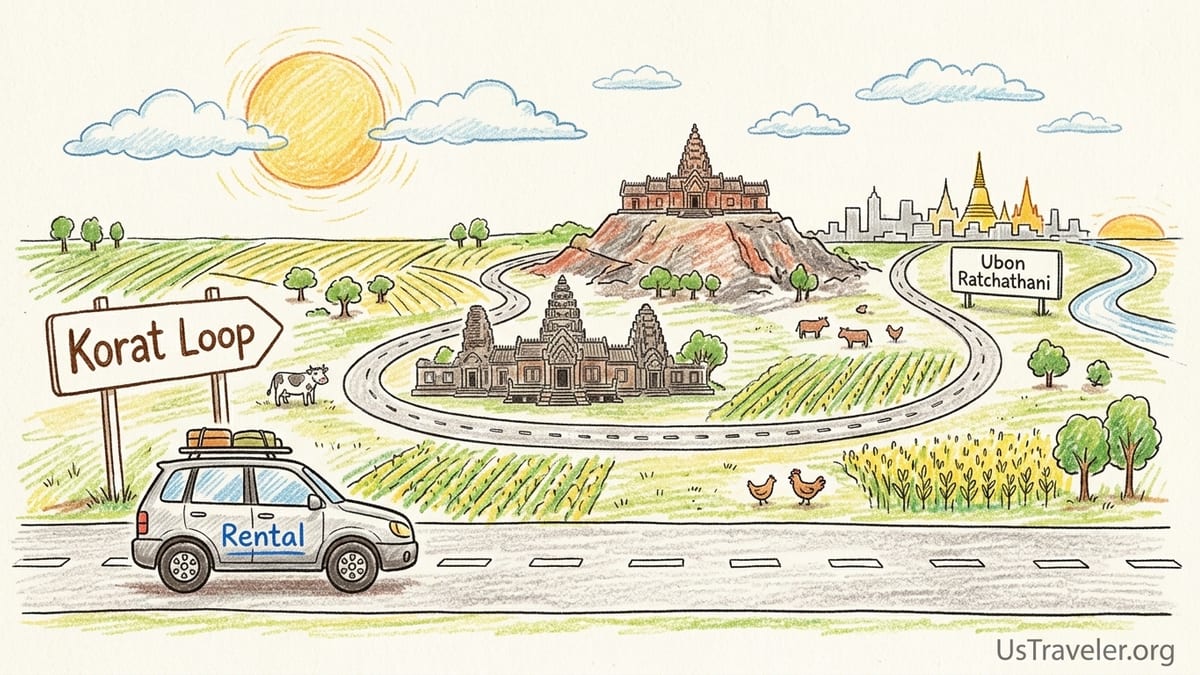
Why Korat Is The Best Starting Line (And The Smart Way To Think In Loops)
Korat sits at the gateway to the Khorat Plateau, and it’s where Isan starts to feel like Isan: big skies, long straight highways, and a slower rhythm once you’re outside the city ring roads. As a planning base, Korat has a simple advantage: you can drive a strong lower-Isan circuit that hits headline Khmer sites and ends in Ubon Ratchathani without backtracking every day, and you can also split off later for Mekong and upper-Isan loops around Udon Thani, Nong Khai, and Loei.
The loop approach also solves the biggest Isan road-trip mistake, which is attempting a province-by-province conquest. Distances are bigger than many first-time visitors expect, and “quick detours” can turn into 200 km side missions. A loop keeps your drive times predictable and your hotel nights anchored in real towns with good food, fuel, and late check-in options.
One more practical reason to loop: most mainstream rental-car pricing and policies in Thailand still favor returning the car to where you collected it. One-way rentals are possible with some international brands, but they can be limited by location coverage, fleet availability, and drop-off fees. Starting and ending in Korat is an easy win for cost control and flexibility, especially if you’re following the one-week, roughly 830 km Korat-based loop highlighted in Lonely Planet’s 2026 coverage.
Car Rental In Isan: Where To Pick Up, What To Book, And What To Bring
Korat has straightforward self-drive options, including downtown rental locations from major brands. For example, Budget Thailand lists a Korat Downtown branch on Mitraphap Road, which is the region’s main north-south artery and a convenient place to start your loop without battling Bangkok traffic. If you want broader choice, you’ll also see national and international brands showing availability in Nakhon Ratchasima through the big booking platforms, but it’s worth confirming the exact pickup point and office hours before you commit.
For upper-Isan routes, Udon Thani is the most convenient pickup hub because it has a busy airport and strong competition among rental providers. Hertz, for instance, lists a Udon Thani Airport location and explicitly notes that one-way rentals are available within its Thailand network. If you’re building separate loops, this matters: you can fly or train into Udon, drive the Mekong and Loei segments, then return the car to Udon for a clean round-trip plan.
Vehicle choice in Isan is less about “need an SUV” and more about comfort and time. A compact sedan is fine on major highways, but if you’re doing long daylight drives and want less fatigue, a mid-size sedan or small crossover can feel worth it for seat comfort and stability in rain. If you’re traveling as a family or with lots of bags, a 7-seat SUV is widely rented in Thailand; as a real-world example of current pricing in the region, a local Udon provider advertises a Toyota Fortuner from about 2,290 baht per day as a starting price, with airport pickup offered. Treat that as a baseline reference and expect the final quote to change by dates, insurance terms, and availability.
Documents and driving rules deserve extra attention. Thailand’s enforcement can be inconsistent, but you should plan as if you will be checked. Bring your home license and an International Driving Permit issued by an official authority in your home country. Avoid “instant online IDP” sites that are not tied to a national issuing body. Rental desks may hand you the keys with just a passport and a license, but that does not protect you at a roadside stop or in an insurance dispute. If you are not comfortable with right-hand-drive, consider picking up the car in daylight, doing a short “practice loop” around quieter roads near your hotel, and only then committing to the long highway legs.
Fuel, Tolls, And Road Quality: What It Actually Feels Like On The Ground In 2026
Isan’s main highways are generally in good shape, and the driving is easiest when you stay on the big connectors and treat smaller roads as slower scenic segments. Mitraphap Road (often referred to as Highway 2, the Friendship Highway) is the region’s spine between Korat and the north, and you’ll find frequent rest areas, service stations, and food courts that make long legs manageable.
Fuel planning is refreshingly simple because stations are frequent, but prices are not something you should guess. Thailand’s Energy Policy and Planning Office publishes retail pump prices, and as of September 15, 2026, Gasohol 95 is listed at about 39.09 baht per liter at major brands, while E20 is about 34.09 baht per liter and E85 about 30.03 baht per liter. On the diesel side, recent national reporting around early September 2026 listed Diesel B7 at about 39.84 baht per liter and Diesel B20 at about 34.84 baht per liter. In practice, this means you can ballpark a 1,000 baht top-up as roughly 25 liters of Gasohol 95 at current rates, which is useful when you’re deciding whether to detour to a rural viewpoint before dusk.
On the road, the biggest stress factor is not potholes, it’s time of day. Isan towns can be calm at midday and surprisingly congested in the late afternoon school and market hours. The second factor is visibility and lighting: smaller provincial roads can be darker than travelers expect after sunset. Plan your long drives early, aim to arrive at your hotel before dinner, and treat night driving as the exception rather than the default.
Tolls are generally less of an issue in Isan than on the big Bangkok corridors, but you still want cash for parking fees, site entry, and small service-station stops. Keep a small envelope of 20, 50, and 100 baht notes in the car so you are not standing at a ticket booth with only a 1,000 baht note and a line behind you.
Loop 1: The Lower-Isan Circuit (Korat To Phimai To Buriram To Ubon)
If you only do one Isan road trip, make it this one. It’s commercially strong because it links the region’s most recognizable ancient architecture with towns that are easy to sleep in, easy to eat in, and easy to keep moving from. This is also the logic behind the one-week Korat loop that Lonely Planet’s 2026 road-trip coverage highlights at roughly 830 km: you start outside Bangkok, pick up wheels in Korat, and meander through lower-Isan highlights without turning it into a marathon.
Start with Korat to Phimai as your “warm-up day.” Phimai Historical Park is one of Thailand’s great Khmer-era sites, and it’s also a practical road-trip stop because the town is small and navigable. The Fine Arts Department lists the park open daily, typically 07:00 to 18:00, and also provides visitor services such as parking, restrooms, and an information center. For foreign visitors, you’ll see admission commonly listed at 200 baht at the ticket window and in multiple current references, while Thai nationals are typically charged a much lower rate. If you want an easy add-on that feels genuinely educational, Phimai National Museum has separate hours, opening 09:00 to 16:00 from Wednesday to Sunday, and a separate ticket.
From Phimai, continue toward Buriram for the region’s most dramatic temple drive. Phanom Rung Historical Park sits on an extinct volcano and is the signature stop in this loop. The Fine Arts Department’s own park information lists it open daily from 06:00 to 18:00 and sets foreign admission at 200 baht, with a vehicle fee for cars listed at 50 baht if you enter via the applicable gate. The experience is physical: heat, stairs, long stone walkways, and very little shade on the top, so it’s the kind of place where arriving by 08:00 can change the whole day.
Finish the loop in Ubon Ratchathani, which is a comfortable “real city” to reset in. It’s also a sensible place for a two-night stop if you want to slow down: one day for monasteries and riverfront neighborhoods, another day for day trips. If you are tempted to push onward toward the border, remember that border timing, paperwork, and queues can turn a simple “pop over” into an all-day event. For most road-trippers, Ubon works best as the eastern anchor of a lower-Isan loop, not as the start of a cross-border plan.
Loop 2: The Mekong Cities Route (Udon Thani And Nong Khai As A Two-Base Plan)
For a very different Isan mood, build a short upper-Isan loop around Udon Thani and Nong Khai, and treat it as its own trip. Udon has the transport advantages: a major airport, lots of accommodation choice, and easy onward roads. Nong Khai delivers the scenery: the Mekong River at dusk, riverfront cafes, and the feeling of being on Thailand’s edge.
This is also the cleanest route if you want a Laos day trip without committing to a multi-country overland journey. The 1st Thai-Lao Friendship Bridge crossing between Nong Khai and Vientiane is widely described as operating daily from 06:00 to 22:00. Even if you have no intention of crossing, Nong Khai’s border infrastructure means transport services and onward logistics are well developed, which can matter if you want to keep your trip flexible.
From a self-drive perspective, plan Udon and Nong Khai as a two-base plan rather than a long daily commute. A realistic rhythm is two nights in Udon (market evenings, day trips) and one or two nights in Nong Khai (sunset walks, riverfront). The drive between them is short enough that you can shift bases after breakfast without it consuming the day.
One more practical note: if you are thinking about a one-way rental that starts in Udon and ends elsewhere, confirm it before you book. Some airport locations can do it, but one-way inventory can be restricted on popular weekends and Thai holiday periods, and the drop fee can erase any time savings if your final destination is not a major airport city.
Loop 3: Loei And The Cooler Northeast (A Scenic Detour That Still Works As A Loop)
Loei is the loop you save for when you want Isan to feel greener and cooler, with ridge roads, viewpoints, and towns that feel more like a pause than a checklist. It’s also a smart add-on to the Udon and Nong Khai route because you can build a triangle: Udon to Nong Khai for the Mekong, then west toward Loei for scenery, then back to Udon for your flight or train.
Road quality is generally reliable on the main routes, but Loei is where you’ll notice a bigger difference between highway driving and local mountain-road driving. You do not need special skills, but you do need daylight. If you’re traveling in rainy season, build more buffer time and avoid pushing arrival times into the dark, when fog and wet pavement can make even short drives tiring.
Hotel planning is easiest if you pick one hub town for each “mood.” Udon is your logistics hub, Nong Khai is your Mekong sunset base, and Loei town or a nearby district is your nature base. The point is not luxury, it’s predictability: a place with reliable parking, a front desk that understands late arrival, and enough dinner options that you are not driving again at 9 p.m. to find food.
If you want this loop to feel like a road trip rather than a series of drives, schedule at least one low-driving day where the car stays parked. In Loei, that could mean a morning coffee, a midday viewpoint, and a long, slow dinner. The more you treat Isan as a pace shift, the more it delivers.
One-Way Versus Round-Trip: How To Choose Without Blowing The Budget
Round-trip planning is the default for a reason. It protects you from drop-off surprises, it makes insurance and deposit disputes easier to resolve, and it gives you more freedom to adjust your route mid-trip. The Korat-based lower-Isan circuit is ideal for round-trip because it naturally loops, and it aligns with the one-week, roughly 830 km Korat loop noted in current 2026 guidebook coverage.
One-way planning can still make sense when your trip is built around airports. A common example is flying into Udon Thani, driving a Mekong and Loei loop, and flying out of Udon again. That is still a round-trip in rental terms, but it’s a one-way trip in travel terms, and it’s often the best of both worlds. True one-way rentals, such as picking up in Korat and dropping in Ubon, can be convenient, but you should only do it when the provider confirms the drop location, the hours, and the fee in writing before you travel.
Whichever strategy you choose, your real cost is not just the daily rental rate. It’s also insurance coverage, deposit policy, and the time cost of chasing paperwork if something goes wrong. If you’re trying to keep the trip stress-free, pay extra attention to the basics: clear fuel policy, a documented walkaround with photos, and a backup plan if you arrive after the office closes.
The Takeaway
Isan is one of Thailand’s best self-drive regions when you plan it like a set of loops. Start with a lower-Isan circuit from Korat through Phimai and Phanom Rung to Ubon for the strongest blend of landmark sites and easy hotel stops. Then, if you have more time, treat the Mekong and Loei as a separate upper-Isan road trip built around Udon Thani and Nong Khai. Keep your driving in daylight, anchor your nights in real towns, and use current fuel prices and site hours as part of your plan, not an afterthought.
Done this way, Isan doesn’t feel like “the part of Thailand you rush through.” It feels like the Thailand you finally have time to understand.
FAQ
Q1. How many days do I need for a first Isan road trip?
Seven days is a realistic first trip if you base it around a Korat loop that includes Phimai, Buriram’s Khmer sites, and Ubon Ratchathani, with time for unplanned stops.
Q2. Where should I rent a car for Isan, Korat or Udon Thani?
Rent in Korat for the lower-Isan circuit (Phimai, Phanom Rung, Ubon). Rent in Udon Thani if you’re focusing on the Mekong (Nong Khai) and Loei, since Udon’s airport has broad rental coverage.
Q3. Are roads in Isan good enough for a normal sedan?
Yes on major routes. A normal sedan is fine for Korat, Phimai, Buriram, Ubon, Udon, and Nong Khai. Choose a higher-riding vehicle mainly for comfort, luggage space, and long-day fatigue reduction.
Q4. What do fuel prices look like in Thailand right now?
As of September 15, 2026, Gasohol 95 is about 39.09 baht per liter per Thailand’s official retail price reporting, with E20 around 34.09 baht and E85 around 30.03 baht per liter.
Q5. What are the opening hours and entrance fee for Phimai Historical Park?
Phimai Historical Park is listed by Thailand’s Fine Arts Department as open daily, typically 07:00 to 18:00. Foreign visitor admission is commonly listed at 200 baht at current references, with a much lower Thai-national rate.
Q6. What are the opening hours and entrance fee for Phanom Rung Historical Park?
Phanom Rung is listed by the Fine Arts Department as open daily from 06:00 to 18:00, with foreign admission 200 baht. A car entry fee can apply depending on the gate used.
Q7. Do I need an International Driving Permit to drive in Thailand as a tourist?
Bring your home-country license and an International Driving Permit issued by an official authority in your home country. Do not rely on unofficial “online IDP” documents.
Q8. Should I plan a one-way car rental from Korat to Ubon?
Only if the rental company confirms the drop-off location, hours, and fee before you book. For most travelers, a Korat round-trip loop is simpler and often cheaper.
Q9. What are the border crossing hours at Nong Khai to Vientiane?
The 1st Thai-Lao Friendship Bridge checkpoint between Nong Khai and Vientiane is widely described as operating daily from 06:00 to 22:00, but queues can vary by time and season.
Q10. What’s the biggest safety tip for driving in Isan?
Keep long drives in daylight. Rural roads can be dark at night, and arriving before dinner dramatically reduces fatigue and risk.