


Bangkok to Udon Thani is one of Thailand’s most useful overnight rail corridors: you can fall asleep in Bangkok and wake up in Isan with enough daylight left to reach Ban Chiang, hunt for the Red Lotus Sea, or continue to Nong Khai for the Lao border. In September 2026, schedules show multiple departures from Krung Thep Aphiwat Central Terminal (Bang Sue), including a flagship night sleeper service with first class available on selected runs, plus a cheaper late-night train and a daytime express. Here is how the tickets actually work, what each class feels like in real life, when to book, and when flying from Don Mueang still wins.
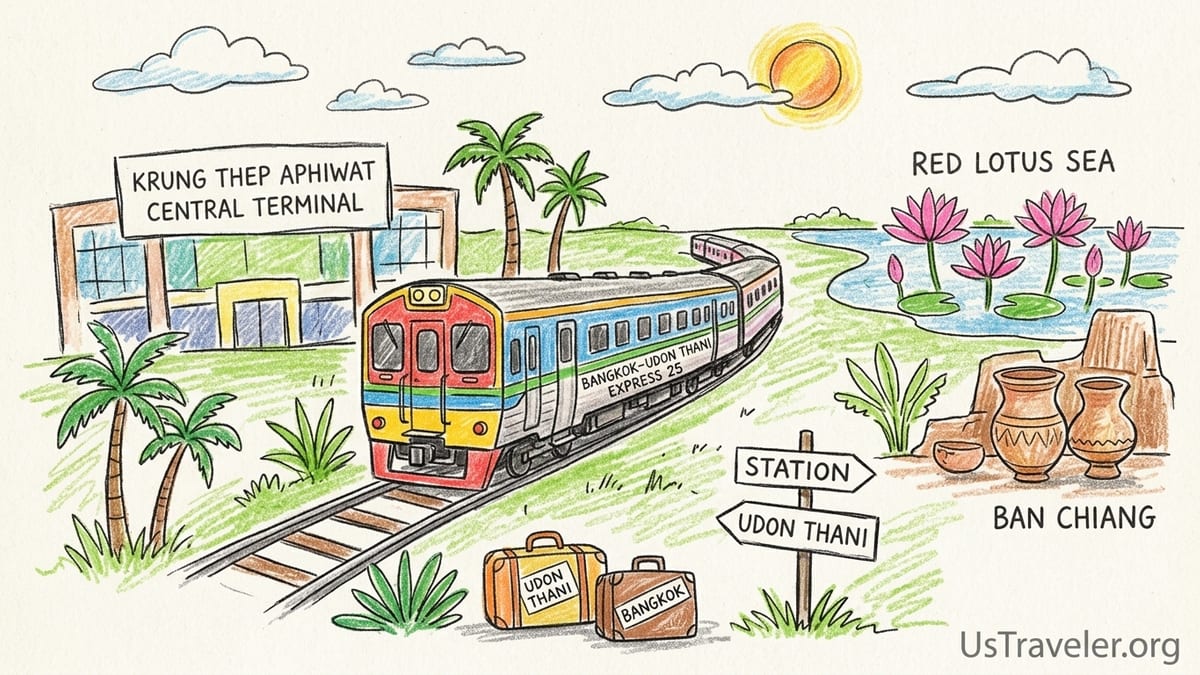
What’s running in September 2026: the Bangkok to Udon Thani timetable you’ll actually use
If you are planning around sleep, arrival timing matters more than the train number. In September 2026, the most popular overnight option is Special Express 25, departing Krung Thep Aphiwat at 20:25 and reaching Udon Thani at about 05:39 the next morning. It continues onward to Nong Khai, so Udon Thani is an intermediate stop rather than the terminus.
There is also a later, cheaper overnight option: Rapid 133 departing Krung Thep Aphiwat at 21:25 and arriving Udon Thani around 07:02. The extra hour and change sounds minor on paper, but in practice it can mean arriving closer to hotel check-in time and closer to when Ban Chiang transport starts moving.
For daytime travel, Express 75 is the workhorse: it departs Krung Thep Aphiwat at 08:45 and arrives Udon Thani around 16:55. This is the option for travelers who want daylight scenery and do not want to sleep on a train, but it also consumes most of your day in transit.
Real-world example: if you land in Bangkok in the afternoon and want to be in Udon early for a morning lake trip, Train 25 is the cleanest fit. If you want dinner in Bangkok and do not mind arriving later, Train 133 can be easier to score at the last minute.
Where you depart now: Krung Thep Aphiwat (Bang Sue) and why it changes your plan
For this route, the key station is Krung Thep Aphiwat Central Terminal, often still called Bang Sue by locals and taxi drivers. In 2026, most long-distance Northeastern services are marketed from Krung Thep Aphiwat rather than the old Hua Lamphong era mindset, and booking the wrong Bangkok station name is a classic reason travelers think trains are “sold out.”
In practical terms, Krung Thep Aphiwat is a better departure point for most visitors staying near Chatuchak, Ari, or the MRT corridor. It is also straightforward from Don Mueang area hotels, and it is typically a shorter taxi ride from the northern side of the city than older central stations.
Another real-world convenience is that some services stop at Don Mueang station shortly after departure. For example, Train 25 calls at Don Mueang at about 20:40 to 20:42, and Train 133 around 21:42. If you are staying near Don Mueang Airport, boarding there can save you a cross-city ride at rush hour.
Timing tip: do not treat the station like an airport. You do not need to arrive two hours early, but for sleepers you do want enough time to find your platform, buy snacks, and locate the correct carriage position before the train rolls in.
Ticket classes explained: first class sleeper vs second class AC sleeper vs seats
On paper, “first class” and “second class” sound like a simple comfort ladder. In real life, they are different experiences. First class sleeper on the Bangkok to Nong Khai line (where Udon Thani is a stop) is a private, lockable compartment layout on selected services, typically sold as two-berth compartments. If you are traveling as a couple and you value privacy, it is the most hotel-like option you can buy on rails in Thailand without chartering anything.
Second class air-conditioned sleeper is the sweet spot for most travelers: open-plan berths with curtains, reading lights, and an attendant who converts seats into beds after departure. In Thailand, the lower berth is typically priced higher than the upper because it is wider, easier to access, and lets you keep an eye on your bag more comfortably. If you are 6 feet tall and sensitive to tight spaces, the lower berth is the one you will thank yourself for at 02:00.
Seats break into two main mindsets. Daytime air-conditioned seats on Express 75 are fine for a long day, especially if you bring a neck pillow and do not need deep sleep. Overnight seats on cheaper services can be tempting for budget reasons, but sleeping upright for 9 hours in bright stations and stop-and-go noise is a gamble unless you are the kind of traveler who can sleep anywhere.
Concrete example: if you want to arrive at 05:39 on Train 25 and go straight to Nong Prajak Park for sunrise, second class AC sleeper lets you arrive functional. If you take a late overnight seat, you might arrive at 07:02 technically “on time,” but still feel like you lost a night.
How much it costs in 2026: what you’ll likely pay and what drives price swings
For the modern sleeper services on the Bangkok to Nong Khai corridor, widely published fare references for the line put second class air-conditioned sleeper berths roughly in the high hundreds to around the 1,000 baht range per person, and first class air-conditioned sleeper higher, often roughly in the 1,300 to 1,500 baht range per person, with the main variable being whether you choose an upper or lower berth and whether you are booking to Udon Thani or beyond. The exact fare you see on the day can vary by train type and quota.
If you want a grounded benchmark, older published fares for Train 25/26 on this corridor list second class AC sleeper around 894 baht for an upper berth and about 994 baht for a lower berth, and first class AC sleeper around 1,350 to 1,550 baht per person depending on berth and configuration. These numbers are best used as a planning baseline, then confirmed at booking time on the official system.
Daytime seats are the budget comfort play. For the daytime express option, published references put second class air-conditioned seats around the 400 to 500 baht band, while cheaper non-AC classes can be significantly less. If you are doing Bangkok to Udon as a daytime repositioning move and you would rather spend your money on a hotel, this is where you save.
Price swing reality: weekends, Thai public holidays, and long school breaks can wipe out the best sleeper inventory long before the date. When that happens, it is not that “trains are canceled.” It is that sleepers are finite, and the last remaining options may be daytime seats, late-night seats, or flights.
Booking windows, D-Ticket strategy, and what to do when sleepers look sold out
In 2026, the booking window matters because sleepers are a limited resource. Multiple sources tracking SRT policy note that advance booking has been opened up to around 90 days ahead for many long-distance services, including popular sleeper routes. That means a September travel date can become bookable in early summer, and on peak dates the best berths disappear quickly.
In real life, the single most common mistake for Bangkok to Udon searches is picking the wrong origin station name in the booking system. If you search from an old station label or a generic “Bangkok” entry instead of Krung Thep Aphiwat, you can easily end up staring at an empty results page and assuming everything is gone.
If Train 25 second class sleepers are sold out, you have three practical pivots: switch to Train 133 and take what is available, switch to Express 75 daytime and sleep in Udon that night, or switch modes and fly. Another small but real tactic is changing the boarding point: if you can board at Don Mueang station, you may find different inventory patterns on some days and you also reduce your logistics on departure night.
Example scenario: you are traveling as a family of four and need adjacent second class sleepers. If you cannot find four berths together on Train 25, splitting across carriages often still works because attendants are used to families traveling in clusters. But if you require a private compartment feel, you are shopping in the first class inventory pool, and you should book as soon as your date opens.
Luggage and onboard reality: what to pack for, what you can carry, and sleep quality
Thai long-distance trains are generally friendly to normal travel luggage, but the onboard reality is space, not policy. A typical traveler rolling a medium suitcase and carrying a daypack will be fine on sleepers as long as they can lift or angle the bag into the berth area. Oversize sports gear or multiple large suitcases can become awkward quickly in second class sleepers because aisles are narrow and the train is designed for people, not freight.
Some travel references note that oversized items beyond a standard allowance can be carried in a baggage car by purchasing a separate cargo or baggage ticket. If you are traveling with golf clubs, a bicycle in a box, or production gear, plan to ask about baggage handling before departure rather than assuming you can wrestle it into your berth at 20:20 with a crowd behind you.
Sleep quality depends on class and on you. In second class, bring earplugs if you are a light sleeper, because station stops, announcements, and the rhythm of the rails are part of the experience. The air-conditioning can run cool overnight, so a light layer helps even though bedding is provided.
Small but practical example: if you are heading to the Red Lotus Sea for an early boat departure, pack a separate “morning kit” in your daypack with cash, sunscreen, and a fresh shirt. Digging through a suitcase under a lower berth at 05:20 is a bad way to start a lake morning.
Train vs flying: when a 65-minute flight is better than a 9-hour sleeper
Flying from Bangkok to Udon Thani is fast and frequent. In September 2026, published flight schedules show multiple non-stop flights per day from Don Mueang (DMK) to Udon Thani (UTH) on Thai AirAsia, Nok Air, and Thai Lion Air, with typical block times around 1 hour to 1 hour 10 minutes. On a sample date such as Tuesday, September 15, 2026, schedules show morning departures like 06:00 on Nok Air, 08:00 on Thai Lion Air, and around 08:05 on Thai AirAsia.
The catch is not the flight time, it is the airport time. If you are staying far from Don Mueang, you can burn the same number of hours in traffic and check-in lines that you would have spent simply boarding a sleeper at Krung Thep Aphiwat. But if you are already near Don Mueang, flying can feel almost unfairly efficient.
Price is also more dynamic than rail. Deal aggregators and airline booking platforms in 2026 show Bangkok to Udon one-way fares often around the 1,000 to 1,500 baht range when booked ahead on low-cost carriers, with baggage rules that can push the total up if you need checked luggage. A common real-world trap is buying a cheap fare with only a 7 kg cabin allowance, then paying extra later because your bag is 9 kg after you added toiletries and souvenirs.
My practical rule: fly if you need to be in Udon by midday for a fixed appointment, or if sleepers are full and you value time over the romance of rail. Take the night train if you want to save a hotel night, arrive early, and start your Isan trip with less airport friction.
The Takeaway
For most travelers in September 2026, the best Bangkok to Udon Thani option is the overnight sleeper on Special Express 25: it departs Krung Thep Aphiwat at 20:25 and reaches Udon around 05:39, which is nearly perfect for onward day trips and continuing to Nong Khai. Second class AC sleeper is the value leader, while first class sleeper is worth it when privacy matters and you can secure availability. Express 75 is the comfortable daytime alternative when you want daylight and do not need an early arrival. Flying from Don Mueang to Udon Thani is the speed champion, especially if you are already near DMK, but luggage add-ons and airport time can narrow the gap more than people expect.
Udon Thani itself is not just a destination, it is a hub. Travelers use it as a base for Ban Chiang’s UNESCO-listed archaeology, the seasonal Red Lotus Sea, and as a staging point for continuing to Nong Khai and the Lao border. Choose your mode based on what you need the next morning: a sunrise arrival and energy for a day trip, or a fast hop that drops you close to town without spending the night on rails.
FAQ
Q1. What is the best sleeper train from Bangkok to Udon Thani in 2026?
Special Express 25 is the most popular because it leaves Krung Thep Aphiwat at 20:25 and arrives Udon Thani around 05:39, ideal for morning plans.
Q2. Are there multiple night trains from Bangkok to Udon Thani?
Yes. In September 2026 schedules commonly show at least two night departures, including Train 25 and the later Rapid 133.
Q3. Does the Bangkok to Udon Thani train depart from Hua Lamphong?
No for most travelers. The practical departure point is Krung Thep Aphiwat Central Terminal (Bang Sue), which is where these services are scheduled to start.
Q4. What time does the late-night train arrive in Udon Thani?
Rapid 133 is typically shown arriving around 07:02, which is later than the flagship sleeper and can suit travelers who prefer a slower morning start.
Q5. Is first class sleeper available on the Bangkok to Udon Thani route?
First class sleeper can be available on selected services on the Bangkok to Nong Khai corridor, where Udon Thani is an intermediate stop, but availability is limited and sells out quickly.
Q6. How far in advance can I book Bangkok to Udon Thani train tickets?
In 2026, SRT advance sales are commonly reported as opening up to about 90 days ahead for many long-distance services, which is important for sleepers.
Q7. Should I choose a lower or upper berth in second class AC sleeper?
If budget allows, choose the lower berth for easier access and a slightly roomier feel. The upper is fine if you pack light and sleep easily.
Q8. How strict is luggage on the sleeper train?
Normal travel bags are usually fine onboard, but large or extra items can be awkward in narrow aisles. For oversized items, it is smarter to ask about baggage handling options before departure.
Q9. When is flying better than taking the sleeper train?
Fly when you need speed or when sleeper berths are sold out. The flight itself is around 1 hour to 1 hour 10 minutes, but you must factor in airport transfer and baggage add-ons.
Q10. Is Udon Thani mainly a destination or a stepping stone?
Both. Many travelers use Udon as a base for Ban Chiang and the Red Lotus Sea, and also as an onward hub to Nong Khai and the Lao border.