


Nong Khai is the classic Isan gateway to Laos, and in 2026 the border crossing is easier than many first-timers expect, as long as you understand one key idea: you are not just buying a ticket, you are buying a sequence of steps across the Thai-Lao Friendship Bridge, through two immigration checkpoints, and then onward into Vientiane from either the city bus station or Khamsavath railway station. This transactional guide walks you through the real-world choices travelers face right now: the short cross-border train (about 30 minutes), the direct cross-border bus from Nong Khai bus terminal, shared vans and taxis, and private transfers, plus exactly what happens at passport control on both sides.
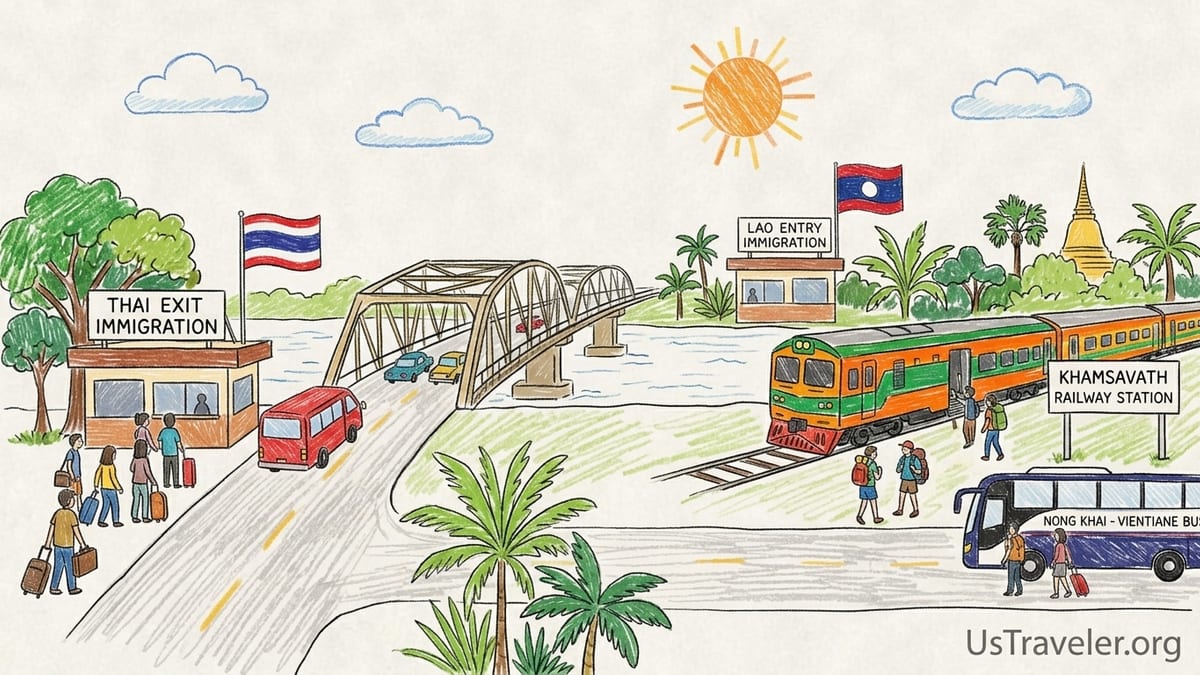
What The Border Crossing Actually Looks Like (Nong Khai to Vientiane)
The First Thai-Lao Friendship Bridge sits a few kilometers outside Nong Khai town and functions like a funnel: whether you cross by train, bus, van, or private car, you still pass through Thai exit immigration, ride across the bridge, then clear Lao entry immigration. You cannot simply walk across the bridge end to end on foot, so every traveler uses a vehicle for the bridge segment, even if you walk through the buildings.
In practice, most travelers start from one of two places in Nong Khai: Nong Khai Railway Station (for the cross-border train) or Nong Khai Bus Terminal (for the direct international bus). A third option is to go straight to the Thai border post (sometimes called the Friendship Bridge checkpoint) by tuk-tuk or taxi, clear Thai exit, then use the small shuttle service over the bridge to the Lao side and continue from there.
The big difference is what happens after you enter Laos. The direct international bus usually drops you in central Vientiane near the main bus station area by the Morning Market, while the train delivers you to Khamsavath railway station, a modern rail terminal that is not in the historic center. That makes the train fast on paper but not always the fastest “door to hotel” option.
Train Option (2026): Nong Khai to Vientiane Khamsavath in About 30 Minutes
As of 2026, travelers can use direct cross-border rail services from Nong Khai to Vientiane (Khamsavath). The headline is the ride time: about 30 minutes between stations, including the bridge crossing. Real-world timetables still matter, because this is not a metro-style shuttle with constant frequency.
Two departures commonly shown on current booking and timetable sources are a morning train departing Nong Khai around 08:35 and arriving Khamsavath around 09:05, plus an afternoon service departing around 17:25 and arriving around 17:55. If you are planning a same-day connection deeper into Laos, that morning arrival is the one that usually works better with daytime onward travel.
For a concrete purchase example: online agents and timetable listings in September 2026 have shown Nong Khai to Vientiane (Khamsavath) train tickets priced around 70 baht for the short cross-border leg. When you see a fare that low, remember it covers only the rail segment; you still need budget for your Nong Khai local ride to the station, any border fees, and your transport from Khamsavath into the city.
Operationally, the “30 minutes” train time does not mean you can arrive at Nong Khai station 10 minutes before departure and expect a smooth run. Cross-border rail passengers must complete exit and entry formalities, and trains can be sensitive to late arrivals. If you want this to be stress-free, treat it like an international departure: arrive early, keep your passport accessible, and have your Laos entry plan ready before boarding.
Buying Tickets: Where To Pay, What To Show, And How Far Ahead
Ticket buying is usually the first point where travelers get tripped up, because the crossing mixes domestic Thai rail practices with an international border. In general, you can buy in person at Thai stations, and Thailand’s rail system also sells seats online through its official channels for many routes. The catch is that availability, sales windows, and the exact booking experience can change by season, and cross-border services sometimes have extra constraints compared with purely domestic trains.
If you are already in Nong Khai, the simplest real-world approach is to buy at Nong Khai Railway Station a day or two ahead and confirm the departure time posted at the station. If you are coming from Bangkok or Udon Thani, buying earlier is wiser in peak periods (weekends, long holidays, and year-end travel) because even “cheap” trains can sell out when everyone is moving at the same time.
Online booking examples in September 2026 show the route displayed as Nong Khai to Vientiane with the destination listed as “Khamsavath.” That detail matters: Vientiane has more than one transport hub, and you do not want to confuse Khamsavath (the Thailand-connected station) with the Laos-China Railway’s main Vientiane station used for high-speed-style services north to Vang Vieng, Luang Prabang, and the China border.
For payment, bring Thai baht in small bills if you are on the Thai side. Once you cross, Laos-side counters may accept kip, and for immigration-related payments many travelers report smoother transactions with clean, undamaged notes. Even if you plan to pay everything by card in Vientiane, the border crossing itself is still a cash-heavy experience.
Immigration Step-By-Step: Thai Exit, Bridge Transfer, Lao Entry
The most important thing to understand is that immigration is not a single desk. It is a chain: Thai exit stamp first, then the bridge transfer, then Lao entry processing. Your mode of transport mainly determines how you move between these points and whether you keep the same vehicle or change.
On the Thai side, you clear exit immigration at the border facilities near the Friendship Bridge. If you are on the international bus, the driver usually tells everyone when to get off and where to line up, and the bus waits while passengers get stamped out. If you are traveling by train, procedures can vary by service, but the overall logic stays the same: you must be stamped out of Thailand before you are admitted to Laos.
After Thai exit, you cross the bridge by an approved vehicle. Many travelers use the shuttle service that runs between the two border posts, with common reports of a small fare in the 30 to 35 baht range. Do not assume you can walk across the bridge itself, and do not assume the shuttle runs 24 hours. If you are doing a late afternoon crossing, the safest move is to avoid cutting it close to evening closing times.
On the Laos side, you enter the Lao border post and complete entry procedures. Laos immigration offers multiple pathways depending on nationality and documentation: visa-exempt entry for eligible passports, visa on arrival for many nationalities, and eVisa for eligible travelers. If you are arriving by train directly into Khamsavath, note that Khamsavath is recognized as an official eVisa entry point for rail arrivals, and it also processes international arrivals inside the station for cross-border train services.
Arriving At Khamsavath Station: What It Is, Where It Is, And How To Continue
Khamsavath railway station is Vientiane’s cross-border rail arrival point for trains coming from Thailand, and it also functions as a formal immigration entry location for international passengers. It is not the riverside tourist core, and it is not the Laos-China Railway’s better-known Vientiane station used for services north. In other words: arriving at Khamsavath is arriving “in Vientiane,” but not necessarily where you want to be staying.
Travelers should plan onward transport the same way they would from an airport: decide between a taxi, a pre-arranged pickup, or a bus connection. Published travel guidance and timetables frequently describe Khamsavath as roughly 7 to 8 kilometers from central Vientiane, which makes it close enough for a quick taxi but far enough that walking is not realistic with luggage and heat.
For concrete cost expectations, travel references in 2025 to 2026 commonly cite metered taxi trips from downtown Vientiane to the station in the range of roughly 80,000 to 100,000 kip, while hotel-arranged transfers can be significantly higher. Those examples are useful because pricing in Vientiane can swing based on where you hail the ride, time of day, and whether you negotiate or use a meter.
There are also published references to local bus connections priced around 20,000 kip per adult for certain station-related routes, which can be great value if you are traveling light and do not mind a longer ride time. The trade-off is convenience: after an international border process, many travelers prefer the certainty of a taxi rather than figuring out the right bus stop and route signs immediately.
Bus, Van, And Private Transfer Options: When They Beat The Train
The direct cross-border bus from Nong Khai bus terminal to central Vientiane remains the default choice for many travelers because it reduces decision points. You buy one ticket at the terminal, you ride to Thai immigration, you cross, you clear Laos immigration, and you continue to the city, typically finishing near Vientiane’s central bus station area by the Morning Market. That “one vehicle most of the way” workflow is why the bus can feel simpler than the train, even when the train ride itself is faster.
Concrete fare examples commonly quoted for the Nong Khai to Vientiane cross-border bus are around 55 baht on weekdays and around 60 baht on weekends and holidays. Time-wise, guide sources often describe the full trip including border formalities as roughly two hours, which lines up with what many travelers experience when queues are moderate. The risk is variability: if immigration lines spike, the bus is not magically faster, it just keeps you in a single system.
Shared vans and informal minibus options can be attractive if you are starting from Udon Thani or if you want hotel pickup in Nong Khai, but they add negotiation and coordination. A typical real scenario: a driver offers a “Vientiane transfer” price that sounds cheap, then you discover it only covers a drop at the border, not across the bridge and into town. If you use a van, clarify before you pay whether the price includes the bridge shuttle, whether it waits through immigration, and where the Laos-side drop-off is.
Private transfers make the most sense for small groups, families, or travelers with lots of luggage, because the cost can be split and the driver can handle the awkward pieces, like timing the crossing to avoid peak queues and taking you directly from Khamsavath or the Lao border post to a specific hotel on Rue Samsenthai or near the Mekong riverfront. The key is to confirm the itinerary in plain terms: pickup point, border handling, vehicle change or no vehicle change, and the final Vientiane address.
The Takeaway
The Nong Khai to Vientiane crossing is fast in distance but complex in sequence, so the best option depends on what you value. If you want the shortest station-to-station trip and like the idea of arriving at a proper rail terminal, the direct train to Khamsavath is a compelling 2026 option, with published examples showing about 30 minutes and low fares around 70 baht for the short leg.
If you want the fewest moving parts and a drop closer to the city center, the direct cross-border bus from Nong Khai bus terminal is often the smoothest purchase: a modest fare in the 55 to 60 baht range and a straightforward flow through immigration, even if the total journey time can be longer once you include queues.
Whatever you choose, plan the border as an international process, not a local commute. Bring cash for small shuttle and transport payments, keep your passport and entry documentation easy to reach, and decide in advance how you will get from Khamsavath or the Laos-side border post into central Vientiane, because that last leg is where “quick crossings” most often lose time.
FAQ
Q1. How long is the train from Nong Khai to Vientiane (Khamsavath)?
Published 2026 timetables commonly show about 30 minutes station-to-station, but you should still arrive early for border formalities.
Q2. How much is a Nong Khai to Vientiane (Khamsavath) train ticket in 2026?
Recent September 2026 booking examples have shown around 70 baht for the short cross-border rail leg, excluding local transport and immigration-related fees.
Q3. Are there direct trains from Nong Khai to Vientiane every day?
Current timetable listings in 2026 commonly show daily services, including a morning departure around 08:35 and an afternoon departure around 17:25, but you should confirm at the station close to travel day.
Q4. Can I use a Laos eVisa when arriving by train at Khamsavath?
Yes. Khamsavath railway station is recognized as an official Laos eVisa entry point for international rail arrivals, so eVisa holders can clear immigration there.
Q5. Can I get a Laos visa on arrival at Khamsavath station?
Visa on arrival is commonly available at major entry points, and Khamsavath processes international arrivals; eligibility depends on nationality and current Lao immigration rules at time of travel.
Q6. Can I walk across the Thai-Lao Friendship Bridge?
You generally cannot walk the bridge end to end as a pedestrian crossing. Travelers clear immigration on foot inside the buildings, then use a shuttle or vehicle to cross the bridge segment.
Q7. How much is the shuttle across the Friendship Bridge?
Travel references commonly cite a small fee, often around 30 to 35 baht, but it can change, so treat it as a typical on-the-day cash payment.
Q8. Where does the cross-border bus from Nong Khai drop off in Vientiane?
Many services go to Vientiane’s central bus station area near the Morning Market, which is more walkable for central hotels than Khamsavath station.
Q9. How do I get from Khamsavath station into central Vientiane?
The most common choices are taxi or bus. Recent guidance often cites taxis around 80,000 to 100,000 kip from downtown areas, while some bus connections are referenced around 20,000 kip per adult.
Q10. What is the easiest option for first-time travelers: train or bus?
For most first-timers, the direct cross-border bus is easiest because it minimizes transfers and usually drops closer to the city center, while the train is faster on the rail segment but requires a plan from Khamsavath.