

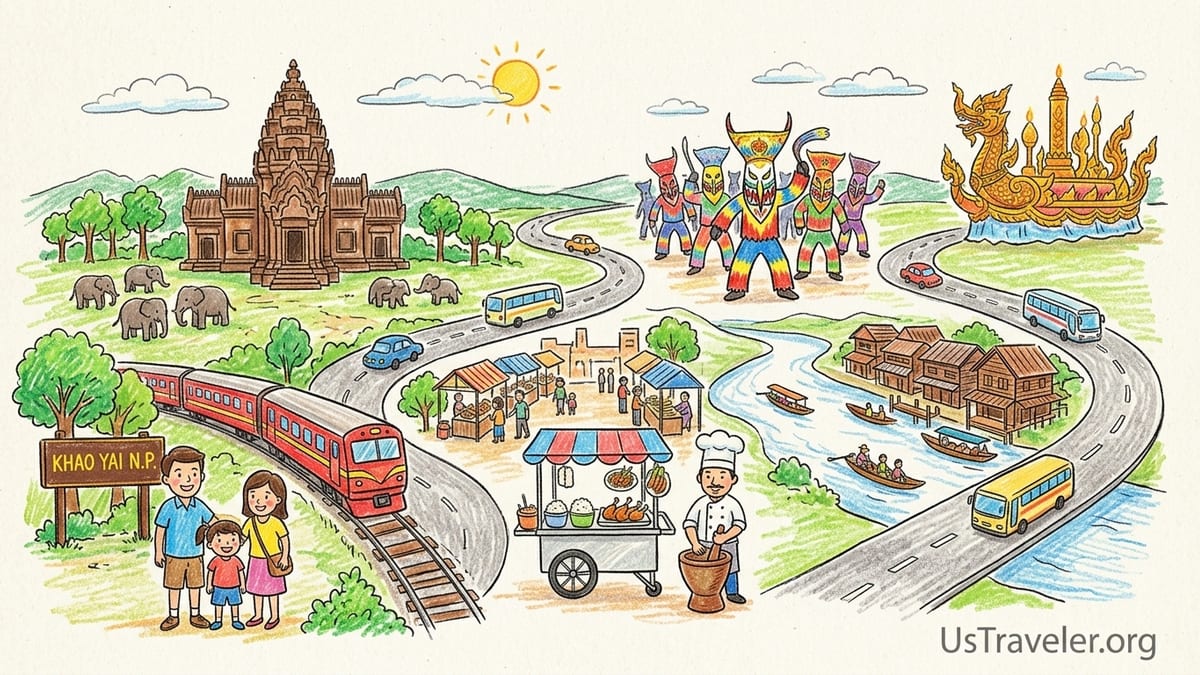
Thailand’s Northeast, known as Isan, is the country’s biggest region and one of its most rewarding for travelers who want bold food, big skies, Khmer-era stone temples, Mekong River life, and festivals that still feel local. Isan is not a single, linear destination you “do” from one end to the other. It is a wide plateau of towns, national parks, archaeological sites, and border provinces that work best as themed routes, the same way the Tourism Authority of Thailand (TAT) promotes the region through multiple travel corridors rather than one continuous circuit. For first-time visitors, the key is to divide Isan into a handful of bases and plan day trips and overnights from each.
What Is Isan, Exactly, and Where Are the 20 Provinces?
Isan is the cultural and geographic shorthand for Northeastern Thailand, a region of 20 provinces stretching from the forested hills near Khao Yai at the western edge to the Mekong River border with Laos, and down to the Dongrak range along Cambodia. The 20 provinces are: Nakhon Ratchasima (Korat), Chaiyaphum, Buriram, Surin, Si Sa Ket, Ubon Ratchathani, Amnat Charoen, Yasothon, Roi Et, Maha Sarakham, Khon Kaen, Kalasin, Mukdahan, Nakhon Phanom, Sakon Nakhon, Nong Bua Lamphu, Udon Thani, Nong Khai, Loei, and Bueng Kan.
For travelers, that list matters less than how you group it. In practice, you will spend your time in a small number of hubs connected by flights, long-distance trains, and highways. Think of Isan as six “first-timer zones”: Korat and Khao Yai as the gateway; Buriram with the southern Khmer-temple belt (including Surin and Si Sa Ket); Khon Kaen as a central transport and university city; Udon Thani and the UNESCO-linked prehistoric site of Ban Chiang; Nong Khai and the Mekong border scene opposite Vientiane; Loei and Chiang Khan for cooler-season river towns; and Ubon Ratchathani for the easternmost culture-and-nature mix.
TAT’s approach aligns with how most visitors actually travel: themed routes that combine food, festivals, heritage, and nature in clusters. When you plan Isan this way, you avoid the classic first-timer mistake: trying to “cover the whole northeast” in one loop, then spending most of the trip staring at highway asphalt.
How to Plan an Isan Trip: Bases, Seasons, and Realistic Travel Times
Isan distances are real. On a map, Korat and Ubon might look like they belong in the same “region,” but overland travel can still take most of a day. A smarter rhythm is to pick two or three bases for a one-week trip, or three to five bases for two weeks, then connect them by plane or overnight train when it saves time. If you are flying in from Bangkok, most first-timers build their first Isan days around either Korat (for Khao Yai and Khmer sites) or Udon Thani (for the Mekong and Ban Chiang), then add one deeper province such as Loei or Ubon.
Overland times vary by stops and traffic, but you should plan conservatively. Bangkok to Korat by road is commonly around 3 to 4 hours depending on the day and where you start in Bangkok; Korat to Buriram is often another 2.5 to 3.5 hours; Khon Kaen to Udon Thani is commonly about 1 to 1.5 hours by road; Udon Thani to Nong Khai is roughly an hour; and Ubon Ratchathani is far enough that it is often most efficient to fly from Bangkok or connect from another hub with a long-distance bus and accept the long day.
Seasonally, Isan’s “best” time depends on what you want. The cool season (roughly November to February) suits Loei’s highland parks and Mekong sunsets in Chiang Khan. The early rainy season is festival season, and it can be spectacular if you plan for downpours. Ubon Ratchathani’s Candle Festival, for example, anchors a big travel window in July, while Loei’s Phi Ta Khon festival is in June for 2026 (20 to 22 June 2026, with the main parade on 21 June 2026). In the hottest months, many travelers lean into city food culture, museums, and short dawn-and-dusk nature excursions rather than midday hiking.
Korat and Khao Yai: The Gateway to Isan (and a Great First Stop)
Nakhon Ratchasima, usually called Korat, is the classic entry point to Isan by road and rail. It is big, practical, and well-connected, and it sits close to two different kinds of first-timer highlights: Khao Yai National Park for wildlife and waterfalls, and major Khmer-era stone sites for history. Many visitors combine Korat with a Khao Yai stay in Pak Chong, then continue deeper northeast.
Khao Yai is one of Thailand’s most accessible major national parks, and it rewards travelers who book at least one early morning wildlife drive or guided walk. Entrance fees and vehicle rules can change, so check the park’s current official fee page before you go. In general, Thailand’s national parks use dual pricing and vehicle fees, and foreigners should expect to pay a higher adult entrance fee than Thai citizens. In practical terms, that means you should budget a few hundred baht per person plus a vehicle entry fee if you arrive by car or taxi, then add extra for a private driver or tour if you are not self-driving.
History-minded travelers should also look at Korat province’s Khmer-era attractions and museums, then plan the next leg toward Buriram for the densest concentration of major stone sites. Even if you are not a “temple person,” seeing one well-preserved Khmer sanctuary in Isan helps you understand why the region is sometimes called Thailand’s Khmer-temple belt, and why the landscape feels culturally distinct from the beaches and the north.
Buriram and the Southern Khmer-Temple Belt: Stone Sanctuaries and Big-Sky Countryside
If your Isan trip is going to include Khmer architecture, Buriram is the most convenient anchor. The headline sites are Phanom Rung and Prasat Muang Tam, which together make an excellent day trip with a driver from Buriram town. A useful detail for budget planning is that Thailand’s Fine Arts Department has announced periods when visits to Phanom Rung Historical Park and Prasat Muang Tam are free of charge, so it is worth checking official updates before your visit rather than assuming a ticket price.
Beyond Buriram, the southern belt continues through Surin and Si Sa Ket, where you can stitch together temple-hopping with local food and rural markets. This is also a region where a driver makes a huge difference: public transport can get you between cities, but many of the best ruins and viewpoints are not convenient without your own wheels. If you are traveling in a pair or small group, splitting a day-rate car can be the difference between seeing one site and seeing four.
Buriram is also a reminder that Isan is not only “old stones.” It is a living sports and event province, and it is easy to build a modern weekend around a stadium event, a night market, and an early morning temple run. For first-timers, that mix of contemporary Thai city life and deep history is exactly what makes Isan feel different from Thailand’s more tourist-saturated circuits.
Khon Kaen: The Central Hub for Food, Transit, and City-Style Isan
Khon Kaen is often underestimated because it is not built around a single “must-see” monument. But as a first-timer base, it is one of Isan’s easiest cities: it sits on the main transport corridor, it has a strong university influence, and it is a reliable place to reset with good hotels, coffee shops, and straightforward onward connections. If you are stringing together multiple Isan zones, Khon Kaen is a practical overnight stop that keeps travel days from becoming exhausting.
Food is one of the best reasons to be here. Isan cuisine is famous across Thailand for punchy flavors and a love of char-grilling, lime, herbs, and roasted rice powder. A first-timer “training set” is som tam (papaya salad), larb (minced meat salad), gai yang (grilled chicken), and sticky rice. In Khon Kaen you will also see regional variations, including darker, funkier pla ra style som tam that locals love. If you are new to Isan spice levels, order your first som tam “phet nit noi” (a little spicy) and adjust from there, rather than trying to prove a point on night one.
Khon Kaen also works well for day trips if you have a driver, especially for travelers who prefer archaeology, textiles, and local crafts over waterfalls. Think of it as the “connective tissue” of an Isan itinerary: it is where you catch your breath, eat extremely well, and then decide whether your next leg goes north to Udon Thani and Nong Khai, west to Loei, or east toward Ubon.
Udon Thani, Ban Chiang, Nong Khai, and the Mekong: Prehistory and a Border-River Mood
For first-time visitors who want a clear theme, Udon Thani plus Nong Khai is one of the simplest Isan pairings. Udon is a convenient transport city with an airport and rail connections; Nong Khai delivers the Mekong River atmosphere and easy access to the Laos border area opposite Vientiane. If you do not want to rent a car, you can still cover a lot here with short rides and day tours.
The region’s standout archaeological site is Ban Chiang, associated with a prehistoric settlement and widely recognized in Thailand’s cultural tourism promotion. Ban Chiang National Museum is the easiest entry point for visitors, and its admission is commonly posted at 200 baht for foreigners and 30 baht for Thai visitors. Plan a half-day with travel time from Udon Thani, then pair it with a market meal back in town. This is the kind of place that makes Isan feel like a different Thailand: older, earthier, and less coastal, where pottery patterns and burial finds can be as memorable as a beach sunset.
For transport planning, the Udon Thani to Nong Khai rail segment is short, and several sources that track Thai rail schedules describe it as under an hour. That makes it realistic to sleep in Udon for flight convenience while still doing Mekong evenings in Nong Khai, or to flip it and base in Nong Khai for river views while day-tripping back to Udon for museums and malls. If you continue onward to Laos, note that border procedures and onward connections can add time, so treat “a quick hop to Vientiane” as a half-day move rather than a casual taxi ride.
Loei and Chiang Khan: Cooler-Season River Towns and Festival Energy
If you want the Isan that surprises people, go to Loei. This is the province that gives you mountain air, misty viewpoints, and some of Thailand’s most distinctive local festivals. Chiang Khan, a Mekong riverside town, is the easy first-timer base: it is small, walkable, and built for slow travel, with dawn alms-giving culture and sunset strolls along the riverfront.
The headline festival is Phi Ta Khon in Dan Sai District, a masked “ghost” celebration that blends Buddhist merit-making and local spiritual tradition. For 2026, Thai government communications list the festival dates as 20 to 22 June 2026, with the grand parade on 21 June 2026. If you plan to attend, book your accommodation early in Dan Sai or nearby, expect busy roads, and bring rain protection, since June can be wet.
Loei is also a good reminder that travel times in Isan can be deceptive: mountain roads slow things down, and the “shortest” route on a map is not always the fastest. If you are connecting Loei to Udon Thani or Khon Kaen, build in buffer time for stops and road conditions, and avoid planning a festival morning and a long transfer the same day unless you are traveling with a private driver.
Ubon Ratchathani: Candle Festival, Border Landscapes, and a Deeper Isan Finale
Ubon Ratchathani sits at Thailand’s eastern edge, and it often feels like the “deep Isan” finale for travelers who started in Korat or Udon. It is a strong destination even outside festival season, but it becomes a marquee trip in July when the city celebrates its signature candle tradition around Buddhist Lent. In 2026, Thai government tourism communications describe a festival program window running from 13 July to 17 August 2026, while local and regional public relations channels highlight the core parade dates of 28 to 30 July 2026. In practice, that usually means you can catch exhibitions and related events across a broader period, with the biggest procession days concentrated at the end of July.
Ubon is also where flights can save you a full day. Nonstop flights from Bangkok’s Don Mueang to Ubon Ratchathani are widely scheduled, with typical flight time around 1 hour and 15 minutes. That makes it realistic to eat breakfast in Bangkok and be checking into a Ubon hotel before lunchtime, then spend your afternoon at a candle workshop neighborhood, a museum, or a riverside dinner rather than arriving exhausted by bus.
Because Ubon is large and spread out, choose your hotel strategically. For a festival visit, staying near central landmarks and main event areas reduces the need for late-night transport, especially when roads close for parades. Outside festival weeks, Ubon also works well as a base for day trips to parks, river landscapes, and border districts, but you will typically want a driver for the most efficient sightseeing days.
The Takeaway
Isan is best approached as a set of travel zones, not a single sweep across a map. Start with Korat and Khao Yai for an easy gateway, then pick a theme: Khmer temples in Buriram and the southern belt, transport-and-food ease in Khon Kaen, prehistory and the Mekong from Udon Thani to Nong Khai, cool-season river towns in Loei and Chiang Khan, and festival-scale culture in Ubon Ratchathani. Build your itinerary around bases, not provinces, and use flights or trains when they meaningfully cut a travel day. Do that, and Isan stops being “too big to plan” and becomes one of Thailand’s most satisfying first-time regions.
FAQ
Q1. What is Isan in Thailand?
Isan is Northeastern Thailand, a 20-province region known for Lao-influenced culture, bold cuisine, Khmer-era temples, Mekong River towns, and major seasonal festivals.
Q2. Which provinces are in Isan?
The 20 provinces are: Nakhon Ratchasima, Chaiyaphum, Buriram, Surin, Si Sa Ket, Ubon Ratchathani, Amnat Charoen, Yasothon, Roi Et, Maha Sarakham, Khon Kaen, Kalasin, Mukdahan, Nakhon Phanom, Sakon Nakhon, Nong Bua Lamphu, Udon Thani, Nong Khai, Loei, and Bueng Kan.
Q3. How should first-time visitors divide Isan for trip planning?
Use hubs: Korat and Khao Yai; Buriram and the southern Khmer-temple belt; Khon Kaen; Udon Thani and Ban Chiang; Nong Khai and the Mekong; Loei and Chiang Khan; and Ubon Ratchathani.
Q4. What are the must-try Isan foods for beginners?
Start with som tam, larb, gai yang, and sticky rice, then try local variations such as pla ra style som tam if you want a stronger fermented flavor profile.
Q5. How much is the Ban Chiang National Museum ticket?
Ban Chiang National Museum is commonly posted at 200 baht for foreign visitors and 30 baht for Thai visitors, but confirm on-site before you go.
Q6. Are Thailand national parks in Isan expensive?
Many parks use dual pricing, with foreigners typically paying a few hundred baht for adult entry plus vehicle fees. Always check the park’s current official fee information before your visit.
Q7. What are the 2026 dates for Phi Ta Khon in Loei?
Phi Ta Khon in Dan Sai District is scheduled for 20 to 22 June 2026, with the main parade on 21 June 2026.
Q8. When is the Ubon Ratchathani Candle Festival in 2026?
Official tourism communications describe a broader program from 13 July to 17 August 2026, with core parade dates widely promoted as 28 to 30 July 2026.
Q9. Is it better to fly or take the train to Isan?
Fly when you are going far, such as Bangkok to Ubon Ratchathani, to save a full day. Use trains for classic overland travel to major rail cities like Khon Kaen, Udon Thani, and Nong Khai.
Q10. How many days do you need for a first Isan trip?
Plan about 7 days for two hubs, or 10 to 14 days for three to five hubs, so you can add day trips without turning the trip into constant transit.