


I learned the hard way that “South Thailand” is not one continuous beach holiday. On my first trip, I bounced from Phuket to Krabi to Koh Lanta and ended up staring at whitecaps and cancelled boats, while friends on the Gulf side were posting calm-sea snorkeling days from Koh Tao. On my next swing through the region, I finally traveled it like two separate coasts with two separate moods: the Andaman Coast for dramatic limestone bays, deeper sunsets, and wilder monsoon edges; and the Gulf of Thailand for a different rhythm of islands, ferries, and weather windows. This guide is the version I wish I had in my pocket before I started stitching these places together.
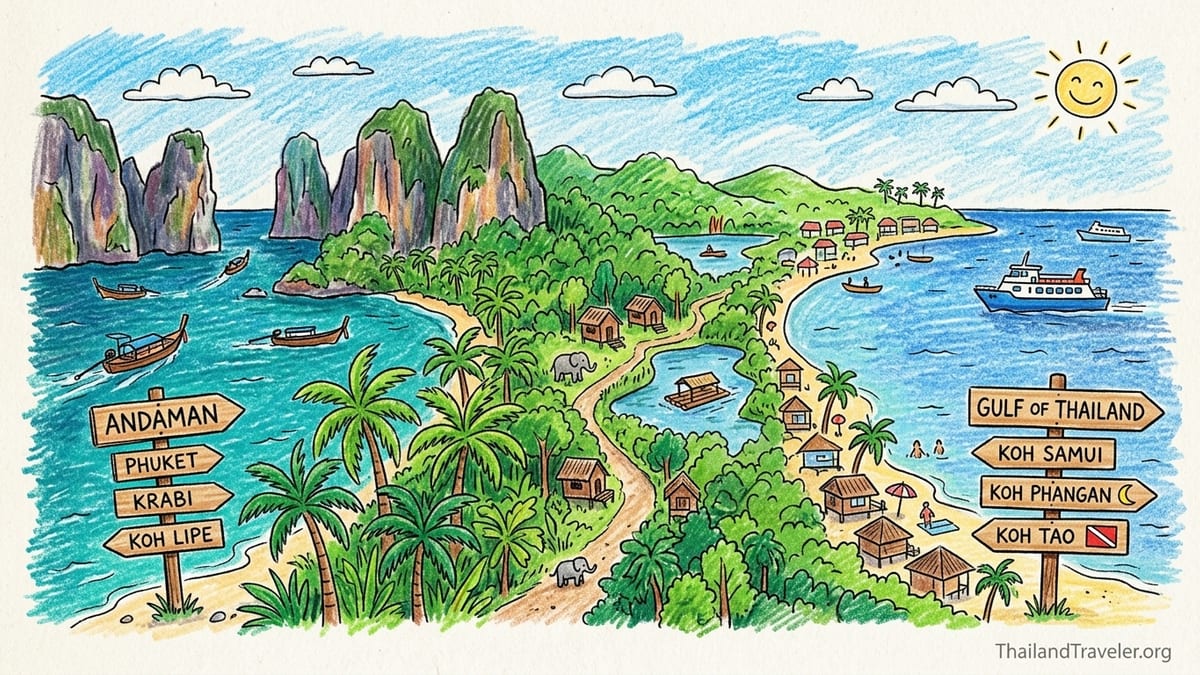
Two Coasts, Two Different Trips: What I Felt Between Andaman and the Gulf
My first clue came from the sea itself. The Andaman side felt bigger and moodier to me, with long boat rides that could turn bouncy fast, and a coastline that looks carved by giants: Phuket’s headlands, Krabi’s limestone walls, and the way Khao Lak sits quietly beside the marine parks that shut down for months each year. The Gulf felt more like an island network, with faster ferry hops and a different kind of beach culture, from Koh Samui’s resort sprawl to Koh Phangan’s party tide to Koh Tao’s dive-town energy.
What surprised me most was how much the “right” coast depended on my dates. On the Andaman side, I planned around national-park closures and the southwest monsoon. On the Gulf side, I planned around ferry timing and where I wanted to sleep: a quiet cove on Koh Tao, a beach road on Phangan, or a walkable base on Samui. When people ask me where to go, I don’t answer with an island name anymore. I ask when they’re traveling, and whether they want dramatic scenery or easy island-hopping.
I also felt the difference in crowds. Phuket and Ao Nang (Krabi) hit me like classic first-timer magnets: convenient, full of tours, and easy to overbook with day trips. Koh Lanta felt like a decompression chamber after that. On the Gulf side, I found the crowds to be more “event-driven,” especially around Koh Phangan’s Full Moon Party dates, while Koh Tao’s vibe clustered around dive schools and beachfront bars.
Andaman Coast, My Way: Phuket, Krabi, Khao Lak, Koh Lanta, Koh Lipe
I started in Phuket because it is simple for first-timers: big airport, endless hotels, and every kind of transport option. I based myself where I could move without constant taxi negotiations, so I used the Phuket Smart Bus along the west coast. The flat fare is 100 baht on the airport-to-Rawai line, and I liked that I could just tap a contactless card instead of hunting for cash. It was not fast, but it was predictable, and it made Patong, Karon, Kata, and Phuket Town feel connected enough for a first few days of orientation.
From Phuket, I went to Krabi to get that postcard limestone scenery. I stayed around Ao Nang because it is the most plug-and-play base for first-time visitors, even if it is busy. What I remember most is how transfers “look short” on a map but feel long in real time. On travel days, I learned to treat the middle of the day as lost time: checking out, waiting for a van, sitting in traffic, then arriving sweaty and hungry.
Khao Lak was my deliberate quiet detour. It felt lower-rise and calmer than Phuket, and it made sense as a base for the marine parks in the dry season. The key reality is that the Similan and Surin Islands marine national parks do not operate year-round. The annual closure is mid-May to mid-October, and recent announcements have set it as May 15 to October 15 for the 2026 closure window. If your trip falls inside that span, no amount of optimism will turn the Similans into a day trip.
Koh Lanta is where I finally slowed down. I got there via a combined van and short car-ferry hop, and it felt like a reset from Phuket and Ao Nang. Roads were straightforward, the island felt more spread out, and nights were quieter. I loved it for several nights, not because it had the single “best beach,” but because it let me settle into routines: morning coffee, late swim, sunset dinner, repeat.
Koh Lipe was my “end-of-the-line” island on the Andaman side, and I treated it as a reward for the long transfer. The journey was the point: I took a speedboat-style ferry run, and even in decent weather it felt like a full travel day. On Lipe itself, I learned my classic mistake: arriving without a clear plan for where to sleep relative to the walking streets. The island is small, but the heat makes a ten-minute lug with a backpack feel like an hour, so I now choose a hotel area before I arrive, not after I’m already tired.
Into the Green Middle: Khao Sok as the Reset Button Between Coasts
South Thailand is not only beaches, and Khao Sok National Park is exactly where I felt that most. I traveled in by road, and the moment the scenery shifted to dense greenery and steep karst silhouettes, the coastal noise dropped out of my head. It is a smart mid-trip move because it breaks up boat days and lets you sleep somewhere that sounds like cicadas and rain instead of music and longtails.
Khao Sok also reminded me that time-sensitive details matter, even when you are “just going to the jungle.” As of mid-2026, the entrance fee at the Khao Sok National Park headquarters area has been listed at 200 baht for adults and 100 baht for children. I paid at the gate, kept the receipt like it was a boarding pass, and planned my days so I wasn’t paying repeatedly just because I wandered in and out.
I split my time between the village area and a lake experience on Cheow Lan, and I would do it that way again. The village made it easy to join tours, buy snacks, and recover from travel. The lake portion felt like the cinematic version of Thailand’s interior, but it was also where I noticed how regulated the experience is: scheduled boats, set meal times, and activity windows that do not always match your ideal pace. The mistake I made was assuming I could be “spontaneous” once I arrived. In Khao Sok, I now plan at least one day ahead.
If I had to choose where to spend extra nights, Khao Sok wins over many extra beach nights, especially for first-timers who are doing a two-week loop. It made the coasts feel more different, because I had a true contrast point in the middle instead of hopping beach to beach until they blurred together.
Crossing Coasts: How the Transfers Actually Felt (And What I’d Do Differently)
The hardest part of South Thailand is not choosing a beach. It is stitching regions together without burning your best days inside vehicles. I learned to be ruthless about geography: the Andaman coast chain works best when you move in one direction, and the Gulf chain works best when you commit to the ferry network rather than trying to “sample everything.” Every time I tried to force an extra island in the middle, I lost a day to waiting around piers and check-in counters.
On the Andaman side, I relied on a mix of minivans and ferries. These transfers are common and bookable, but they are not clockwork. A route can be sold as a single ticket and still involve multiple handoffs: hotel pickup, a van to a pier, a boat leg, then another van. The trip rarely feels like the neat timetable you imagined while sipping coffee the night before.
To get from the Andaman side toward the Gulf islands, I routed through Surat Thani because it is a practical mainland hub for reaching Koh Samui, Koh Phangan, and Koh Tao by ferry. This is where I became picky about buffers. I stopped trying to connect a long van ride with a tight same-day ferry window. When I tried that once, I arrived stressed, hungry, and paying last-minute taxi prices because I missed a pier transfer connection by minutes.
My rule now is simple: if I have a must-do event on an island, like a dive course start date on Koh Tao or a festival weekend on Phangan, I arrive the day before. The cost of one extra night is usually less than the cost of missed ferries, rushed meals, and travel-day arguments with your own itinerary.
Gulf of Thailand, My Way: Koh Samui, Koh Phangan, Koh Tao
Koh Samui was my re-entry into “easy Thailand.” It has a major airport, lots of hotel zones, and the kind of infrastructure that makes first-time visitors relax. I stayed in a busier area first, then moved to a quieter stretch once I realized how much traffic and nightlife sound shape your sleep. Samui felt best as a short comfort stop for me: long enough to recover, do a couple of meals I was craving, and set up the next island hops.
From Samui, I hopped to Koh Phangan by ferry and immediately felt the island’s split personality. On one trip, I arrived near a party weekend and watched the pier area go chaotic with backpacks and taxis. On another, I arrived on a calmer week and found the island surprisingly peaceful once I got away from the main arrival points. The short sea crossing was easy, but the island logistics took time: finding a hotel on the right coast, dealing with limited late-night transport, and realizing that “just across the island” can mean dark roads and slower drives than you expect.
Koh Tao was the place I gave extra nights, and it paid me back. It felt compact and purpose-driven, with dive shops, classroom sessions, and a social scene that revolves around who is diving tomorrow. I used Lomprayah high-speed ferries in the Gulf, and their 2026 timetable is published by the operator, which helped me plan around real departure times rather than guesswork. Even with a schedule, I still treated ferry days as flexible, because weather and loading times can stretch what looks like a clean hop into a half-day project.
If you are a first-timer choosing between these three Gulf islands, my personal takeaway is this: Samui is easiest, Phangan is the most date-dependent, and Tao is the most rewarding if you commit at least a few nights. I met too many travelers who treated Koh Tao as a one-night stop and left just as they were settling in.
Seasonality and Closures: Choosing the Coast for Your Dates, Not Your Bucket List
Nothing affects a first-time South Thailand plan more than seasonality, because the sea is the infrastructure. On the Andaman side, the monsoon period is when marine parks and boat routes can shut down or become rough enough that you do not want to be on a speedboat if you can avoid it. The clearest example is Mu Ko Similan and Mu Ko Surin, which have a well-publicized annual closure. Recent reporting and park announcements have set the closure from May 15 to October 15, reopening mid-October for the new season. If your trip is in that window, build your Andaman plan around mainland experiences, calmer bays, and flexibility instead of trying to force a Similan day trip.
On the Gulf side, ferries operate year-round, but conditions can still cancel crossings, and busy periods can sell out seats. I learned to treat the Gulf as “more connected, not more guaranteed.” I also learned that party calendars change the entire texture of Koh Phangan. If you are not there for that specific scene, you might prefer to stay on a quieter beach or choose Koh Tao instead.
National parks and marine areas also come with fees and rules that can change, and they are enforced more consistently than many travelers assume. In Khao Sok, I paid the published entrance fee and planned around it. In marine parks, I treated tickets and receipts as essential, not optional, because operators and rangers do check.
If you are traveling in the shoulder months and you only have time for one coast, I would rather see you pick the coast that matches your weather window than chase the most famous island name. Your best beach day is the one you can actually take a boat to, on a day the sea agrees with you.
The Takeaway
I stopped thinking of South Thailand as a single destination and started treating it like two different coastal trips connected by a jungle interior. The Andaman Coast gave me the big scenery: Phuket’s convenience, Krabi’s limestone drama, Khao Lak’s quieter base, Koh Lanta’s slow evenings, and Koh Lipe’s far-flung island feel. The Gulf gave me the island network: Samui’s comfort, Phangan’s mood swings depending on the calendar, and Tao’s dive-town focus that rewards extra nights.
If you are a first-time visitor, my biggest practical advice is to choose your coast based on your travel dates first, then pick islands. Build in buffers for ferry days, do not overstuff your itinerary, and give at least one place enough nights to feel like you live there rather than just pass through.
My final mistake-turned-lesson is this: I used to plan Thailand by highlights. Now I plan it by flow. When the flow works, South Thailand feels effortless. When it does not, you spend your best days sweating on piers, watching boats you cannot board, and wondering why paradise feels like a commute.
FAQ
Q1. Andaman Coast or Gulf of Thailand: which is better for first-timers?
I found the Gulf easier for fast island-hopping and ferries, while the Andaman felt more dramatic but more affected by monsoon-season sea conditions and marine park closures.
Q2. When are the Similan Islands closed?
The Similan Islands national park has an annual closure in the monsoon period, with recent announcements listing May 15 to October 15, reopening mid-October for the new season.
Q3. How much is Khao Sok National Park entry?
As of mid-2026 listings, the headquarters area entrance fee has been 200 baht for adults and 100 baht for children, but I still recommend confirming locally because fees can change.
Q4. How did I get around Phuket without taxis?
I used the Phuket Smart Bus on the west-coast route, which has a flat 100 baht fare and accepts contactless card payment as well as cash and QR options.
Q5. Which places did I think deserve several nights?
Koh Lanta and Koh Tao were the easiest places for me to settle in for multiple nights, and Khao Sok was worth extra time as a non-beach reset.
Q6. Which places worked better as short stops for me?
I treated Phuket and Koh Samui as practical short bases to organize onward travel, rather than places I needed to linger unless I had a specific reason.
Q7. Is Koh Phangan only about the Full Moon Party?
No, but the party calendar changes the island’s crowd levels and transport vibe dramatically, so I plan accommodation and arrival dates around it.
Q8. Are ferry schedules reliable in the Gulf islands?
They are structured and published by operators, but I still build in time buffers because weather, loading, and peak-season demand can disrupt plans.
Q9. What is the biggest planning mistake I made in South Thailand?
I tried to “sample everything” and underestimated how long transfers feel in real life, especially when combining vans, piers, and boats in one day.
Q10. If I can only pick one coast, how should I decide?
I would pick the coast that matches your travel dates and sea conditions first, then choose islands, because weather and closures matter more than fame.