


South Thailand’s “must-do” day trips look interchangeable on booking pages: the same turquoise water, the same limestone cliffs, the same lunch photo. On the water, they feel wildly different. Some tours are calm, comfortable, and timed to beat crowds. Others are loud, tightly scheduled, and leave you feeling like you spent more time lining up for photos than snorkeling. I’ve done a handful of these routes in real life and I’ve also researched the best-run alternatives and park rules for the rest, so you can choose what actually matches your travel style, your sea legs, and your tolerance for crowds.
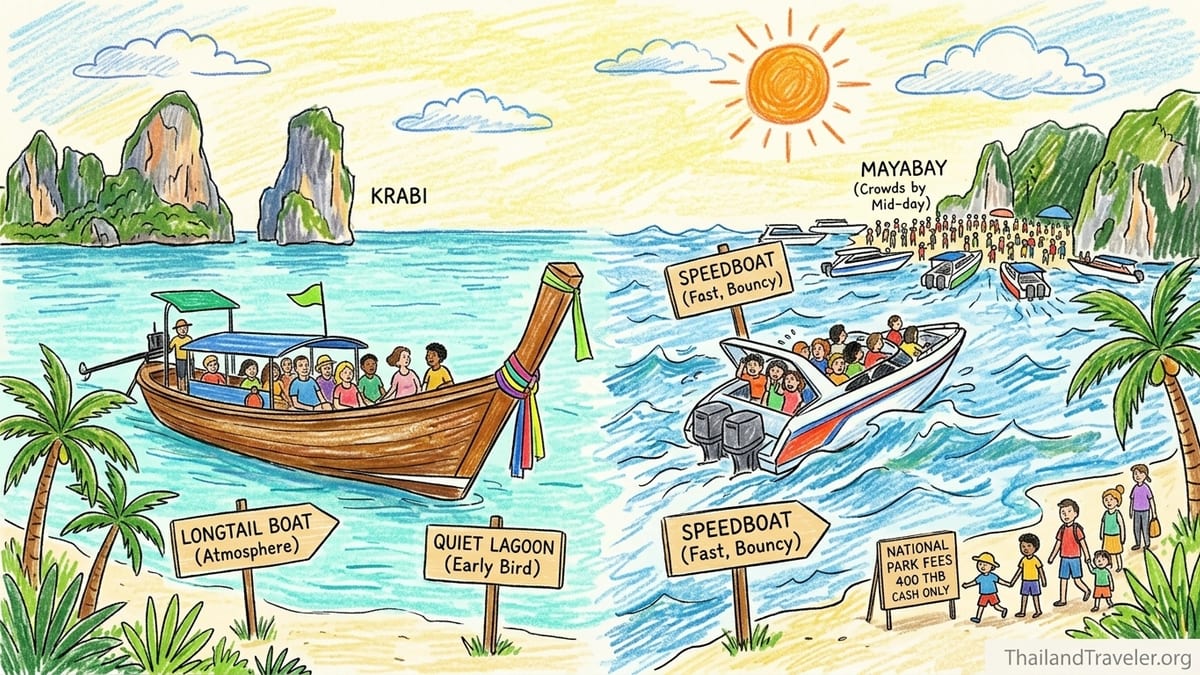
Before You Book: The Two Things That Decide Your Day (Boat Type and Timing)
In South Thailand, “the same itinerary” can mean two completely different experiences depending on the boat and the departure time. A shared speedboat is fast and can hop between stops, but it is also bouncy, loud, and often packed shoulder-to-shoulder. A big boat or catamaran is slower, but it usually has more stable seating, more shade, and a bathroom that does not feel like an emergency. Longtail boats are the most atmospheric option in Krabi, but they are the least predictable for comfort, especially when the sea kicks up.
The other deciding factor is timing. The most in-demand places, Maya Bay, Phi Phi Leh lagoons, and the classic Krabi sandbar, can be serene in early light and chaotic by mid-day. Many operators now sell “early bird” versions specifically to hit Maya Bay first, while most standard tours arrive after the peak crowds have already built up.
Budgeting also changes once you account for national-park fees and island fees that are often excluded from the advertised price and collected in cash. For the Phi Phi park area, the widely published foreign adult entry fee is 400 THB and children 200 THB. Maya Bay landings also follow the same park authority fee structure, but whether you pay it separately or it is bundled depends on the operator and where you depart from. In Krabi’s Four Islands circuit, many tours still collect a separate 400 THB park fee in cash at the pier. Bring small bills, assume cash-only, and ask one question before you pay: “Is the national-park fee included, or collected on the day?”
First-Hand: Phi Phi and Maya Bay Day Trip (What It Really Felt Like)
I did a shared speedboat day trip to Phi Phi and Maya Bay from Phuket on a clear-season day, the kind of weather that looks like a filter. Hotel pickup was early, around 6:30 a.m., followed by a pier check-in with a quick breakfast snack and a wristband system. The boat was a standard twin-engine speedboat with bench seating and a hard canopy. The passenger load felt close to full, roughly 30 to 40 people, and seat comfort was “fine for two hours, not fine for four.” If you are prone to back pain, the pounding can add up, and if you are prone to seasickness, this is the route where you want motion-sickness tablets before you leave your hotel, not after the first wave hits.
The biggest difference-maker was the guide quality. Our lead guide was organized and direct about the rules, especially at Maya Bay: no swimming in the bay and no stepping into the water from the beach area. That part matters because Maya Bay is now managed like a conservation site, not a free-for-all beach day. The guide also did a good job setting expectations about crowds: you are not getting “empty Maya Bay,” you are getting “Maya Bay with a controlled flow.” Food was a basic Thai buffet lunch later in the day, fine but not memorable, with bottled water on board and soft drinks for sale.
On pacing, the day felt slightly rushed once the main sites started stacking up. We spent around 35 to 45 minutes on the Maya Bay beach area including the walk in and the queueing for photos. At Pileh Lagoon, the boat idled while people rotated through photo spots, and the actual “in the water” time was short. Snorkeling stops were the most variable: the first snorkel was around 25 to 30 minutes, visibility was decent but not “aquarium clear,” and the second snorkel felt more like a quick dip than a real session. Crowds were the constant background noise, and the trip only felt calm in the moments between places.
Unexpected costs were limited to the national-park fee and small pier extras. The bigger “surprise” was how often you are on and off the boat and how little time you have to just float. If your dream is a long snorkel with minimal interruption, a Phi Phi day trip is not the top pick. If your dream is checking off iconic scenery efficiently, it delivers.
Verified Rules: Maya Bay Closures and Why Your “Must-Do” Might Be Closed
Maya Bay does not operate like a normal beach anymore, and the dates matter. The most important planning detail is the annual seasonal closure: Maya Bay is typically closed to landings from August 1 through September 30 and reopens October 1. That closure pattern has been repeatedly communicated by operators and travel advisories that track the Department of National Parks schedule, and it aligns with the monsoon conservation window. If your trip falls in August or September, you can still do Phi Phi waters, lagoons, and snorkeling, but you should not plan your entire day around setting foot on Maya Bay because you may not be allowed to land.
Even when Maya Bay is open, the rules can make first-time visitors think the tour “cheated” them. Swimming in the bay area is restricted, and visits are managed with controlled entry and timed flow to reduce ecological damage. The best mindset is to treat Maya Bay like a viewpoint and conservation walk rather than a beach-swim stop.
To avoid disappointment, book based on what your operator guarantees when Maya Bay is closed. A good operator will clearly state what replaces it, usually extra time at Phi Phi Don, Bamboo Island, or additional snorkel stops. A vague operator will keep “Maya Bay” in the title even when the landing is not possible, and you will only find out on the boat.
Phang Nga Bay vs Krabi Four Islands vs Railay: Picking the Right “Limestone Day”
If you want dramatic limestone scenery without the “Phi Phi intensity,” Phang Nga Bay is the better day. It is more about kayaking, mangroves, and sheltered water than open-sea pounding. The classic route includes James Bond Island, but the best moments usually happen in a canoe with a local paddler slipping into sea caves and lagoons. Because the bay is sheltered, it is generally kinder for seasickness than an Andaman open-water sprint.
Krabi’s Four Islands tour is the opposite: short distances, frequent stops, and a heavy emphasis on beach time and snorkeling. It can be a great first day in Ao Nang because it is logistically easy and does not require a long transfer. It is also one of the trips where national-park fees are frequently collected in cash on the day, often quoted at 400 THB for foreign adults. The sandbar stop is tide-dependent, and on the wrong tide you still get scenery but not the walkable “postcard” strip.
Railay is not a tour you have to buy. It is an attraction you can independently visit by longtail boat from Ao Nang, commonly priced around 100 THB each way with a ride time of roughly 10 to 15 minutes. Railay works best as a half-day or sunset mission with zero snorkeling pressure: arrive, walk between Railay West and Phra Nang, and spend your time where it feels good rather than where the itinerary tells you to stand.
Alternatives I Researched (Not First-Hand): Similan, Ang Thong, Koh Tao Snorkeling, and Khao Sok
The Similan Islands are the Andaman’s “best water” reputation for a reason, but they are also the most seasonal. The park typically closes mid-May through mid-October due to monsoon conditions and conservation management. Recent public announcements and park guidance have repeatedly reflected closures in that window, and some seasons describe the closure running until October 14 with reopening around October 15. The other major operational change is that e-ticketing has been introduced for Similan in the national parks system, so you should expect more structured entry control and less flexibility for last-minute arrivals. If you are traveling in the rainy season, do not assume “we’ll just go if it’s sunny that day.” Many boats do not run because the park is closed, not because the weather is bad at your hotel.
Ang Thong Marine Park is the Gulf-side counterpart to the Andaman icons: limestone islands, lagoons, viewpoints, and beach landings, usually as a day trip from Koh Samui. The verified foreign adult entry fee is commonly listed at 300 THB, with 150 THB for children, and many operators collect it separately in cash. The big decision is whether you want a large, stable day boat with a slower pace or a speedboat version that maximizes stops. If your priority is the viewpoint hike and Emerald Lake (Talay Nai), choose a tour that explicitly budgets time for the climb rather than squeezing it between kayak sessions.
Koh Tao snorkeling day trips, especially those that include Koh Nang Yuan, are often advertised at an appealing base price, and then an island fee is collected on arrival. Current listings and major tour marketplaces frequently cite a separate fee around 250 THB for adults and 150 THB for children for Koh Nang Yuan. Practically, that means you should not show up with only a card and expect everything to be “included.” If you are a strong swimmer who wants longer snorkel sessions, Koh Tao tends to feel less like a photo conveyor belt than Phi Phi, but it is also weather-dependent in a different way: wind chop can build quickly, and some bays can be crowded with boats all chasing the same “best coral” stop.
Khao Sok and Cheow Lan Lake are the non-beach counterpoint that many travelers underestimate. Khao Sok National Park’s headquarters-zone entry fee is widely published at 200 THB for foreign adults, while the Cheow Lan Lake zone has also been treated as a special-fee area with a separate higher entrance fee around 300 THB for foreign adults, plus small pier fees. Because Cheow Lan access is by longtail boat from the dam pier, tour inclusions vary a lot: some packages include the longtail and lunch, others add a “pier fee” and separate boat charge. When comparing tours, ask for the total cash outlay at the pier, not just the upfront booking price.
How to Choose the Best Tour for You (Comfort, Crowds, and Value)
If you want the iconic images and you have limited time, Phi Phi and Maya Bay is still the headline day trip, but go in with the right goals. Choose an early departure, prioritize an operator that clearly states the Maya Bay rules and closure dates, and assume short stop times. If you are sensitive to motion, choose a larger boat option when possible or pick a more sheltered day like Phang Nga Bay.
If you care more about enjoying the water than checking boxes, the “best value” days are usually the ones you can customize: Railay independently, or a smaller Four Islands longtail with fewer people, or a Koh Tao snorkel day where you can stay in the water longer at fewer stops. In plain terms: fewer stops can feel like more vacation.
Finally, match your tour to the season. In the Andaman, monsoon months can mean rough rides, cancellations, or park closures, especially for the Similan Islands. In those months, Gulf-side alternatives like Koh Tao or Ang Thong can be the smarter use of a day, even if they were not your original plan.
The Takeaway
The best South Thailand day trip is not a single place, it is the right pairing of destination, season, and boat. Phi Phi and Maya Bay is the iconic checkmark, but it can feel fast and crowded. Phang Nga Bay is the calmer limestone experience. Krabi’s Four Islands and Railay are the easiest wins for a flexible Ao Nang stay. Similan is the high-reward water day when it is open, Ang Thong is the Gulf’s island-hopping classic, Koh Tao is the snorkeling-focused choice, and Khao Sok is the reset button when you need rainforest and lake silence after too many speedboats.
Plan around park fees and closures upfront, carry cash for the day-of collections, and choose an itinerary that matches how you actually want to spend your hours: sitting, bouncing, queuing, hiking, floating, or snorkeling. When the tour fits your body and your expectations, South Thailand stops feeling like a checklist and starts feeling like the trip you came for.
FAQ
Q1. Is Maya Bay open year-round?
No. Maya Bay typically closes to landings from August 1 through September 30 each year and reopens around October 1, depending on park management.
Q2. Can you swim at Maya Bay?
Even when Maya Bay is open, swimming in the bay area is restricted under conservation rules. Most visits are managed as a beach and viewpoint walk rather than a swim stop.
Q3. How much is the Phi Phi national-park fee?
The commonly published foreign adult fee for the Phi Phi park area is 400 THB, with a reduced child price. Some tours include it and others collect it in cash on the day.
Q4. Do Krabi Four Islands tours include the national-park fee?
Often no. Many Four Islands trips collect a separate national-park fee in cash at the pier, frequently quoted at 400 THB for foreign adults, so confirm before paying.
Q5. What’s the easiest way to visit Railay without a tour?
Take a longtail boat from Ao Nang. The ride is commonly about 10 to 15 minutes, and fares are often around 100 THB per person each way.
Q6. When are the Similan Islands closed?
The Similan Islands typically close mid-May through mid-October for monsoon season and conservation. Exact reopening dates can vary slightly by year, so verify before you book.
Q7. What is the Ang Thong Marine Park entry fee?
Foreign adult entry is commonly listed at 300 THB (with a reduced child fee). Many Koh Samui tours collect it separately in cash.
Q8. Is there an extra fee for Koh Nang Yuan on Koh Tao snorkeling trips?
Yes, many trips charge an additional island fee on arrival. Current listings commonly cite about 250 THB for adults and 150 THB for children, paid separately from the tour price.
Q9. Do you pay separate fees for Khao Sok headquarters and Cheow Lan Lake?
Often yes. The headquarters zone and the Cheow Lan Lake zone can have separate entrance fees, and some visitors also pay small pier fees when boarding boats at the lake.
Q10. Which tour is best if I get seasick?
Choose sheltered-water routes like Phang Nga Bay, or pick larger boats when available. Open-sea speedboat runs to Phi Phi can be rough, especially in choppier seasons.