


I’ve bounced between South Thailand’s Andaman Coast and the Gulf more times than I can count, and the biggest lesson I’ve learned is that “best” depends on how you like to travel. Some places reward a fast, high-energy itinerary. Others punish it. On my first night back in Phuket, the humidity hit me like a warm towel the moment I stepped outside the terminal, and I remembered exactly why this region is so addictive: within a single week you can go from neon nightlife to limestone cliffs, from rainforest lakes to coral reefs, and still end your day with a plastic stool dinner that tastes like a secret.
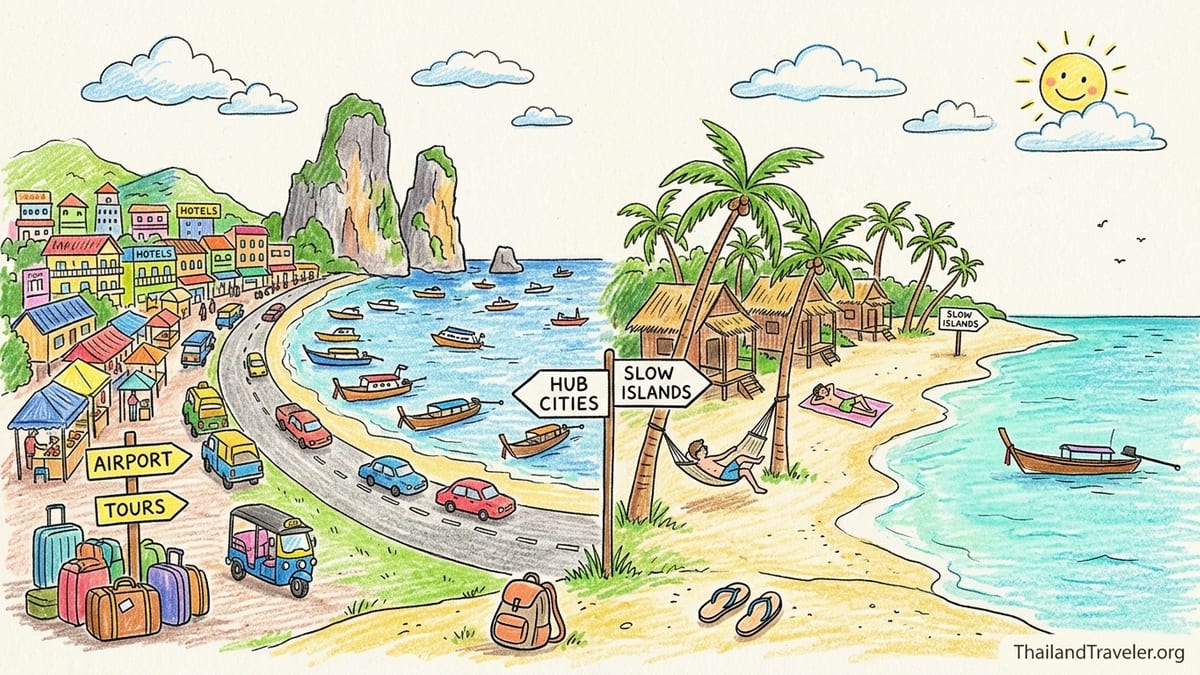
Start With Your Trip Pace: Hub Cities vs Slow Islands
Arriving in Phuket feels like arriving in a full-service travel machine. You land, you’re moving within minutes, and the island immediately offers choices: big hotels, small guesthouses, beach clubs, night markets, day tours leaving at dawn, and taxis that remind you very quickly that convenience has a price. When I want variety and backup plans, Phuket is where I start. When I want quiet, Phuket is where I leave.
Krabi town and Ao Nang felt like the opposite kind of gateway. The pace is easier, and even the beachfront strip in Ao Nang reads more “holiday base” than “all-night city.” The surprise for me was how much the scenery does the heavy lifting here. You can be sitting with an iced coffee and still feel like you’re in a movie because the limestone cliffs are everywhere, even when the town itself is ordinary.
Then there are the islands that force you to slow down, whether you intend to or not. Koh Lanta, Koh Lipe, Koh Tao and parts of Koh Phangan are the kind of places where your schedule becomes “breakfast, water, sunset, repeat,” and that’s not a failure of imagination. It’s the point. If you’re traveling as a family or you simply burn out on constant logistics, these are the destinations that quietly fix you.
My rule now is simple: pick one “hub” (Phuket, Krabi/Ao Nang, or Samui) and one “slow” island, then add one inland stretch like Khao Sok if you want rainforest. Anything more and you spend too much time holding ferry tickets and not enough time in the water.
Phuket and Khao Lak: Big Energy, Easy Logistics, Different Beaches
Phuket is the easiest place in this article to reach and to build plans around, especially if you’re flying in from abroad or connecting from Bangkok. What arriving actually felt like for me was sensory overload in the best and worst ways: frangipani, exhaust, wet heat, and the thump of bass drifting out of a taxi’s open window. I’ve stayed in a small hotel near Kata on one trip and in Patong on another. Kata gave me a calmer morning routine and better “walk to dinner” nights, while Patong did what it does: it gave me convenience, noise, and the ability to find something open at any hour.
Most of my time in Phuket goes into day trips and food, not into “finding the perfect beach.” I love using Phuket as a launchpad: a beach morning, a late lunch somewhere casual, then a night market dinner where you can grab grilled seafood and fruit shakes without committing to a formal plan. The disappointment, consistently, is how quickly the island can feel like you’re being sold an experience at every turn. If you’re sensitive to that, pick a quieter beach area or use Phuket as a one- or two-night landing pad before heading onward.
Khao Lak, north of Phuket, surprised me because it feels built for travelers who want the Andaman Sea without Phuket’s constant volume. The first time I arrived, it felt like the air got quieter. The beaches are long and less hectic, and the whole town is more “resort strip” than “party district.” I stayed in a mid-range resort area where evenings were genuinely restful, and most days revolved around the sea: swimming, lazy meals, and planning one big outing.
The practical detail that matters most right now is that Khao Lak’s signature day trips depend on the marine park season. The Similan Islands marine parks are closed every year from May 15 to October 15, reopening on October 15, 2026 for the 2026 to 2027 season. If you arrive during closure, no legitimate operator can take you there, and Khao Lak can feel too quiet if that was your main reason for coming. In season, many trips run from Thap Lamu Pier near Khao Lak, which usually means less road time than joining a tour that starts with a long pickup loop from Phuket.
Krabi, Ao Nang, and Railay: Limestone Drama, Beach Days, and Boat Logistics
Krabi is where South Thailand starts looking like the postcards. My first arrival into the Ao Nang area felt like a reset: the road winds past karst formations, and you get that “I should stop and stare” feeling even before you check in. I’ve stayed in Ao Nang when I wanted easy restaurants and tour pickups, and I’ve done Railay when I wanted that special, slightly separated-from-the-world feeling.
Railay still gives me one of my favorite arrivals in Thailand. You don’t just “get there.” You take a boat, you feel the spray, and you watch the limestone walls grow until they’re towering above you. It immediately changes your mood. I stayed at a beachfront resort on Railay West on one trip because I wanted to wake up with sand at my doorstep. What I liked was the sheer simplicity: beach, a short walk to another beach, then dinner. What I disliked was that anything involving the mainland requires planning around boats and weather.
Railay is accessible only by sea, and the boat ride from the mainland is short. From Ao Nang Beach or Ao Nam Mao Pier, long-tail boats commonly take about 15 to 20 minutes. Some resorts also run their own scheduled shared shuttle boats on limited timetables, which is helpful if you’re arriving with luggage and want a more structured plan than negotiating at the pier. The surprise for me was how different Railay feels depending on the time of day: calm and almost dreamy at sunrise, then suddenly busy when day-trippers arrive.
How many nights did I want? In Ao Nang, I’m happy with two to four nights because it’s a base, not a mood. In Railay, I want at least two nights. One night feels like you’re constantly thinking about the next boat. Three nights is the sweet spot if you want to slow down, climb, kayak, and still have time to do nothing.
Khao Sok National Park: The Rainforest Detour That Earns Its Place
If you’ve been beach-to-beach for a week, arriving in Khao Sok feels like walking into a different country. The air is cooler under the trees, the green is louder, and the sounds change from waves to insects and birds. The first time I arrived, I remember stepping off a van and feeling like my lungs relaxed. I stayed in a simple bungalow-style place near the park area because I wanted early mornings and a short ride to excursions, not a fancy room I’d barely be in.
Most of my time in Khao Sok goes into two experiences: jungle time and lake time. Even if you’re not an experienced hiker, the rainforest atmosphere is the point. The surprise for me was how quickly weather can change and how that affects what you can do. Khao Sok is often open daily in areas not affected by seasonal recovery closures, but certain trails or zones can have specific closure periods during the wet season. That means you should treat any “must do” hike as conditional and confirm locally when you arrive.
Getting to Khao Sok is straightforward if you’re already in the south, but it’s not effortless. It’s a transfer destination: you’re combining flights, vans, and timing. What disappointed me was the number of travelers who arrive exhausted and then try to cram everything into a single day. The park rewards patience. If you only have one night, you’ll still get the atmosphere, but you may feel rushed.
Personally, I want two nights minimum in Khao Sok. On my best trip, I gave it three nights: one for settling in, one for a full day on the water and forest, and one for a slow morning before moving on. If your group includes kids or anyone who is beach-fatigued, Khao Sok can be the part of the itinerary everyone remembers most clearly.
Koh Lanta and Koh Lipe: Two Andaman Islands, Two Completely Different Moods
Koh Lanta is where I go when I want Thailand to exhale. Arriving felt noticeably calmer than Phuket and even Krabi: fewer aggressive sales pitches, longer stretches of road without constant noise, and a beach culture that’s more about sunsets than selfies. I stayed near one of the west-coast beaches where you can walk to casual restaurants, and my days fell into a rhythm of morning swims, late breakfasts, scooter rides for coffee, and unhurried dinners.
What surprised me about Lanta is how well it works for families and for travelers who want a “base” without heavy nightlife. It’s also a strong choice if you like having options: you can do island-hopping, you can find quieter coves, and you can still get decent food without needing reservations. The disappointment, if you’re chasing the most dramatic water color, is that Lanta’s best moments are often about light and mood, not about that neon-blue tropical lagoon look.
Koh Lipe, on the other hand, hits you immediately with “you came for the water.” Arriving by boat, I felt that rush of excitement you get when the sea turns clear enough to see the bottom. Lipe is smaller and more intense in a compact way: beaches, walking streets, dive shops, and sunset viewpoints all tightly packed. I stayed in a simple beachfront-adjacent place so I could wake up, walk barefoot to breakfast, and be in the water quickly. My days were snorkeling, short boat trips, and letting the island’s scale shrink my mental calendar down to hours instead of plans.
The most important practical note for Lipe is seasonality and access. In high season, ferry and speedboat routes expand and direct connections can include links from nearby islands and the mainland, and some operators publish seasonal schedules that run from around November into April. Outside high season, routes can thin out and seas can be rougher. If Lipe is your “main character” destination, I’d give it more nights than you think because the travel day in and out can be long. I always want at least three nights on Lipe, and four is better if you’re there for diving or you simply want a slower pace.
Koh Samui, Koh Phangan, and Koh Tao: Gulf Islands for Comfort, Parties, and Dive Days
Koh Samui feels like the Gulf’s convenience capital. Arriving by plane is almost comically easy compared to multi-leg ferry journeys, and Samui’s airport is famously distinctive and privately operated, which helps explain why flights can be pricier than flying into Surat Thani. The first time I landed, it felt like the trip had already been “handled” for me: taxis, resorts, and polished tourism infrastructure are everywhere. I’ve stayed around Chaweng for walkable dining and around quieter stretches when I wanted sleep. Samui is excellent if your group wants comfort, spa days, reliable restaurants, and the ability to pivot plans without stress.
Koh Phangan is the island people reduce to one night, but it’s better when you don’t. My arrival to Phangan felt like a choice point: you can lean into party energy, or you can immediately escape it. I’ve stayed away from Haad Rin when I wanted calm beaches and morning swims, and I’ve done the party side when the calendar lined up. If Full Moon Party is part of your plan, check current dates carefully because they can shift around holidays. For example, one widely published upcoming date is Saturday, September 26, 2026 at Haad Rin, with additional dates later in October, November, and December 2026 listed by multiple party schedule sites. Even if you’re not going to the party, those nights affect room availability, transport timing, and the general feel of the island.
Koh Tao is where I go when diving is the main goal and I want my days to be simple: wake up, coffee, boat, two dives, lunch, nap, sunset. Arriving can feel like joining a small community because so many people are there for the same reason. I stayed near Sairee Beach on one trip so I could walk to dive shops and casual dinners, and I spent most of my time underwater or recovering from being underwater. The surprise was how quickly your schedule fills up once you commit to diving: your “free” days disappear into course timing, gear fitting, and early starts.
Logistics matter more in the Gulf than people expect. If you’re connecting from Samui Airport to ferries, late arrivals can limit your same-day onward options, which can force an unplanned night on Samui. From the mainland, Surat Thani is a common gateway for combined bus-and-ferry tickets to Samui, Phangan, and Tao, and newer combined transfer services have been promoted by some operators in recent years. My personal preference: if your trip is short and diving is the anchor, I’ll pay more to fly closer and protect my time. If the trip is long and budget matters, I’ll accept the transfer day and treat it as part of the journey.
Hat Yai and Songkhla: A Food-First Detour Most Beach Itineraries Skip
Hat Yai rarely makes the “best of” beach lists, and that’s exactly why I like it. Arriving in Hat Yai felt like stepping into a working southern Thai city where tourism is present but not the only purpose. If you’ve been on islands for days, Hat Yai can be refreshing: real traffic, real commuters, and a food culture that doesn’t need a sunset view to be good. I stayed in a straightforward city hotel where the point was air-conditioning, showers, and being close to markets, not ambiance.
Most of my time in Hat Yai went into eating and wandering: grilled chicken, sweet drinks, busy sidewalks, and the kind of night-market browsing that turns into an accidental full meal. The surprise for me was how easy it was to add a coastal day without changing hotels. Songkhla Old Town is close enough to treat as a half-day or full-day trip, and multiple local guides describe it as roughly 30 km from Hat Yai, often around a 30 to 40 minute ride depending on traffic and where you start.
Songkhla felt like a completely different mood: heritage streets, lake breezes, and a slower coastal feel than the islands. If your trip is focused on beaches and diving, you might skip this region. But if your group includes food lovers, culture travelers, or anyone who gets restless after too many identical beach days, Hat Yai and Songkhla can be a smart palate cleanser.
Would I stay longer? In Hat Yai alone, one night can be enough. If you pair it with Songkhla and you actually want to linger in the old town, I’d plan two nights total so you’re not doing a rushed day trip before a flight.
The Takeaway
If I had to design the most satisfying South Thailand trip for different travelers, I wouldn’t rank destinations. I’d match them to the experience you actually want.
If beaches and nightlife are the priority and you want maximum convenience, I’d start with Phuket, then escape to a calmer island like Koh Lanta once you’ve had your fill of activity. If scenery and day trips are the priority, Krabi with a Railay stay delivers drama without constant noise. If rainforest is non-negotiable, Khao Sok earns two nights and makes the rest of your beach time feel richer. If diving is the anchor, I’d build around Koh Tao and protect your transfer days. And if you want a southern culture and food chapter that feels lived-in rather than resort-like, Hat Yai and Songkhla are the detour that changes the texture of the whole trip.
The most important practical advice I can give is to plan around seasons, not just wish lists. The Andaman side has marine-park closures that are fixed and predictable, like the Similan Islands closure from May 15 to October 15 each year, reopening on October 15, 2026 for the next season. The Gulf side can keep running through different weather patterns, but ferry timing and late flight arrivals can quietly steal days. Build an itinerary that assumes one disrupted sea day, and you’ll enjoy the good days twice as much.
FAQ
Q1. Which South Thailand destination is best for a first trip if I want easy logistics?
Phuket or Koh Samui are the easiest starts because you can fly in and find transport, hotels, and tours immediately without complex connections.
Q2. Is it better to stay in Ao Nang or Railay in Krabi?
Ao Nang is better for convenience and day trips. Railay is better for the “only accessible by boat” atmosphere and waking up right on a dramatic beach.
Q3. How long is the boat ride to Railay, and can I get there without a car?
Railay is accessible only by sea, and long-tail boats commonly take about 15 to 20 minutes from Ao Nang Beach or Ao Nam Mao Pier. You can arrive by taxi or shuttle to the pier and continue by boat.
Q4. When are the Similan Islands closed, and how does that affect Khao Lak?
The Similan Islands marine parks close every year from May 15 to October 15, reopening on October 15, 2026 for the 2026 to 2027 season. During closure, Khao Lak is much less useful as a base if Similan day trips were your main goal.
Q5. Is Khao Sok worth it if I only have a week total?
Yes, if you want a rainforest chapter. Plan at least two nights so you are not trying to squeeze the lake and jungle into one exhausted day.
Q6. Which island is best for families who want calm beaches?
Koh Lanta is often a strong fit because it’s laid-back, easy to settle into, and not centered on nightlife.
Q7. Which destination is best for snorkeling and clear water right off the beach?
Koh Lipe is often chosen for clear water and easy access to snorkeling, especially in the calmer high-season months when boat routes are more reliable.
Q8. Where should I base myself for scuba diving in South Thailand?
Koh Tao is the most straightforward dive-focused base in this set, with many dive shops and a day-to-day rhythm built around boat dives and courses.
Q9. Do Full Moon Party dates stay the same every month?
Not always. Dates can shift around holidays, so you should confirm the current schedule close to your trip if you plan to visit Koh Phangan specifically for party week.
Q10. Is Hat Yai worth adding if my trip is mostly beaches and islands?
It can be, especially for food and a more local city feel. It also makes it easy to add Songkhla Old Town as a short side trip, giving your itinerary more variety.