


Koh Samet is one of Bangkok’s quickest island escapes, but every route shares the same final step: a short sea crossing from Ban Phe in Rayong Province. The tricky part is choosing which mainland transfer and which boat type makes sense for your schedule, luggage, and tolerance for waiting at the pier. Below is a September 2026, purchase-focused guide that compares the most common options travelers actually book: Ekkamai minibus plus ferry, van plus speedboat, private transfer, and independent travel to Ban Phe Pier.
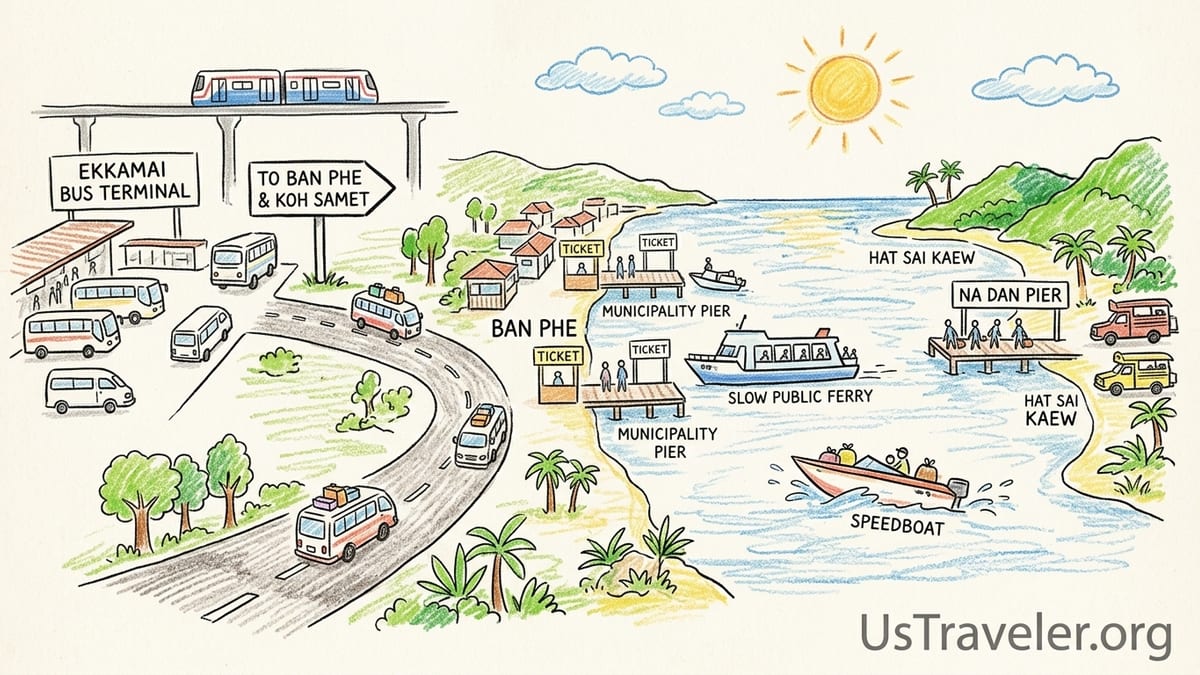
Know the geography first: Ekkamai, Ban Phe, and Koh Samet’s main pier
Most Bangkok travelers start at Ekkamai (Bangkok’s Eastern Bus Terminal), which sits next to Ekkamai BTS on Sukhumvit. From there, road transfers head southeast toward Rayong and the coastal town of Ban Phe, where boats depart for Koh Samet. On the island side, the most common arrival point is Na Dan Pier, which is the main public pier and the one most scheduled ferry style services use.
In Ban Phe, you will see multiple piers and ticket counters clustered along the waterfront. Travelers often say “Ban Phe Pier” generically, but in practice you may be directed to a specific pier such as Nuanthip Pier or the Municipality Pier area depending on the operator and boat. That is normal, but it is exactly why through-tickets can be worth paying for when you are new to the route: someone assigns you to the right counter and the right boat, instead of you guessing at the waterfront.
One more reality check: you cannot drive onto Koh Samet. Even if you arrive by private car, you will still park on the mainland and continue by ferry or speedboat.
Option 1: Ekkamai minibus plus ferry (best value, most forgiving)
If you want the most straightforward “buy once and go” trip without paying private-transfer money, the classic choice is an Ekkamai departure with a combined minibus plus ferry ticket. In September 2026, booking inventories show through-fares starting in the low hundreds of baht. Real examples currently on sale include a Cherdchai Tour bus plus ferry product from Ekkamai to “Koh Samet Pier (including boat fare)” priced at ฿264, which breaks down as ฿194 for the bus portion and ฿70 for the ferry portion. This is the kind of pricing that makes through-tickets a clear transport-purchase decision rather than just “nice to have.”
Journey time is usually shaped more by Bangkok traffic than by the sea. As a working expectation, plan roughly 3.5 to 4 hours for the road leg from Ekkamai to Ban Phe, plus the sea crossing. Slow ferry style crossings are commonly around 30 to 45 minutes in normal conditions. Your “door to Na Dan Pier” total is often around 5 to 6 hours when you include check-in time, any pier transfers, and the buffer between arriving at Ban Phe and your boat departing.
Boat type on this option is usually the standard public ferry. That matters if you get motion sick or if you are traveling with a larger suitcase: ferries are more stable than speedboats and generally handle luggage more comfortably. If you are the kind of traveler with a medium suitcase plus a carry-on, this is typically the easiest public option. If you are carrying a very large hard-shell suitcase, you can still do it, but be prepared to lift it over steps and across narrow gangways at the pier.
Late departures are possible, especially because the boat schedule is the least controllable link in the chain. It is common for a road transfer to arrive early and then wait, or arrive late and then have to catch the next boat. Some booking platforms bundle “connection protection” language, meaning they will rebook you if the transfer is missed due to the first leg being late, but you should still treat that as a safety net rather than a guarantee that you will arrive at your hotel by a specific hour. If you have a hard check-in requirement (for example, meeting a resort speedboat at a fixed time), build extra cushion or choose a private transfer.
Option 2: Van plus speedboat (fastest public option, but watch your luggage)
If your priority is arriving on the island earlier in the day, van plus speedboat is often the fastest public combination. September 2026 inventories show Ekkamai to Koh Samet through-products that explicitly include speedboat service, with sample schedules that run in the morning and midday. On paper, some listings show total durations around 3 to 4 hours for the full journey, which is achievable when traffic is light, transfers are efficient, and the speedboat connection is tight.
The tradeoff is comfort and luggage space. Speedboats are quicker (often around 10 to 20 minutes on the water depending on pier and sea conditions), but they can be bumpy, loud, and wet. If you are traveling during rainier months on the Rayong coast, you should expect more spray and more chop. On the van side, luggage capacity is the common pain point: a “van” in Thailand frequently means a minivan with limited trunk space. With a full passenger load, one big suitcase per person can become a squeeze. If you are traveling as a group with multiple large bags, the van plus speedboat option can become stressful even if the ticket is cheap.
This is the option that tends to disappoint travelers who assumed the speedboat is always “on demand.” Some piers and operators run frequent departures, but you may still wait if you arrive between scheduled boats or if the next boat fills up. If you are choosing van plus speedboat mainly to save time, your best defense is to book an early departure out of Bangkok and avoid starting the day with Bangkok rush-hour gridlock.
One practical example of when van plus speedboat shines: a weekend trip where you want to get to Hat Sai Kaew area by lunchtime, check into your hotel, and still have a full afternoon on the beach. A through-ticket that gets you to Na Dan Pier earlier can genuinely add usable vacation time, provided you keep luggage minimal.
Option 3: Private car transfer to Ban Phe, then choose ferry or speedboat on arrival
A private transfer is the “stop doing logistics” solution: you book a car, get picked up where you are staying in Bangkok, and get dropped at the pier area in Ban Phe. You still have to take a boat, but the road portion becomes simpler and often faster because you are not stopping to collect passengers. Some private-transfer guides and operators market this as roughly 2.5 hours “door to pier” in good conditions, but you should still treat Bangkok traffic as the wildcard. If you depart Friday evening, that 2.5 hours can stretch substantially.
Pricing is the obvious downside. While public through-tickets start in the low hundreds of baht in September 2026, private transfer pricing is typically in the thousands of baht for the car. For many travelers, the best value point is not “private car all the way,” but “public transfer on the way out, private car on the way back” when you are trying to catch a flight or you have a fixed meeting time in Bangkok.
Private transfers become especially sensible in three real-world scenarios. First, you have bulky luggage such as dive gear, a baby stroller, or large hard-shell suitcases for a family. Second, you are staying far from Ekkamai and would otherwise spend extra time and money crossing Bangkok just to start the public route. Third, you are arriving in Bangkok on an international flight and want a single pickup that goes straight to Rayong without you navigating transit with bags.
Once you arrive at Ban Phe by private car, you can decide based on conditions. If the sea looks calm and you want speed, buy speedboat tickets at the pier. If the sea looks rough or you are prone to motion sickness, buy the public ferry ticket. This flexibility is a quiet advantage of the private-car approach: you are not locked into a pre-assigned boat type.
Option 4: Independent travel to Ban Phe Pier (maximum flexibility, maximum DIY)
Independent travel means you purchase the Bangkok to Ban Phe segment separately, then buy your boat ticket at the pier. This can be as simple as taking a bus from Ekkamai to Ban Phe, then walking to the right counter to buy a ferry or speedboat ticket. It is the most flexible approach because you are not tied to a combined schedule and you can change your mind on the pier.
Time-wise, it is not necessarily slower than a through-ticket. The road segment is the same highway trip either way. The difference is what happens when you arrive: with a through-ticket, someone may shepherd you to a counter; independently, you need to choose your pier and operator yourself. In Ban Phe, multiple piers are close to one another, but when you are hot, tired, and carrying luggage, “close” can still feel confusing.
For boat pricing, the range depends on the pier and boat type. Public slowboat fares can be around ฿50 to ฿100 in many published schedules, while speedboats are often priced higher, commonly in the ฿150 to ฿200 range for shared departures on some routes. Because prices and operators can change with season, the smartest independent strategy is to arrive at Ban Phe with a time buffer and enough cash to choose the next sensible departure rather than the cheapest theoretical ticket.
Independent travel is also the best way to handle one of the most common traveler questions: “What if I miss the last combined departure out of Bangkok?” If you go fully independent, you can sometimes still reach Ban Phe by taxi or private car later in the day, then negotiate a private speedboat if conditions and operators allow. You should not count on this as a routine plan, but it can be a backup for late arrivals.
Boats explained: ferry vs speedboat vs fast ferry, and what your luggage feels like on each
On the Ban Phe to Koh Samet crossing, you will generally encounter three categories: the slow ferry (public ferry), the speedboat, and in some published timetables a faster ferry or catamaran style service. The slow ferry is the least expensive and the most stable ride for most people. Speedboats are quicker but are more sensitive to choppy sea conditions and can be a rough ride in wet weather.
Luggage is not just about whether it “fits,” but how it moves. On a ferry, larger bags are usually manageable and you can set them down without worrying as much about spray. On a speedboat, bags may get piled together and can get splashed. If you are carrying electronics or anything that cannot be wet, it is smart to use a waterproof cover or dry bag even if the sky looks clear. A calm morning crossing can still throw up spray.
Another practical detail: most scheduled services deliver you to Na Dan Pier, and from there you continue by songthaew-style pickup taxi to your beach area and hotel. If your accommodation is at a specific beach far from Na Dan, a speedboat can sometimes drop closer to certain beaches depending on operator and demand, but travelers should not assume every shared speedboat will do custom hotel drop-offs unless it is explicitly sold that way by the operator or your resort.
If you are traveling with children or older relatives, the ferry is often the more pleasant choice even if it adds minutes. The speedboat saves time on paper, but the real “experience time” can feel longer when everyone is bracing for bumps and holding onto bags.
Through-ticket or DIY? When paying for the combo is actually worth it
A through-ticket is worth it when you value reduced friction more than micro-optimizing the cheapest possible fare. In September 2026, the bigger story is that the price gap is often not large: combined products are being sold starting around the low hundreds of baht, which is close enough to DIY pricing that many travelers will happily pay for the coordination. A real example in current inventory is the ฿264 Ekkamai-to-Koh Samet product that bundles bus and ferry.
Through-tickets are also worth it when you are arriving at Ekkamai as a first-timer and do not want to navigate Ban Phe’s multiple piers while managing luggage. Many traveler reviews emphasize that a staff-led transfer at the pier can remove the “Where do I go now?” moment. That is especially helpful if you do not speak Thai or if you are traveling on a tight weekend schedule.
DIY is worth it when you want control over boat type and timing. For example, you might take the bus to Ban Phe and then decide on the pier whether the sea looks calm enough for a speedboat, or whether you prefer the ferry. DIY is also the better choice if you have a flexible day and want to stop for food in Ban Phe, buy supplies, or wait for a specific operator or pier that your resort recommends.
One caution: through-tickets reduce complexity, but they do not remove weather risk. In periods of rough seas, boats can be delayed or canceled. A combo ticket does not magically create a safe crossing when conditions are poor. In those moments, your best asset is time: build buffer into your schedule and avoid planning a same-day Bangkok event that depends on arriving at a precise hour.
The Takeaway
If you want the best price-to-convenience ratio, start with an Ekkamai through-ticket that bundles minibus plus ferry. September 2026 pricing that starts in the low hundreds of baht makes this option hard to beat for most travelers, and the ferry ride is generally the easiest with luggage.
If you care most about speed and you are packing light, van plus speedboat can get you onto the island faster, but it is less comfortable in choppy conditions and less forgiving with big suitcases. If you are traveling with bulky bags, kids, or a group, the time you “save” can disappear in the form of cramped van storage and a rougher sea ride.
Private car transfers are the premium choice when you want door-to-pier simplicity, when you are staying far from Ekkamai, or when luggage and timing matter more than cost. If you are comfortable doing a bit of DIY, independent travel to Ban Phe gives you the most flexibility to pick your boat based on real conditions on the day.
FAQ
Q1. What is the easiest way to get from Bangkok to Koh Samet in September 2026?
The easiest option for most travelers is a through-ticket from Ekkamai that includes the minibus and the ferry, so you do not have to sort out separate tickets at Ban Phe.
Q2. How long does Bangkok to Koh Samet take in total?
Plan roughly 5 to 6 hours for most public options when you include check-in, Bangkok traffic, pier transfers, and waiting time. Faster through-tickets can be shorter in light traffic, but delays happen.
Q3. Are speedboats from Ban Phe to Koh Samet always faster than ferries?
On the water, yes, speedboats are typically much faster. In real life, the total journey is only faster if your road transfer and boat connection line up without a long wait at the pier.
Q4. Is a combined bus plus ferry ticket really that cheap right now?
Yes. September 2026 booking inventories show combined bus and ferry products starting in the low hundreds of baht, including examples around ฿264 on some schedules.
Q5. Which option is best if I have a large suitcase?
A minibus plus ferry combination is usually more comfortable than a van plus speedboat, because ferries are more stable and vans often have limited luggage space when full.
Q6. What happens if my bus arrives late and I miss the boat?
Typically you wait for the next departure, or you are re-accommodated depending on the operator and ticket terms. You should still build buffer into your day because you may not arrive on the island at the time printed on the booking.
Q7. Can I travel independently and buy the boat ticket at Ban Phe on arrival?
Yes. Many travelers go independently: take a bus or car to Ban Phe, then choose a ferry or speedboat at the pier based on timing, price, and sea conditions.
Q8. Where do boats arrive on Koh Samet?
Most scheduled public services arrive at Na Dan Pier, the main island pier. From there, you typically take a songthaew-style taxi to your beach area and hotel.
Q9. Is a private transfer worth it for Koh Samet?
It can be worth it if you value door-to-pier simplicity, have bulky luggage, are traveling as a family, or need more control over timing than public schedules allow.
Q10. What is the best plan for late departures from Bangkok?
If you are leaving Bangkok late in the day, a private car to Ban Phe gives you the best chance of reaching the pier efficiently, but you should confirm realistic last-boat expectations and keep a backup plan in case sea conditions disrupt service.