


Koh Chang’s best snorkeling is rarely right off your hotel beach. The clearer water and healthier coral tend to sit farther out in Mu Ko Chang National Park, especially around the Koh Rang island group, with classic stops like Koh Wai and Koh Yak along the way. In 2026, the choice most travelers face is simple: pay more for a faster speedboat that squeezes in extra snorkel stops, or book a larger wooden day boat that’s slower but steadier, often better for families and anyone prone to seasickness. This guide breaks down the real-world routes, what’s usually included, how national-park fees actually get collected, and what to expect when weather turns a dream day on the reef into a cancellation text message.
Know the Islands: Koh Wai, Koh Rang, Koh Yak, and the “National Park Zone”
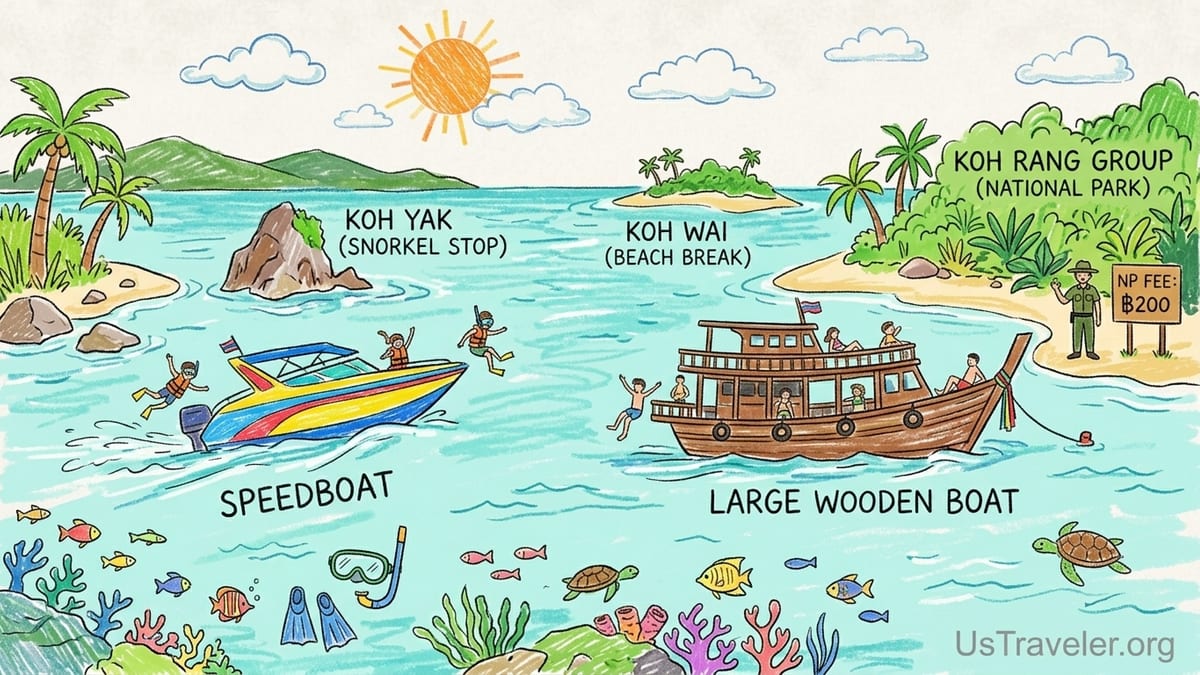
Most Koh Chang snorkeling day trips aim for a familiar chain of islands south and southeast of the main island. Koh Wai is often the easy first or last stop: a small, relaxed island where boats anchor in a sheltered bay and you can snorkel near shore or jump in from the boat for a short reef session. It’s also a common “break” stop where guides hand out fruit, water, and sometimes a quick beach walk before the next run.
Koh Rang is the headline act for many tours, not because it’s one single island, but because it’s a cluster inside Mu Ko Chang National Park with multiple snorkelable points. This is where you’re most likely to see the clearest water on a typical day trip from Koh Chang. Operators often describe Koh Yak Yai and Koh Yak Lek as part of the same outing, using them as two separate snorkel drops so groups aren’t all piled into one spot at once.
Travelers sometimes see “Koh Yak” or “Koh Yark” on itineraries, and it can look like an extra island you must research. In practice, it’s usually shorthand for one of the Koh Yak islets used as snorkel stops on Koh Rang route days. The important takeaway is not the spelling, but the boat style and timing: speedboats can hop between more points, while larger boats typically commit to fewer anchorages with longer swim time at each.
Speedboat vs Large Wooden Boat: What You Actually Get for the Price
In 2026, join-in speedboat snorkeling products around Koh Wai and Koh Rang commonly price in the rough band of ฿1,100 to ฿1,900 per person depending on route complexity, operator, and whether the national-park fee is bundled. A concrete example from a Koh Chang based tour seller shows a Koh Rang and Koh Wai speedboat day priced at ฿1,300 with hotel pickup, snorkeling equipment, lunch and drinks, and the national-park fee included, which is a strong value if you want predictable total cost without surprise cash collection on the water.
Large wooden-boat day trips can be noticeably cheaper than speedboats, particularly if you book at Bang Bao and don’t need a faster route. Real-world pricing seen in Koh Chang markets and online listings in 2026 commonly lands in the mid-hundreds of baht for the tour itself, with the key detail being whether the foreigner national-park entrance is extra. One widely sold itinerary type is the “4 to 5 island” wooden-boat day that loops Koh Yak, Koh Rang, and Koh Wai, often with buffet lunch and gear included but foreigner park fees collected separately.
Time is the trade. Speedboats can reach Koh Rang faster, usually meaning more snorkel drops and sometimes a longer total swim day even if the day length on paper is similar. Large boats take longer to reach the outer islands and can feel like a floating day lounge with shade, toilets, and a less bumpy ride, but you’ll spend more time underway. If you are staying far north on Koh Chang, such as White Sand Beach, the speedboat option departing from the west coast can also reduce the “van time” to Bang Bao, depending on the operator’s pier.
Comfort is the other trade. If your idea of a great day is minimal motion, a bigger wooden boat is usually kinder to your stomach because it doesn’t slam into chop the way a speedboat can. But if you’re the kind of traveler who gets restless, hates waiting for big groups to gear up, or wants to maximize reef time at multiple sites, speedboats tend to deliver the more dynamic day.
Routes You’ll See in 2026: Classic Koh Rang Loop vs Longer Runs Toward Koh Mak and Koh Kood
The classic Koh Chang snorkeling day is the Koh Rang loop: depart in the morning, do multiple snorkel drops around the Koh Rang group, mix in Koh Yak stops, and finish with Koh Wai for a late-day swim or a beach break. Many operators describe this as a four or five island day even though the experience is less about “island sightseeing” and more about rotating snorkel spots and one or two beaches.
Some speedboat itineraries stretch farther south and try to combine snorkeling with an island beach lunch away from the crowds. One example sold in Koh Chang’s tour market is a speedboat day that snorkels around Koh Rang and nearby small coral islands, then heads to Koh Mak for a Thai lunch on the beach before returning and adding a Koh Wai snorkel on the way back. This kind of route is appealing if you want a different lunch setting than the usual boat buffet, but it also adds distance, which can mean more exposure to afternoon wind and chop.
If your real goal is “I want Koh Mak or Koh Kood,” it’s often smarter to think beyond day tours and treat those islands as a transfer with optional stops. In 2026, inter-island speedboat transfers are sold with realistic travel times, such as roughly 45 to 60 minutes from Koh Chang to Koh Mak and around 70 to 90 minutes from Koh Chang to Koh Kood in high season conditions. You can sometimes plan a travel day that includes a stop at Koh Wai if passengers need drop-off or pickup, but it’s not the same as a dedicated snorkel tour with multiple reef drops.
For travelers trying to force Koh Kood into a “day trip from Koh Chang,” the limitation is usually schedules, not distance. Even when boats run, you’ll be working around fixed departure windows that are designed for transport, not maximizing snorkel time. If you want Koh Kood’s beaches and calmer vibe, plan at least one overnight and treat snorkeling there as a separate activity, rather than trying to bolt it onto a Koh Chang reef tour.
What’s Included: Snorkeling Gear, Lunch, Drinks, Guides, and Hotel Pickup
Most mainstream Koh Chang snorkeling products are sold as all-in day packages: boat, mask and snorkel, life jacket, lunch, water, and a guide. A representative 2026 speedboat product marketed for Koh Rang and Koh Wai specifically lists hotel pickup and drop-off, speedboat transfers, snorkeling equipment, lunch and drinks, a professional guide, life jackets, and insurance. When you’re comparing prices, that “transfer included” line matters, because paying separately for a long songthaew run to Bang Bao or Kai Bae can quietly erase the savings of a cheaper boat ticket.
Lunch styles vary by boat class. Many larger wooden tours offer a simple buffet on board, which can be surprisingly satisfying after a few snorkel drops, but don’t expect restaurant presentation. Speedboats sometimes do lunch on an island beach or do a set meal on a larger support boat, depending on the operator’s setup. If you have strict dietary needs, confirm before paying, because the default lunch on many day boats is Thai style with limited vegetarian protein options.
Snorkeling equipment is usually included, but quality is not uniform. In real life, you may get a basic mask and snorkel that fits fine, or you may be fighting small leaks all day. If you have your own mask, bringing it can transform the day. Fins are not always guaranteed in every package, and even when they are available, sizes can run out on crowded days. If fins matter to you, confirm at booking rather than assuming.
Hotel pickup coverage also has edges. Many operators focus on west-coast resort belts like White Sand Beach, Klong Prao, and Kai Bae, then down to Bang Bao. If you’re staying on the east side or deep in the interior, you may be asked to meet at a main road pickup point or pay a supplement. The most reliable way to avoid surprises is to share your hotel name at booking and ask for the exact pickup time window, because “8:00 pickup” can mean you wait from 7:30 to 8:30 while the van loops beaches.
National Park Fees: How Much, Who Pays, and Why It’s Often Collected at Sea
Mu Ko Chang National Park has a foreigner entrance fee structure that, as of June 2026, is commonly published as ฿200 for adults and ฿100 for children (with Thai citizen pricing lower). This matters because many Koh Rang area snorkel sites sit inside the park zone where rangers can collect fees, and that fee can be either included in your tour price or charged separately on the boat.
In practical terms, you’ll see three patterns. First: “park fee included,” which is the simplest, especially for families who want a clean total per person. Second: “park fee excluded,” where staff ask for cash while you’re on the water or after the first snorkel stop, sometimes with rangers present. Third: mixed handling, where Thai entry fees may be built into some locally marketed prices, but foreigners pay an additional ฿200 on top. This is common enough that some sellers explicitly state foreigner park fees are extra even when the tour looks cheap upfront.
Bring cash in small notes even if you think it’s included, because collection practices can change with route and day. If your operator includes the fee, you may still be asked to show the ticket or wristband later at another stop. If the fee is separate, paying quickly with exact cash keeps the boat moving and avoids the awkward moment of a guide hunting change while everyone else is ready to jump in.
One more nuance: not every water activity around Koh Chang triggers the same fee at the same time. Some tours spend most of the day in the park zone (Koh Rang routes), while others focus closer to Koh Chang. If your main goal is snorkeling and you’ve chosen a Koh Rang itinerary, assume the foreigner national-park fee applies unless the operator clearly confirms it is included.
Seasickness, Safety, and Seasonal Cancellations: How to Protect Your Day
If you get motion sick, your boat choice matters as much as your medication. A large wooden boat tends to roll more slowly and predictably, while a speedboat can pound hard in choppy water, especially on the afternoon return. Even travelers who are “usually fine” can feel it when the Gulf kicks up. If you know you’re sensitive, book the steadier boat, sit mid-ship, avoid staring at your phone, and consider taking a well-known motion-sickness tablet you’ve used before. If you’ve never taken one, don’t experiment for the first time on the pier.
Seasonality in Trat is not theoretical. Operators publish closures and reduced operations around the rainy season, and some tours openly state they run only in a limited window such as November through March for certain routes. Even when trips are technically “available,” they can be weather dependent in the shoulder months and may cancel on short notice if wind and swell make the outer islands unsafe.
If you’re traveling in the wet season months, build flexibility into your itinerary. Book snorkeling for your second day on Koh Chang rather than your last, so you have a buffer if the operator cancels and offers a reschedule. If the sea looks rough at breakfast, it’s often better to accept a swap to a calmer activity on the island (waterfalls, mangrove paddling, Bang Bao seafood) than to force a long, bumpy run and spend the day queasy.
Safety gear is standard on reputable trips: life jackets, basic briefings, and guides who watch weaker swimmers. Still, take personal responsibility. If you’re not a confident swimmer, wear the life jacket even if you feel self-conscious. If you have kids, choose the calmer boat and the simpler route, and don’t over-focus on “five islands” marketing. A smaller number of stops with more controlled water time is usually the better family day.
The Takeaway
For most travelers, the best-value Koh Chang snorkeling day in 2026 is still the classic Koh Rang loop with a Koh Wai stop. Choose speedboats when you want more snorkel drops, less transit time, and you’re comfortable with a bumpier ride in chop. Choose large wooden boats when you want stability, shade, a slower pace, and a lower price point, especially if someone in your group is prone to seasickness.
Before you pay, confirm four concrete details: whether the foreigner national-park fee is included, whether hotel pickup is included from your exact beach area, whether fins are provided (if you care), and what happens if the trip is canceled for weather. Do that, and Koh Chang’s outer islands can deliver the clear-water day most people imagine when they book Thailand: coral patches, reef fish, warm swims, and a boat ride back as the afternoon light softens over the green hills of the main island.
FAQ
Q1. What is the typical 2026 price for a Koh Rang and Koh Wai speedboat snorkeling day trip?
Many popular join-in speedboat snorkeling products in 2026 land roughly around ฿1,100 to ฿1,900 per person, with route and inclusions driving the final price.
Q2. Do Koh Chang snorkeling tours usually include snorkeling equipment?
Most day tours include basic mask and snorkel, plus a life jacket. Fins may be limited or not guaranteed, so confirm if fins matter to you.
Q3. Is lunch included on Koh Wai and Koh Rang tours?
On most full-day tours, yes. Large boats often serve a simple buffet on board, while some speedboat routes do a set lunch or beach lunch depending on the itinerary.
Q4. How much is Mu Ko Chang National Park entrance in 2026?
Published 2026 park fees are commonly ฿200 for foreign adults and ฿100 for foreign children, with lower Thai citizen pricing.
Q5. Why do some operators say the park fee is excluded even when the tour looks cheap?
Some tours sell the boat day at a low base price and then collect the foreigner park fee separately on the water. Always ask whether the fee is included in your total.
Q6. Which is better for seasickness: speedboat or large wooden boat?
A large wooden boat is usually steadier. Speedboats reduce travel time but can slam over chop, especially on the afternoon return.
Q7. Do tours include hotel pickup on Koh Chang?
Many do, especially from west-coast areas like White Sand Beach, Klong Prao, and Kai Bae. Coverage can vary by operator and your hotel location.
Q8. Are snorkeling trips canceled in rainy season?
They can be. Some operators run limited seasons for specific routes and many trips are weather dependent. Build a buffer day in your plan if snorkeling is a priority.
Q9. Can I do Koh Mak or Koh Kood as a day trip from Koh Chang?
It’s possible on certain schedules, but most travelers prefer an overnight because transport timings are limited and a true day trip often leaves little relaxed beach time.
Q10. What should I bring on a Koh Chang island-hopping snorkel tour?
Bring cash for park fees if not included, reef-safe sunscreen, a towel, dry bag, your own mask if you have one, and motion-sickness medication if you’re sensitive.