


If you are trying to choose between Koh Samet, Koh Chang, and Koh Kood, the real question is not “Which island is best?” It is “Which island fits the trip I actually have?” These three east Thailand favorites solve three different problems. Koh Samet is the easiest short island break from Bangkok. Koh Chang is the most varied, do-a-bit-of-everything destination with enough scale for a real island road trip. Koh Kood is the quieter beach-and-resort escape, but it asks for more travel commitment and rewards you with a slower, softer version of Thailand.
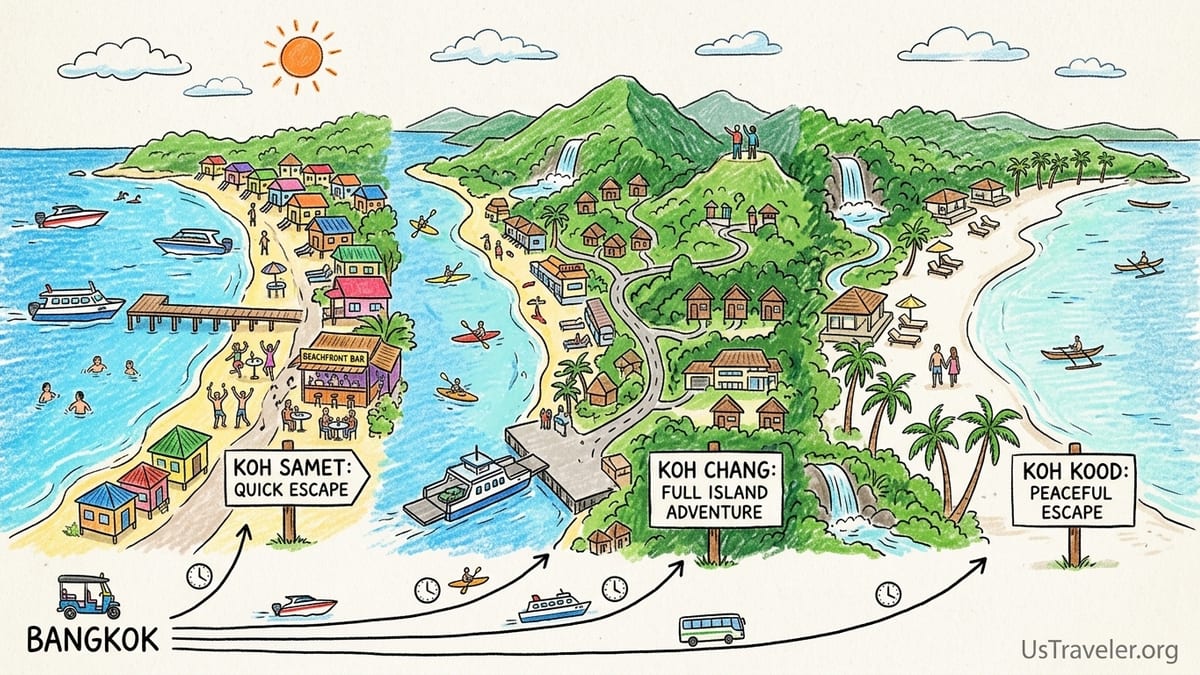
At a Glance: What Each Island Does Best
Koh Samet is the island you choose when time is tight and you still want a real beach payoff. From Bangkok, most travelers route via Rayong’s Ban Phe Pier, then hop a ferry or speedboat to Na Dan Pier. In 2026, slow ferries are roughly 40 minutes and can be as low as about 50 to 70 baht, while speedboats can be around 150 to 200 baht per person depending on the pier and operator. That kind of quick crossing is why Samet dominates as a two- or three-night escape.
Koh Chang is the “full island” choice. It is large enough to have distinct beach towns, inland viewpoints, waterfalls, and day trips, plus enough restaurant and accommodation range to work for backpackers, families, and couples. It is also the easiest of the Trat archipelago islands to reach by car ferry, using the Ao Thammachat Pier on the mainland to Ao Sapparot Pier on Koh Chang, with departures running through the day.
Koh Kood is for travelers who care most about quiet beaches, resort comfort, and a more unplugged atmosphere. It is not difficult, but it is longer: a typical land-and-sea route involves getting to Trat’s Laem Sok Pier and taking a speedboat or catamaran onward, or booking an all-in-one bus-plus-boat service. In mid-2026 examples, Boonsiri’s Bangkok to Koh Kood through-ticket pricing commonly shows around 1,100 baht per adult, which can be a surprisingly clean solution if you want everything arranged.
Decision rule in plain English: pick Koh Samet when you want maximum beach per hour of travel, Koh Chang when you want the widest mix of activities and “backup options,” and Koh Kood when you want the most peaceful version of an island stay and are willing to spend more of your first and last day in transit.
Bangkok Travel Time and Logistics (The Part That Decides Everything)
Koh Samet is the most Bangkok-friendly by a wide margin. The standard route is Bangkok to Ban Phe Pier (Rayong), then onward to Koh Samet. Once you are at Ban Phe, the crossing is fast and frequent: in 2026 schedule roundups, slow ferries run repeatedly through the day, and speedboats run many times daily too. That makes Samet ideal for travelers landing in Bangkok on a Friday afternoon and still wanting to be on sand before dinner.
Koh Chang is longer, but still straightforward. Most travelers go Bangkok to Trat province, then to Ao Thammachat Pier and across to Koh Chang’s Ao Sapparot Pier. A key 2026 detail: the older Centrepoint/Cenferry route has been suspended since mid-2024 and is still out of service, so you should plan around Ao Thammachat for regular car and passenger ferries. Ferries run during the day, and because it is a vehicle ferry route, families and groups often find it easier to bring luggage (and sometimes rental cars) without the “small-boat shuffle” you get elsewhere.
Koh Kood is the biggest commitment. Many travelers do Bangkok to Trat by road, then go to Laem Sok Pier and take a fast boat. The cleanest “no-thinking” option is a through-ticket bus plus catamaran package. For a real-world reference, Boonsiri’s Bangkok (Khaosan Road area) to Koh Kood hotel-transfer option in mid-2026 examples shows departures around 05:00 arriving about 12:15, or departing around 08:00 arriving about 16:30, priced around 1,100 baht for an adult. If you are traveling with kids or bulky luggage, that one-ticket approach can be worth more than shaving off an hour.
If you want to cut travel time to the Trat islands, flying is the wildcard. Bangkok Airways publishes Bangkok (BKK) to Trat (TDX) flight times around one hour, with schedules updated in 2026. Flights are not always frequent year-round, so treat them as a timing tool: if you can align a morning flight with a midday boat, Koh Chang or Koh Kood becomes much more realistic for shorter trips.
Beaches and Water: What “Better” Actually Looks Like
Koh Samet’s beach experience is easy to access and easy to enjoy. You will see why it is popular with Bangkok weekenders the moment you hit Hat Sai Kaew (Sai Kaew Beach): it is broad, bright, and lined with places to eat and grab a drink. The trade-off is that Samet can feel busy, especially on weekends and Thai holidays, and the most convenient beaches are also the most social.
Koh Chang’s beaches vary a lot by area. West-coast zones like White Sand Beach and Klong Prao are set up for classic resort holidays, while other areas can be quieter but require more getting around. The island’s shape also changes your beach days: Koh Chang is mountainous, so you can easily combine a morning swim with an afternoon waterfall stop or viewpoint drive, which makes the “beach-only” question less central than it is on Samet and Kood.
Koh Kood is where beach purists tend to relax their shoulders. The mood is softer: fewer loud beachfront strips, fewer late-night crowds, and more “walk barefoot from breakfast to the sea.” If your mental image of Thailand is calm, clear shallows and long swims without a soundtrack, Koh Kood is most likely to match it. The practical trade-off is convenience: you may be far from the small clusters of shops and restaurants, and some nights you will simply eat where you are staying.
Concrete example: on Samet, it is normal to finish a beach day and walk to dinner in minutes. On Koh Kood, it is normal to finish a beach day and decide between your resort restaurant, a short scooter ride, or arranging a taxi style pickup if you do not ride. On Koh Chang, you can do both depending on where you base yourself, but distances are bigger.
Resorts and Where You Actually Sleep (Budget to Splurge)
Koh Samet is built for quick stays, so you will find plenty of practical mid-range hotels and smaller beachfront resorts that keep the trip simple: arrive, check in, hit the beach. It is also one of the easiest places to justify a “one upgrade night” because the logistics are easy. If you want a low-stress romantic short break, this is where travelers often book a beachfront room, do sunset drinks, and call it a win without needing an itinerary.
Koh Chang has the widest range of accommodation styles. You can find everything from simple guesthouses near busy beach areas to larger family-friendly resorts with pools, kids’ menus, and activity desks. Because the island is bigger, where you stay matters more: a couple wanting walkable dinners and some nightlife will choose differently than a family that wants a calmer beach and a resort where everyone can spread out.
Koh Kood leans more toward the resort-stay model. Even when you are not in a “luxury” property, the rhythm tends to be: breakfast, beach, lunch, nap, sunset, dinner. That makes it excellent for couples and anyone burnt out by city travel, but it also means you should book with intention. If you pick a resort on a beautiful beach but far from other dining options, treat that as a feature, not a surprise.
A practical way to think about cost without guessing prices: Koh Samet is the easiest place to do a last-minute weekend with minimal transport complexity. Koh Chang usually offers the best spread of choice at each comfort level. Koh Kood often costs more overall because even if your room rate is fair, the transport and “resort dining” style can raise the trip total.
Nightlife and Evening Atmosphere (From Party to Peaceful)
Koh Samet has the most concentrated nightlife of the three, largely because the main beach areas are compact and social. On a weekend, you can go from sunset on Sai Kaew Beach to a lively beachfront bar without needing transport, which is exactly what makes Samet such an easy “short break” island for friend groups and couples who want energy at night.
Koh Chang’s nightlife is more spread out. You will find lively pockets around popular west-coast beaches, plus beach bars and restaurants that stay active later than you would expect on a nature-heavy island. The big advantage is balance: you can have a fun night out, then still do a waterfall hike the next morning because the island supports both. The downside is that you may be relying on songthaews or taxis to hop between areas, depending on where you stay.
Koh Kood is the quietest at night, by design. Think early dinners, beach walks, and low-key cocktails rather than bar-hopping. For some travelers, that is the entire point: you are not “missing nightlife,” you are choosing to sleep well and wake up to empty morning beaches. If you know you will get restless without evening options, Koh Kood is usually better as a shorter chapter of a longer trip, not the whole vacation.
If you are traveling with teenagers who want “something happening” after dinner, Koh Chang is the safest compromise. If you are traveling with younger kids, Koh Samet’s walkability can be a plus, but only if you pick a calmer beach zone rather than the busiest nightlife strip.
Snorkeling, Swimming, and Things To Do Beyond the Beach
Koh Samet is best when you treat it as a beach-first island with optional extras. Typical add-ons include a snorkel boat trip, a viewpoint visit, or bouncing between bays by songthaew taxi. It is also a practical place to do nothing: if your real goal is a reset between Bangkok sightseeing days, Samet’s “quick to reach, easy to enjoy” character is the activity.
Koh Chang is the most varied for activities. Its size supports day trips that feel meaningfully different: waterfalls, inland drives, viewpoints, and fishing village style stops, plus island-hopping possibilities in the Trat region. It is also easier to build a flexible itinerary: if the sea is rough, you can pivot inland and still feel like you had a full day rather than a weather-ruined day.
Koh Kood is quieter, but not boring if you like nature at a slower pace. Travelers come for swimming, gentle paddling, and low-key snorkel sessions rather than a packed schedule. The island’s appeal is less about ticking boxes and more about how the days feel. If you want to plan three activities a day, Koh Chang will usually fit you better.
A concrete “real trip” example: if you have a group with mixed interests, Koh Chang is where half the group can do a waterfall outing while the others stay by the pool, then everyone meets for dinner. Koh Kood is where the whole group is more likely to sync into the same slow rhythm. Koh Samet is where everyone can say, “We only have two nights, so let’s just swim, eat, and sleep.”
How Many Nights Each Island Deserves (And the Mistake Most People Make)
Koh Samet deserves two to three nights for most travelers. One night can work, but it often feels rushed because you will still spend part of the day getting to Ban Phe and crossing over. Two nights is the sweet spot for Bangkok visitors: arrive, do a full beach day, leave without feeling like you only saw the pier. Three nights is ideal if you want one “nothing day” plus one optional excursion.
Koh Chang deserves three to five nights if you want the island’s variety to matter. At two nights, it can feel like a lot of travel for a single beach day unless you are flying into Trat at the right time. At three nights, you get enough room for two full days plus a relaxed arrival day. At five nights, you can genuinely explore different beach areas, do at least one inland activity day, and still have time to slow down.
Koh Kood deserves three to five nights, and it works best when you accept the travel commitment upfront. If you only have two nights total, Koh Kood can turn into a transit-heavy trip with one full day on the island, which is rarely what people imagine when they choose it. Three nights is the minimum where Koh Kood’s calm rhythm kicks in. Four or five nights is where it becomes a true “escape” rather than just a pretty stopover.
The common mistake is forcing the wrong island into the wrong time window: choosing Koh Kood for a two-night Bangkok weekend, or choosing Koh Samet for a week when you really crave variety. Match the island to the shape of your trip, and the decision becomes obvious.
The Takeaway
Koh Samet is the easiest short island break from Bangkok, with quick pier-to-beach logistics and a lively, walkable beachfront scene that makes two or three nights feel completely worth it. Koh Chang is the most varied full-island destination, with enough size for different beach zones, inland nature, and evenings that can be either relaxed or social. Koh Kood is the quieter resort-and-beach escape, the one you choose when peace is the point and you are willing to spend more of your first and last day getting there and back.
If you want a simple choice that works for most travelers: pick Koh Samet for weekends and quick resets, Koh Chang for a first-timer’s “one island that does everything,” and Koh Kood when you want the softest beaches and the least noise, and you are ready to commit the time.
FAQ
Q1. Which island is closest to Bangkok: Koh Samet, Koh Chang, or Koh Kood?
Koh Samet is the closest and easiest to reach from Bangkok via Ban Phe Pier in Rayong, followed by Koh Chang, then Koh Kood as the most time-intensive.
Q2. Which island is best for a 2-night trip?
Koh Samet is usually the best fit for two nights because the crossing from Ban Phe is short and frequent, so you keep more time for the beach.
Q3. Which island has the best beaches overall?
If your priority is quiet, clear-water beach time, Koh Kood is often the favorite. If you want good beaches plus variety and infrastructure, Koh Chang is the balanced option. Koh Samet wins for convenience and a fun beachfront scene.
Q4. Which island is best for nightlife?
Koh Samet generally has the most concentrated nightlife in walkable beach areas. Koh Chang has nightlife pockets but it is more spread out. Koh Kood is the quietest at night.
Q5. Which island is best for families?
Koh Chang is often best for families who want space, activities, and resort variety. Koh Samet works well for short family breaks if you choose a calmer beach zone. Koh Kood suits families who specifically want a quiet resort-style stay.
Q6. Which island is best for couples?
Koh Samet is great for short romantic escapes from Bangkok. Koh Kood is ideal for couples who want privacy and a slow pace. Koh Chang works for couples who want beach time plus exploring.
Q7. Can I fly part of the way to make Koh Chang or Koh Kood easier?
Yes. Bangkok to Trat flights can reduce the land travel portion significantly, then you continue by road transfer and ferry or speedboat depending on the island.
Q8. How complicated are ferry logistics for each island?
Koh Samet is simplest because boats run frequently from Ban Phe. Koh Chang is straightforward via the Ao Thammachat to Ao Sapparot vehicle ferry route. Koh Kood is easiest if you book a through-ticket bus-plus-boat service, otherwise you coordinate Laem Sok Pier and a speedboat or catamaran.
Q9. Which island is best if I do not drive a scooter?
Koh Samet is the easiest without a scooter because key areas are compact and local transport is common. Koh Chang can work well if you base yourself in a walkable area and use songthaews and taxis. Koh Kood is most comfortable if your resort is self-contained or you arrange transport.
Q10. If I can only pick one island for 4 nights, which should it be?
For most travelers, Koh Chang is the safest one-island choice for four nights because it offers the widest mix of beaches, activities, and dining, with manageable logistics.