


Central Thailand’s most famous market circuit is not one place, but a triangle: Damnoen Saduak for sunrise canal scenes, Maeklong Railway Market for the train-through-the-stalls moment, and Amphawa for late-day eating on the water and firefly cruises after dark. The catch is that many tours sell these experiences as interchangeable. They are not. The timing is different, the boat styles are different, and the amount of time you actually spend at each stop varies wildly depending on whether you book a big coach day trip, a small group van, or a private driver with a long-tail boat on standby. This guide breaks down what you are really buying and how to choose the best floating market tour for your trip.
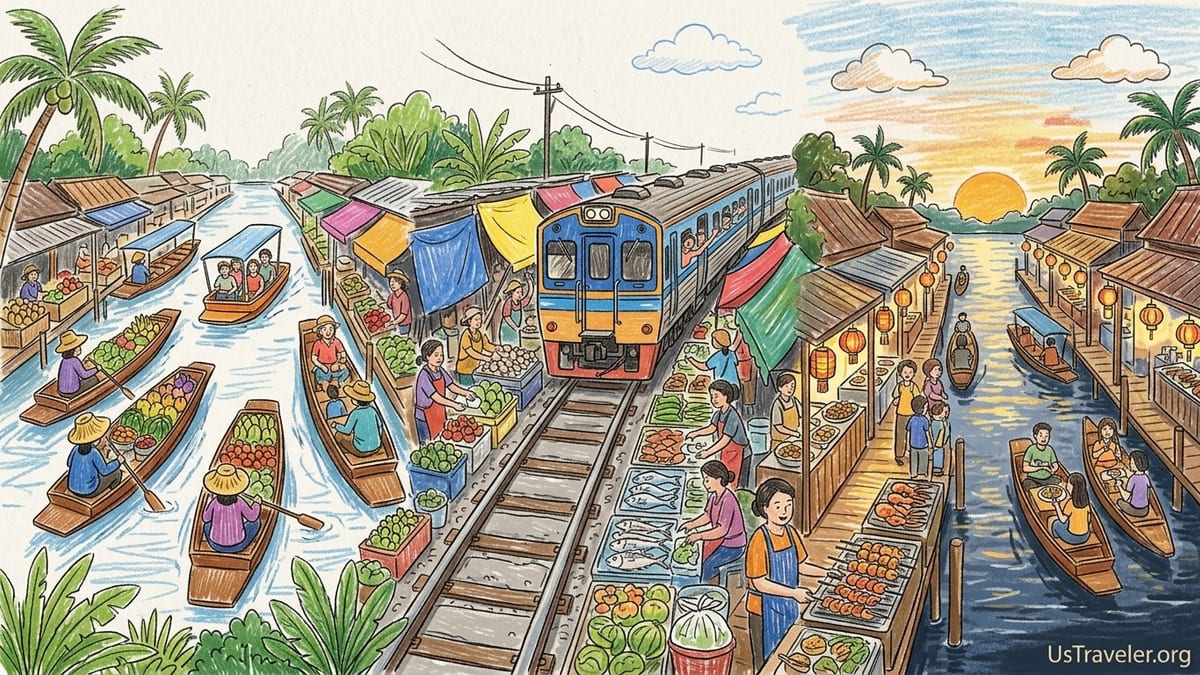
Damnoen Saduak vs Amphawa vs Maeklong: What Each Market Actually Feels Like
If you want the classic Thailand floating-market image, Damnoen Saduak delivers it reliably: narrow canals busy with vendor boats and visitor boats, especially in the early morning when light is soft and the heat is still manageable. Thailand’s tourism authority directly frames Damnoen Saduak as the market of morning energy, with the scene building from first light and best experienced before noon.
Amphawa, by contrast, is built around later-day wandering and evening eating. Thailand’s tourism authority explicitly contrasts the two rhythms: Damnoen Saduak as the excitement of morning, Amphawa as the delight of evening, when riverside houses glow and boats lean into grilled seafood and snacks. Amphawa is also strongly weekend-focused, which matters for scheduling and tour selection.
Maeklong Railway Market is not a floating market at all, and that is why it pairs so well with the floating markets. It is a working fresh market set along the Ban Laem to Maeklong railway line, famous for the moment vendors pull awnings back as the train passes. The train is the headline, but the market itself is also a real local shopping stop for produce, seafood, and prepared foods.
Morning vs Evening Markets: Timing Is the Whole Game
Damnoen Saduak rewards early starts. Many Bangkok departures leave around 6:00 AM to 7:30 AM so you arrive while the canal is active and before mid-morning crowds stack up. If a tour advertises Damnoen Saduak but schedules arrival close to late morning, the “iconic” canal density can look thinner and the experience can tilt toward souvenir browsing rather than a living market scene.
Amphawa is the opposite. Official tourism materials and local listings consistently frame Amphawa as a Friday to Sunday and public-holiday market that runs into the evening, with the atmosphere building later in the day. Travelers who show up at noon expecting a fully formed floating-market buzz can be disappointed. Amphawa’s better window is mid-afternoon into sunset, when riverside tables fill up and the canal starts to look like a moving food court.
Maeklong’s timing is the most precise, because it revolves around train movements. One widely circulated official-style visitor brief lists daily arrival times at 6:20, 9:00, 11:30, and 15:30, with departures at 8:30, 11:10, 14:30, and 17:40. Tours often aim for one of the late-morning or mid-afternoon passes, then route you onward to Damnoen Saduak or Amphawa depending on the day.
Long-tail Boats, Paddle Boats, and “Canal Experiences”: What You’re Paying For
The biggest misunderstanding in floating-market touring is thinking the market visit and the boat ride are the same product. They are often sold together, but they are not always priced together. At Damnoen Saduak, many itineraries include a short paddle-boat segment or a motorized long-tail ride to access the busier canal sections. Some packaged tours spell this out clearly as a fixed-duration ride, such as a 30-minute paddle-boat ride included within a combined Maeklong and Damnoen program.
In practical terms, a long-tail boat is the fast connector. It gets you from a parking area or pier into smaller canals quickly, but it is noisier. A paddle boat is slower and quieter, and can feel closer to the traditional image, but it usually covers a shorter route and can bottleneck when multiple groups arrive at once. If you care about photography, the best combination is often arriving early, taking a quick long-tail transfer to the canal core, then lingering at water level rather than rushing through.
Then there is the “smaller canal experience” category that tours love to market without naming it. The experience can be excellent, but you need specifics. Ask what canal or pier you are using, what boat type, and how long you are on the water. If the operator cannot answer beyond “boat ride included,” assume it is a minimal loop designed mainly to deliver the photo moment, not a slow look at daily canal life.
Commercial Investigation: Group Tours vs Private Tours (And How Much Market Time You Really Get)
Big-group day tours from Bangkok can be good value, but they are optimized for logistics, not lingering. A typical shared itinerary has three time sinks: city pickup loops (collecting guests across neighborhoods), highway driving time, and staging time at piers. The result is that an “8-hour” day can translate into surprisingly little time actually on the canal or inside the market lanes.
Small-group vans tend to improve the day in two ways: fewer pickup stops and faster movement between Maeklong and the floating-market area. On major booking platforms, shared Maeklong and Damnoen experiences regularly price in the rough range of about $30 to $40 per adult for budget-friendly group tours, while other versions with more inclusions or different meeting points can cost more. These tours can still feel rushed, but the pacing is often better than a full-size coach.
Private tours are not automatically “better,” but they give you control over the two moments that matter most: the Maeklong train pass you want to catch and the Damnoen Saduak arrival time you want for light and crowds. Private options on mainstream platforms also frequently bundle hotel pickup, which can be a real comfort if you are traveling with kids, older relatives, or anyone who does not want a 6:30 AM meeting point scramble.
Before booking, look for one of two signals that you are buying real market time. Either the tour states clear dwell time at each stop, or it includes a fixed boat segment and still leaves time for walking. If your itinerary shows three major stops plus multiple “bonus” stops (coconut sugar farm, elephant photo stop, random souvenir compound) with no extra hours added, your market time is what will be compressed.
How to Combine Damnoen Saduak, Maeklong, and Amphawa Without Ruining the Day
The dream combo is Damnoen Saduak plus Maeklong, and optionally Amphawa, but the calendar decides for you. Damnoen Saduak and Maeklong are feasible on any day, while Amphawa is primarily a weekend and public-holiday market. That single fact should drive your planning more than any tour marketing copy.
The most realistic “all three” day is a Saturday or Sunday that starts early with Damnoen Saduak, then catches a Maeklong train pass, then ends at Amphawa for food and evening atmosphere. It can be memorable, but it is a long day with a lot of transport. Many travelers underestimate how different the peak hours are. You are essentially stitching together a dawn experience and a dusk experience with highway time in the middle.
A more comfortable approach is to split the circuit. Do Maeklong plus Damnoen Saduak as a morning to early-afternoon day trip from Bangkok, then do Amphawa separately with an overnight. This is where Amphawa shifts from “market stop” to “weekend riverside town.” Instead of racing to Bangkok after dinner, you can stay near the canal, return for a calmer morning, and treat the market as part of a broader Samut Songkhram experience.
Should You Stay Overnight in Amphawa? When It’s Worth It (And When It Isn’t)
Amphawa is the one market in this trio that makes a strong case for sleeping locally, because its most distinctive experiences sit on the evening and early-morning edges. The evening edge is the food-and-walk vibe, and for many visitors the firefly boat ride after sunset is the signature add-on. The morning edge is the quieter riverside atmosphere before day-trippers return, plus the possibility of early community experiences that simply do not fit into a Bangkok day tour.
Overnight makes the most sense if you are traveling on a Friday or Saturday and want to experience Amphawa without watching the clock. It also makes sense if you want to take your time with riverside dining: order grilled river prawns or whole fish at a canal-side restaurant, wander for desserts, then decide on a boat ride when you see the crowd levels at the pier. If you are trying to do Amphawa as the last stop of a packed day tour, you may arrive hungry and rushed, which is the opposite of what Amphawa does best.
It is less worth it if your trip is short and you can only spare one market experience. In that case, a well-timed morning Damnoen Saduak plus Maeklong combo can be the more efficient “headline” day trip from Bangkok. Amphawa shines when it is treated as an evening destination and not just a checkbox.
The Takeaway
If you want a floating market that looks like the postcard, go early to Damnoen Saduak and treat timing as non-negotiable. If you want a later-day and evening canal atmosphere built around eating and strolling, plan Amphawa on a weekend and consider staying overnight so you are not forced to leave at peak mood. If you want the unforgettable “only in Thailand” moment, Maeklong is the must-add, but you should plan around the train times instead of hoping you will get lucky.
The best tour is the one that tells you, clearly, how long you will be at each market and exactly what boat ride is included. A cheap ticket can still be a smart buy if it gets you there early and gives you real time on the water. A more expensive private option can also be worth it if it protects the two things you cannot buy on-site: the right light at Damnoen Saduak and the right train pass at Maeklong.
FAQ
Q1. Which floating market is better near Bangkok: Damnoen Saduak or Amphawa?
Damnoen Saduak is best for classic morning canal scenes and early photography, while Amphawa is best for late-day food, strolling, and evening atmosphere on weekends.
Q2. Is Amphawa Floating Market open on weekdays?
Amphawa is primarily a Friday to Sunday and public-holiday market, so on weekdays many stalls are closed and the area is much quieter.
Q3. What time should I visit Damnoen Saduak Floating Market?
Go early. Many visitors aim to arrive in the morning so the canals are active and the heat and crowds are lower than later in the day.
Q4. What are the Maeklong Railway Market train times?
Commonly referenced visitor briefings list arrivals around 6:20, 9:00, 11:30, and 15:30, with departures around 8:30, 11:10, 14:30, and 17:40.
Q5. Can I do Damnoen Saduak, Maeklong, and Amphawa in one day?
Yes on a weekend, but it is a long day because Damnoen Saduak is best in the morning and Amphawa is best later in the day and evening.
Q6. Do I need to book a boat ride in advance at Damnoen Saduak?
Not always, but booking a tour that clearly includes a defined boat segment can reduce confusion and help you reach the canal areas that look most like the famous photos.
Q7. What’s the difference between a long-tail boat and a paddle boat?
Long-tail boats are faster and louder and often used as transfers through canals, while paddle boats are slower and quieter and usually cover shorter loops at water level.
Q8. Are hotel pickups included on floating market tours from Bangkok?
Many tours offer hotel pickup either as standard or as a selective option, while others use central meeting points, so check the pickup zone and start time carefully.
Q9. How much time do tours usually spend at the markets?
It varies by operator, but long transport and pickup loops can reduce on-the-ground time, so prioritize tours that state clear stop durations and a defined boat ride.
Q10. Should I stay overnight in Amphawa?
Overnight is worth it if you want Amphawa’s evening vibe without rushing back to Bangkok and prefer a slower pace for dinner, strolling, and optional boat rides.