

Central Thailand is where Bangkok’s fast pace softens into river towns, temple ruins, and market mornings that still run on tides and train timetables. If you want classic Thai history, Ayutthaya is the headline act. If you want living canal culture and snack-first travel, Samut Songkhram is the smart two-in-one, pairing Amphawa with Maeklong Railway Market and smaller waterways nearby. Add Ko Kret for an easy weekend island escape, Nakhon Pathom for big temple energy close to the city, and Lopburi when you want Khmer-era stonework with a side of monkey chaos. This guide focuses on those destinations and compares them for ancient history, markets, river life, food, photography, and how easily you can reach them from Bangkok.
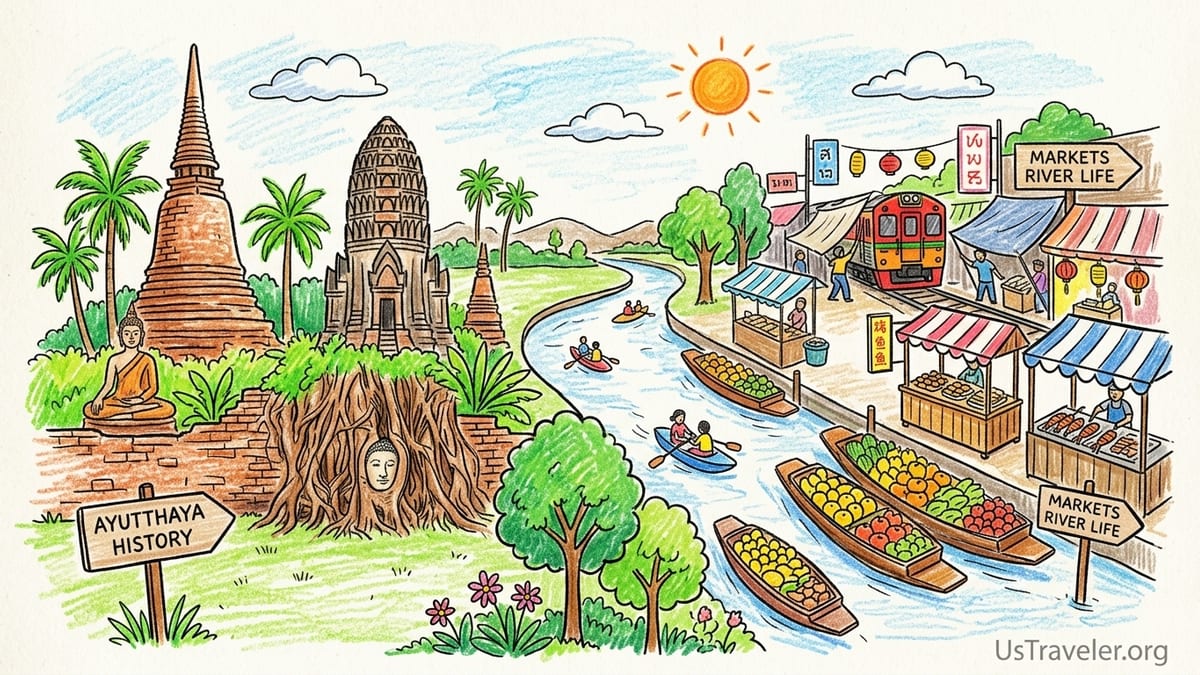
How These Day Trips Compare (History, Markets, River Life, Food, Photos, Bangkok Access)
If your priority is ancient history, Ayutthaya is the clear winner, with multiple ruined temple complexes inside the UNESCO-listed Historic City of Ayutthaya. The experience is big-sky archaeology: prangs, chedis, Buddha images, and brick corridors where morning light and late-afternoon shadows do most of the storytelling.
If your priority is markets and river life, the Samut Songkhram cluster is the strongest. Maeklong Railway Market is a timed spectacle, while Amphawa leans into evening energy and canalside eating. Damnoen Saduak is the most famous floating market in the region and can be very photogenic early, but it can also feel transaction-heavy if you arrive late or accept the first boat quote you hear.
For food, Amphawa and Nakhon Pathom usually deliver the most satisfying “eat as you wander” day. Amphawa is built for grazing along the canal edge, while Nakhon Pathom’s area around Phra Pathom Chedi and nearby markets is a reliable place to try local dishes without turning the day into a long drive.
For photography, you are essentially choosing your subject. Ayutthaya gives you heritage silhouettes and sunset riverside ruins. Maeklong delivers kinetic street-market scenes timed to the train. Amphawa offers warm evening light on water. Ko Kret gives you pottery textures and village-life details. Lopburi offers dramatic Khmer-style stone and candid street moments if you are comfortable shooting around monkeys.
Ayutthaya: Central Thailand’s Essential Ancient-Capital Day Trip
Ayutthaya is the region’s major historic destination and, for many travelers, the most rewarding first day trip out of Bangkok. Start with the “must-see” ruins that balance story and visuals: Wat Mahathat (famous for the Buddha head entwined in tree roots), Wat Phra Si Sanphet (royal chedis that define the old capital’s skyline), and Wat Chaiwatthanaram for riverside views that turn golden near sunset.
Entry fees add up quickly if you pay site by site, so it helps to know the combined ticket option. The official combined pass covers six major sites and is priced at 220 baht for foreigners, sold at participating ticket windows and valid for 30 days. If you plan to hit the big-name temples in one day, the pass is usually the cleanest way to simplify your spend and avoid fumbling for small bills at each gate.
Ayutthaya is also easy to tailor by travel style. If you want budget simplicity, it is possible to do a very inexpensive DIY day using public transport, then renting a bicycle or hiring a tuk-tuk in town for a few hours. If you want comfort and speed, private drivers and small-group day tours are widely available, but the best value is often a plan that limits the number of stops and builds in time at each major ruin rather than rushing through eight places for quick photos.
Practical tip that improves the day immediately: go early and pick your light. The ruins can feel hotter and flatter at midday. If you arrive in the morning, you can shoot softer light at Wat Mahathat and Wat Ratchaburana, then save Wat Chaiwatthanaram for late afternoon when the riverside setting finally matches the hype.
Samut Songkhram: Amphawa, Maeklong Railway Market, And Canal Communities In One Trip
Samut Songkhram is the best “living culture” day trip zone near Bangkok because it stacks distinct experiences close together: Maeklong Railway Market for the train moment, Amphawa for canalside eating and evening atmosphere, and smaller canal communities in between that make the province feel less like a checklist and more like a place.
Maeklong Railway Market is not about shopping lists; it is about timing. The market operates daily, but the headline moment is when vendors pull back awnings and slide baskets off the rails for the passing train. Travelers who plan around the train schedule get the scene they came for, while travelers who arrive randomly often just find a crowded market street and wonder what the fuss is about.
Amphawa is the counterpoint. Instead of a single timed spectacle, it is about lingering: grilled seafood aromas, snacks in your hand, and the canal as the main “street.” If you want a market that feels social rather than hurried, Amphawa is often the better mood than purely morning-focused floating markets.
Keep your expectations grounded and the day becomes excellent. If you treat Samut Songkhram as a two-stop combo, you will still have a strong trip. If you treat it as a river province with neighborhoods, you will notice details like small boat landings, quiet side canals, and family-run stalls where the best bite is simply the one cooked to order while you wait.
Damnoen Saduak: The Famous Floating Market, Done The Smart Way
Damnoen Saduak is still the floating-market image many people carry in their heads: narrow canals, vendor boats, fruit piled high, and that classic top-down angle when you shoot from a bridge. It is also one of the most heavily visited market experiences near Bangkok, which means the timing and the boat arrangement matter more here than almost anywhere else in this guide.
Arrive early. Realistically, the most manageable window is around 7:00 a.m. to 9:00 a.m., before tour-bus traffic makes the canal feel like a boat jam. Entry to the market area is generally free; the cost you feel is the boat. Recent visitor-facing pricing guidance commonly quoted for shared paddle-boat rides sits around 150 to 300 baht per person per hour, while private or motorboat arrangements can jump significantly depending on where you board and how clearly you agree on route and price.
If you want a concrete “what to do” plan: agree on the total boat price before you step in, confirm the duration (for example, one hour), and clarify whether you are doing a short market loop or a longer canal ride. Travelers regularly report that unclear boarding points can lead to inflated quotes, so it is worth walking a few minutes to compare offers rather than accepting the first pitch at a roadside pier.
Damnoen Saduak is most worthwhile if your goal is photography, especially classic floating-market frames. If your goal is food and atmosphere, Amphawa often feels more satisfying. If your goal is a single unforgettable moment, Maeklong’s train sequence is more unique. Damnoen’s strength is that iconic canal scene, and it is best approached as a short early-morning shoot, not an all-morning hang.
Ko Kret: A Weekend Island For Pottery, Riverside Snacks, And Slow Lanes
Ko Kret is one of the easiest “mini-escape” destinations from Bangkok: a small island community in Nonthaburi known for Mon cultural roots, pottery, and a simple rhythm that feels pleasantly separate from the capital even though you are not traveling far.
The biggest planning detail is the calendar. Ko Kret is best visited on weekends and public holidays, when the island’s market-like energy comes alive and more food stalls and workshops are open. On a good visit, you spend the day wandering lanes, stopping for pottery browsing, and snacking along the river edge rather than rushing between “must-see” sights.
For a grounded experience, plan your day around hands-on craft and edible breaks. Look for small kilns and pottery shops where you can see classic earthenware forms and pick up a practical souvenir like a cup, bowl, or plant pot that actually survives being used at home. When the island is lively, you will also find plenty of grab-and-go Thai treats, making Ko Kret ideal if your travel style is more “taste and wander” than “temple marathon.”
Photography here is detail-driven: clay textures, hands at work, river reflections, and casual portraits if you are respectful. Ko Kret is also a refreshing choice if you have already done Bangkok’s big temples and want something quieter that still feels distinctly Thai and locally grounded.
Nakhon Pathom: Big Temple Energy Close To Bangkok (And A Strong Food Detour)
Nakhon Pathom is a smart pick when you want something different from ruins and floating markets but still want an easy Bangkok day trip. The anchor sight is Phra Pathom Chedi, widely recognized as one of Thailand’s most important religious landmarks and a striking visual even if you arrive with zero background reading.
The experience is not just “see the chedi and leave.” Around the complex and nearby areas, the day naturally turns into a mix of temple atmosphere, local movement, and casual eating. Many travelers pair the chedi with a walk or short ride to Sanam Chandra Palace, which adds a different layer of Thai history in a setting that feels calmer and more residential than Bangkok’s grand royal sites.
This is also one of the best destinations in this guide for travelers who want an easy food-focused outing without complicated logistics. You can build a day that is essentially: morning temple visit, midday local lunch, then a relaxed palace stroll before returning to Bangkok.
For photography, Nakhon Pathom gives you scale rather than ruin texture. The chedi’s size creates strong compositions when you include worshippers, offerings, and the surrounding architecture. It is a good reminder that Central Thailand is not only about ancient capitals and market scenes; it is also about living religious spaces that are active every day.
Lopburi: Khmer-Era Stonework, Old Town Wandering, And The Monkey Factor
Lopburi is the outlier in this set, and that is exactly why it earns a place. It adds a distinct historical texture: Khmer-influenced architecture and an old town that is compact enough to explore on foot, with major sights close to the railway station. The signature stop is Phra Prang Sam Yot, a three-towered sanctuary associated with the Bayon style and Lopburi’s period under Khmer influence.
The entry fee at Phra Prang Sam Yot is commonly posted at 50 baht for foreigners, and there is also the option of combined ticketing in the area depending on what you plan to visit. Even if you decide not to go inside, it is easy to photograph the structure from outside the fence, which matters if you are short on time or prefer to keep distance from the monkeys.
About those monkeys: they are not background decoration. In the core monkey areas near Phra Prang Sam Yot and the nearby shrine spaces, you should assume anything loose can be grabbed, including plastic bags, dangling bottle straps, and food you are holding. If you wear glasses, keep them snug. If you carry snacks, keep them sealed and inside your bag until you are seated somewhere calm. Travelers who are prepared often find the scene entertaining. Travelers who are careless sometimes find it stressful.
Lopburi is best for travelers who want a day that feels a little wilder and less curated: interesting stonework, candid street scenes, and the kind of unpredictable moments you cannot schedule. If that sounds exhausting, choose Ayutthaya for history or Nakhon Pathom for calm.
The Takeaway
If you only do one destination, choose Ayutthaya for the strongest concentration of world-class heritage close to Bangkok. If you want the best market-and-river-life pairing, build your day around Samut Songkhram, using Maeklong for the timed train spectacle and Amphawa for canalside eating and evening atmosphere.
Choose Damnoen Saduak when your main goal is that iconic floating-market photo, and treat it like an early-morning mission with a clearly agreed boat price. Choose Ko Kret when you want a softer day built around pottery, small-lane wandering, and riverside snacks on a weekend. Choose Nakhon Pathom when you want a big, living religious landmark and an easy food detour. Choose Lopburi when you want Khmer-era architecture and you are comfortable navigating the monkey factor.
The good news is you do not have to choose “the best” in abstract. Each of these places wins in a different category, and the real trick is matching the destination to the kind of day you actually want to have.
FAQ
Q1. Which Central Thailand day trip is best if I only have one free day from Bangkok?
Ayutthaya is the best all-around choice for first-timers because it delivers the region’s most important historic sights in one concentrated area.
Q2. Is Samut Songkhram better than Damnoen Saduak for floating-market vibes?
For many travelers, yes. Amphawa in Samut Songkhram often feels more like an evening canalside community market, while Damnoen Saduak is more famous and more photo-driven.
Q3. What is the best time to visit Damnoen Saduak?
Arrive early, ideally around 7:00 a.m. to 9:00 a.m., to avoid peak crowding and to get cleaner canal photos.
Q4. How much should I expect to pay for a Damnoen Saduak boat ride?
Recent visitor guidance commonly cites around 150 to 300 baht per person per hour for shared paddle-boat pricing, but private and motorboat quotes can be higher. Always agree on the total price and duration before boarding.
Q5. Is Ayutthaya’s combined temple ticket worth it?
If you plan to visit several of the main paid sites, yes. The official combined pass is priced at 220 baht for foreigners and covers six major ruins, simplifying both cost and logistics.
Q6. When should I go to Ko Kret for the best atmosphere?
Go on a weekend or public holiday, when more stalls and pottery-related spots are open and the island feels lively.
Q7. What makes Nakhon Pathom worth visiting compared with Ayutthaya?
Nakhon Pathom is more about a living religious landmark and a relaxed local day than ruins. It is a strong choice if you want something calmer, closer to Bangkok, and easy to pair with food stops.
Q8. Is Lopburi safe to visit with the monkeys?
Yes, but you need basic precautions: keep food put away, secure loose items, and avoid teasing or feeding monkeys at close range.
Q9. Can I do Maeklong Railway Market and Amphawa in one day?
Yes. That pairing is one of the most efficient and rewarding day trips in the region as long as you plan around the train timing at Maeklong.
Q10. Which destination is best for photography?
Ayutthaya is best for dramatic heritage shots, Maeklong is best for action scenes timed to the train, Amphawa is best for warm evening canal light, and Damnoen Saduak is best for classic floating-market frames early in the morning.