


East Thailand does beaches in a very specific way: quick-to-reach city sand near Pattaya, weekend-perfect islands within striking distance of Bangkok, and far-eastern hideaways where the loudest sound can be a longtail boat idling in the distance. If you are deciding between Jomtien and nearby Chonburi beaches, Koh Larn, Koh Samet, Rayong’s Mae Ramphueng and Laem Mae Phim, Koh Chang, Koh Mak, and Koh Kood, the right choice depends less on “which beach is prettiest” and more on water clarity, how easy it is to swim and snorkel, the kind of accommodations you want, and how much travel you can tolerate from Bangkok.
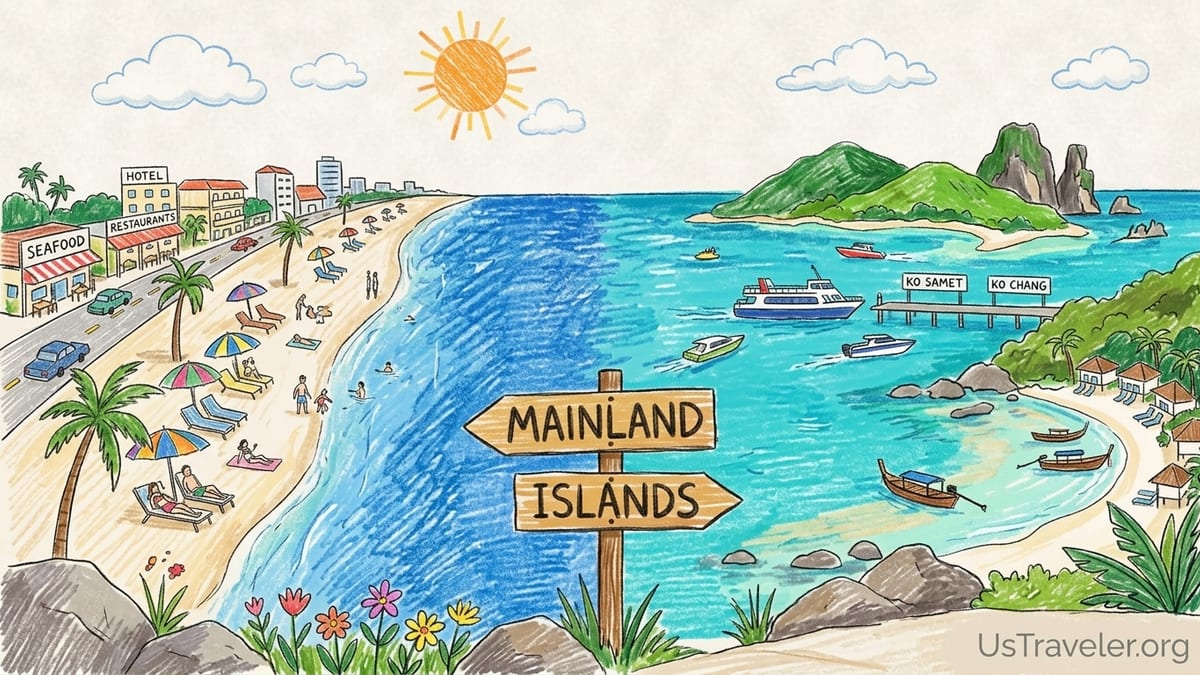
Jomtien And Nearby Chonburi Beaches: The Mainland Options
Jomtien is the classic “I want a beach day without committing to an island transfer” choice on the Pattaya side. It is broad, long, and set up for an easy, no-planning day: you can roll in, rent a lounger, order lunch, and still be back in Bangkok the same evening if you need to. The trade-off is that it remains a mainland urban beach, and the water can turn noticeably murkier after heavy rain, especially in the wet season. If your trip is built around crystal-clear swimming, Jomtien is more of a beach lifestyle base than a postcard-water destination.
Families tend to like Jomtien because the beach is spacious, the entry into the sea is generally gentle, and there is an abundance of practical infrastructure: convenience stores, casual Thai restaurants, pharmacies, and hotels across a wide price range. It also works well for travelers who want beach time plus activities on land, such as water parks in the wider Pattaya and Sattahip area. For a real-world “two-day beach reset,” Jomtien is the sort of place where you book a mid-range hotel, spend the morning on the sand, and head out for seafood dinner without ever needing a boat ticket.
If you want a cleaner-feeling mainland swim without leaving Chonburi, North Pattaya’s Wong Amat is widely regarded as the more pleasant option: it sits away from the busiest central stretch and feels calmer and more residential in tone. For a quieter, more local vibe south of Jomtien, Na Jomtien and Ban Amphur are the names to remember. Ban Amphur, in particular, is the kind of place where the late afternoon scene can turn into a casual beachfront dinner setup, with tables and chairs placed directly on the sand as the sun drops.
Nightlife is the area where staying on the mainland wins. Jomtien itself has bars and a relaxed evening scene, and you are a short ride from Pattaya’s larger nightlife ecosystem if you want it. If you are traveling with friends who want beach time by day and “walk-out-the-door entertainment” at night, Jomtien and its neighboring beaches can be the simplest East Thailand beach plan.
Koh Larn: The Fastest Clear-Water Upgrade From Pattaya
Koh Larn is the quickest way to dramatically improve water color and clarity if you are already in Pattaya or Jomtien. On days when Pattaya’s mainland water looks dull, Koh Larn can feel like someone switched on the saturation. The island’s popularity comes from how little effort it requires: you can do it as a day trip and still sleep in your Pattaya hotel.
For travelers who like concrete logistics, the public ferry is the budget anchor here. Recent 2026 guidance commonly quotes a public ferry cost in the roughly ฿30 to ฿50 range, with a ride time around 30 to 45 minutes depending on sea conditions and the pier you are using. Paid speedboats and bookable services can be significantly more expensive, often starting around a few hundred baht per person depending on operator and timing. The practical takeaway is simple: if you are price-sensitive, take the public ferry and plan around its last return boat rather than improvising at the end of the day.
Swimming is what Koh Larn does best. For families, the main beaches can be busy but straightforward, with plenty of food stalls and rentals. Snorkeling, however, is best treated as “nice if conditions cooperate” rather than guaranteed. You can get enjoyable fish-spotting in clear shallows on calm days, but it is not the same experience as a dedicated reef island. If snorkeling is the priority, you will get more consistent results farther east in the Trat island group, typically via boat trips rather than right off a crowded beach.
Nightlife on Koh Larn is limited compared with Pattaya, which is exactly why many people keep it as a day trip. If your ideal evening is cocktails, beach clubs, or a big variety of dining options, you are usually better off returning to Pattaya and treating Koh Larn as your “blue-water day” rather than your full-time base.
Koh Samet: Bangkok’s Easy White-Sand Getaway (TAT’s Pick)
The Tourism Authority of Thailand has long framed Koh Samet as one of the easiest island getaways from Bangkok, and that reputation matches real traveler behavior: it is a go-to weekend escape with numerous white-sand beaches and enough resorts, restaurants, and bars that you do not need to over-plan. The island tends to feel calmer on weekdays and noticeably livelier on weekends, when Bangkok residents arrive for quick beach breaks.
Koh Samet’s appeal is its balance. You get island sand and clearer water than many mainland options without committing to the longer, more complex travel days required for Trat’s far-eastern islands. Many visitors route through Ban Phe on the Rayong coast, then take a passenger ferry to the island’s Na Dan Pier. Recent 2026 guidance commonly quotes passenger ferry tickets around ฿100 with a crossing time around 40 minutes, although exact timings and operators can vary with season and sea conditions.
On-the-ground, the “easy Bangkok getaway” label plays out in practical ways. You can leave Bangkok in the morning, connect to Ban Phe, and be checking into a beachfront resort in time for a late lunch. On Hat Sai Kaew (often called Sai Kaew Beach), the island’s busy energy is front and center: beach chairs, casual dining, and a dense strip of accommodation. If you want a softer, more couple-friendly feel, bays like Ao Wong Duean are often discussed as a middle ground, with enough restaurants to rotate dinner spots without the intensity of the busiest beach.
Two important reality checks for Koh Samet: first, it is within a national park area, and foreign visitors are commonly required to pay a national-park entrance fee on arrival. Second, its popularity means crowds are part of the package on peak weekends and holidays. If your goal is quiet, you can find it on specific beaches and on weekdays, but Koh Samet is not marketed or experienced as a “deserted island.” It is a compact, convenient island with real amenities, which is exactly why it works.
Rayong Mainland Beaches: Mae Ramphueng And Laem Mae Phim
Rayong’s mainland beaches are often the overlooked middle layer in East Thailand: they are not as instantly famous as Pattaya, and they are not islands, but they can deliver long, relaxed shoreline with fewer moving parts. If you are traveling with a car, or you want “beach plus Rayong food and local life” without boat schedules, Rayong can be a smart choice.
Mae Ramphueng is known for its long, continuous stretch of sand. It can feel more local and less curated than a resort island, which some travelers love and others interpret as “less polished.” For swimming, think in terms of day-to-day conditions: the Gulf can be calm, but rain and runoff can affect water clarity, so it is worth checking the sea when you arrive rather than assuming it will look like an island lagoon. If your group includes kids, the big advantage is space: long sand for walking and play, and the ability to spread out away from dense crowds.
Laem Mae Phim, on the other hand, is often pitched as a comfortable, family-friendly Rayong beach base, with a more holiday-town rhythm and a stronger resort presence. Real-world examples here include beachfront properties that explicitly market direct access and swimming comfort. It is also the kind of area that supports easy “two nights, no stress” itineraries: beachfront morning, seafood lunch, and a low-key evening without needing to travel back to Pattaya’s intensity.
Nightlife in Rayong’s beach areas is generally more subdued than Pattaya or the busiest parts of Koh Samet. You will find bars, casual venues, and beachside dining rather than a concentrated club scene. If you want late nights every night, Rayong will feel quiet. If you want sleep and space, that quiet is a feature.
Koh Chang: The Big Island Base With Variety (And Real Travel Time)
Koh Chang is the “do a little of everything” island in the East: large enough to have multiple beach towns, viewpoints, waterfalls, and a wide range of places to stay, but still less relentless than Thailand’s most famous party islands. It sits within Mu Ko Chang National Park, and travelers should expect the kind of rules and fees that come with a protected area.
For beach quality, Koh Chang is not one single experience. White Sand Beach is popular for a reason: it is easy, developed, and convenient, with plenty of hotels and restaurants, which makes it strong for first-timers and families who want simple logistics. Other areas can be quieter and greener, but they may also mean fewer dining choices within walking distance. The “best beach” question on Koh Chang is usually a “best beach for your routine” question: do you want walkable restaurants and pharmacies, or do you want a resort bay where you mostly stay on property?
Snorkeling is typically not the main reason people choose Koh Chang itself, but it works as a hub. Many visitors book snorkeling or island-hopping trips to smaller nearby islands for clearer reef conditions. If you are traveling with kids, Koh Chang can be a comfortable compromise: a larger island with activities beyond the sea, including waterfalls and viewpoints, while still giving you beach days.
From Bangkok, reaching Koh Chang is a longer day than Pattaya or Koh Samet. Many travelers use combined road-and-ferry routes through Trat province. The key practical update travelers should know is that, as of 2026, the older Centrepoint ferry service is widely reported as suspended since mid-2024, with Ao Thammachat Pier functioning as the main vehicle ferry crossing point. If you are booking transport, this matters because outdated pages and drivers can still reference the old option, which can create confusion on the day you travel.
Koh Mak And Koh Kood: Quiet-First Islands (With Koh Kood The Quietest)
If Koh Chang is the East’s versatile all-rounder, Koh Mak and Koh Kood are the quiet-first alternative. Koh Mak is often described as low-key and slow, with a lifestyle built around cycling, small cafés, and beaches that can feel intentionally uncommercial. It works well for couples and families who want a calm routine and are happy with limited nightlife. In practice, that means evenings that look like a beachfront dinner, a convenience-store ice cream run, and an early night rather than bar-hopping.
Koh Kood is the island that travelers mention when the brief is “quieter, clearer, farther.” The Tourism Authority of Thailand has explicitly promoted Koh Kood for its peacefulness and lack of nightlife, positioning it as a nature-forward destination with clear water, soft white sand, and a remote feel compared with closer-to-Bangkok options. That makes it a strong choice for honeymooners, travelers who want a reset, and families who value calm over convenience.
The price you pay for Koh Kood’s atmosphere is travel time. Many travelers go via Trat province, connecting through Laem Sok Pier. In 2026, a common combined-ticket pattern is bus plus high-speed catamaran, which can still take most of a day end-to-end from Bangkok depending on connections, pickup points, and sea conditions. If your vacation window is only two nights, Koh Kood can feel like too much transit. If you have four nights or more, the slower pace begins to make sense.
For water quality and swimming, Koh Kood can deliver the “why didn’t we come here earlier” feeling on the right day: clear shallows, gentle bays, and beaches that are quiet enough to hear the water. Snorkeling is often done by arranging boat trips, rather than assuming you will find a vibrant reef directly off any random beach. The most realistic plan is to treat Koh Kood as a swimming, kayaking, and relaxation destination, with snorkeling as an add-on you schedule with your resort or a local operator when the sea is calm.
The Takeaway
East Thailand’s best beach is the one that fits your time and your tolerance for transit. If you want the quickest beach break with nightlife and convenience, Jomtien and nearby Chonburi beaches win on simplicity, with Wong Amat, Na Jomtien, and Ban Amphur offering calmer alternatives to central Pattaya. If you want a fast upgrade to clearer water without moving hotels, Koh Larn is the easiest fix.
If you want a true island feel close to Bangkok, Koh Samet remains the standout, and TAT’s framing of it as an easy Bangkok getaway matches the real-world experience: numerous white-sand beaches, lots of places to stay, and a weekend energy that can be part of the fun if you plan around it. If you prefer a mainland base with long sand and fewer crowds, Rayong’s Mae Ramphueng and Laem Mae Phim offer room to breathe.
For bigger-island variety, Koh Chang is the east-coast workhorse: enough development to be comfortable, enough nature to feel like a vacation, and easy access to trips and activities. And if your priority is quiet, clear water, and a beach experience that feels far removed from Bangkok’s pace, Koh Kood delivers the calmest option, at the cost of a longer travel day.
FAQ
Q1. Which East Thailand beach is fastest to reach from Bangkok for a simple weekend?
Koh Samet is one of the most straightforward “leave Bangkok, sleep on an island” options, while Jomtien is the easiest if you want no boat transfers.
Q2. Is Jomtien good for swimming, or should I go elsewhere?
Jomtien can be fine for swimming, but water clarity can vary, especially after rain. For a clearer swim, many travelers choose Koh Larn or head to quieter mainland stretches like Wong Amat or Ban Amphur.
Q3. What is the easiest way to get clear water near Pattaya without changing hotels?
Do a day trip to Koh Larn by public ferry from Bali Hai Pier. It is commonly the simplest “clear water upgrade” from Pattaya or Jomtien.
Q4. Which destination is best for families with small kids?
Jomtien works well for family convenience and space; Koh Samet is a strong island pick with lots of dining and resort options; Koh Chang is best if you want beaches plus waterfalls and other activities.
Q5. Which place has the quietest beaches and the least nightlife?
Koh Kood is widely considered the quietest of these options, with very limited nightlife and a strong focus on nature, swimming, and relaxation.
Q6. Is Koh Samet always crowded?
No. Weekends and holidays can be busy, but weekdays are often calmer. Choosing a less-central beach area and traveling midweek can make a big difference.
Q7. Should I pick Rayong beaches instead of an island?
Pick Rayong’s Mae Ramphueng or Laem Mae Phim if you want long stretches of sand, easier logistics, and a quieter mainland feel without ferry schedules.
Q8. Is Koh Chang better than Koh Samet?
They serve different trips. Koh Samet is faster for a short Bangkok getaway. Koh Chang is better for longer stays where you want variety, excursions, and multiple areas to explore.
Q9. Can I snorkel from the beach on Koh Kood or Koh Chang?
Sometimes, but conditions vary. Many visitors get the best snorkeling by arranging boat trips to suitable spots rather than relying on off-the-beach snorkeling every day.
Q10. If I only have three nights, where should I go for the best mix?
For three nights, Koh Samet is often the best balance of travel time, beach quality, and resort choice. If you prefer a bigger island with more activities, choose Koh Chang and stay near a beach area with walkable dining.