


East Thailand is the long coastal sweep southeast of Bangkok, running from the big beach-city energy of Chonburi and Pattaya through Rayong’s mainland beaches and Koh Samet, then east into fruit-growing Chanthaburi and onward to Trat province, where ferries fan out to Koh Chang, Koh Mak, and Koh Kood. For first-time visitors, the key is understanding that “East Thailand” is not one trip. Someone planning late nights on Walking Street in Pattaya is choosing a fundamentally different vacation than someone booking a stilt-bungalow on Koh Kood and falling asleep to cicadas at 9 p.m. This regional guide connects the zones, explains how they fit together, and helps you pick the right base without trying to mash incompatible itineraries into a single rushed loop.
What Counts As East Thailand, And How The Zones Fit Together
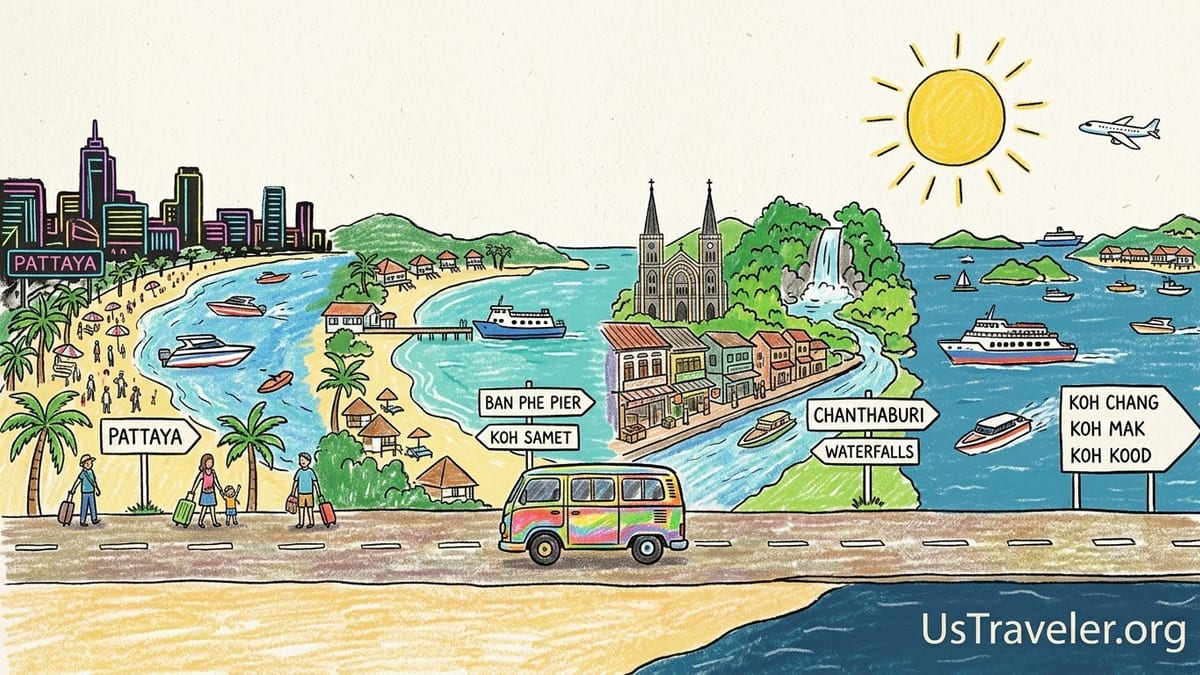
In practical travel terms, East Thailand usually means the coastal provinces you can reach from Bangkok without flying: Chonburi (including Pattaya), Rayong (including the pier for Koh Samet), Chanthaburi, and Trat (gateway to the Trat islands). You can stitch them into one overland journey, but most first-time visitors are happier treating East Thailand as a menu of distinct “trip styles” rather than a single checklist.
Think of it as a spectrum. At the western end, Chonburi and Pattaya are fast, built-up, and nightlife-forward, with the easiest transport links from Bangkok and the biggest range of tours and entertainment. Rayong and Koh Samet sit in the middle: beach days and island time without going fully remote, often with shorter stays of two or three nights. Chanthaburi is where the region turns greener and more local-feeling, with historic riverside streets and nearby national-park waterfalls. Trat is the far end of the line, where you commit to ferries and slower island rhythms, with Koh Chang as the “big island hub” and Koh Mak and Koh Kood as the quieter, smaller-island payoff.
Distance is not the only difference. Your daily logistics change too. In Pattaya you can land in Bangkok, hop on a bus, and be ordering food on Beach Road the same afternoon. On Koh Kood, you are planning around a limited number of boats, potential weather disruption in shoulder season, and last-mile transfers from the pier to your resort. That difference is exactly why this region is so useful for first-timers: you can choose the level of intensity that matches your travel personality.
Chonburi And Pattaya: Beaches With Big-City Convenience And Nightlife
Pattaya is East Thailand’s best-known name for a reason: it is easy, packed with hotels, and built for entertainment. It is not the place to come expecting empty beaches and silence. It is the place to come if you want a full-service seaside city where your evening might include a rooftop bar in Pratumnak, live music around Soi Buakhao, or the neon chaos of Walking Street. If your group includes different interests, Pattaya also works because you can split up and still stay in the same area: one person goes shopping, another takes a day trip, another stays by the pool, and everyone can meet for dinner without needing a scooter or a boat schedule.
For beaches, manage expectations. Pattaya Beach is central and convenient, while Jomtien is often the more comfortable “day at the beach” option for first-timers who want a longer strip of sand and a slightly calmer feel. For a quick island break from the city, many travelers do a day trip to Koh Larn (Coral Island) for brighter water and a change of scenery, then return to Pattaya for dinner and nightlife. That “city base plus island day trip” pattern is a classic Pattaya itinerary.
Getting here from Bangkok is straightforward. Roong Reuang Coach is a common choice for Bangkok to Pattaya by bus, with published fares that are low enough to feel like a commuter route rather than a tourist splurge. If you land at Bangkok’s airports, direct services also exist on some routes, which can be a relief after a long-haul flight when you do not want a taxi negotiation or multiple transfers.
Hotels in Pattaya cover everything from budget rooms near the action to beachfront properties on Wong Amat Beach that feel more “resort” than “party.” A real-world planning tip: if your primary goal is nightlife, stay close enough that you are not relying on late-night transport to get home. If your primary goal is a beachy family stay, pick a quieter zone like Wong Amat or parts of Jomtien so you are not hearing bar music until 2 a.m.
Rayong And Koh Samet: Quick-Access Island Time (With National Park Rules)
Rayong province is the bridge between Pattaya’s intensity and Trat’s island slow life. The main reason first-time visitors come is Koh Samet, a compact island reached by boat from the Ban Phe area on the mainland. It is one of the easiest “real island” experiences from Bangkok, which makes it popular for weekend escapes and short stays. In practice, that means Koh Samet can feel busy in peak periods, and it pays to book ahead if you are traveling on a holiday weekend.
Koh Samet’s travel rhythm is simple: arrive at the pier, take a ferry or speedboat, then base yourself on a beach and live in sandals for a few days. The island is part of a national park system, so you will encounter park entry fees and rules that shape the experience. If you want a nature-focused add-on while staying on the mainland, Khao Laem Ya–Mu Ko Samet National Park includes viewpoints and coastal scenery around the headland, and it is a reminder that Rayong is not only a pier town. It can be a gentle detour for travelers with a car who want a sunset viewpoint before or after island time.
Boats from Ban Phe to Koh Samet run frequently during the day, with different operators and different patterns. Some services run on a schedule, while speedboats may operate more flexibly depending on demand. For first-timers, the practical takeaway is to avoid planning a tight connection from Bangkok to the last boat of the day, especially in rainy months when seas can be rougher and schedules can shift.
Where Koh Samet fits best in an East Thailand itinerary: it is ideal if you want islands but you also want to minimize transfers. It is less ideal if your dream is a remote, low-development beach. Samet is a short hop, and it feels like a short hop. If you want a calmer, more “far away” island atmosphere, that is where Trat’s islands start to make more sense.
Chanthaburi: Historic Town Energy, Waterfalls, And A Different Side Of The East
Chanthaburi is the east-coast province that surprises first-time visitors who assumed the region was only beaches. The town has a lived-in, river-oriented feel, and it makes a smart stop for travelers who want culture and scenery between island stays. You can spend a day walking around old shopfront streets, sitting at a café by the water, then eating seafood that feels more local market than tourist menu.
The big nature draw is the area’s waterfall parks. Namtok Phlio National Park is a well-known example for an easy-to-access waterfall day with a short walk and the kind of humid, green atmosphere that feels like a reset after beach heat. It is the sort of place where you can realistically do a half-day trip: breakfast in town, waterfall visit, late lunch back in Chanthaburi, then a quiet evening.
Chanthaburi also connects to one of the region’s most specific seasonal experiences: the Khao Khitchakut pilgrimage period, when visitors travel to the national park to pay respects at the Buddha footprint site during its limited annual opening. This is not a typical “tourist attraction” day trip. It is a real event with real crowds, and it can be memorable if you approach it as a cultural experience and plan your timing and expectations accordingly.
If you are the kind of traveler who feels restless after too many beach days, Chanthaburi is your antidote. It also works as a practical break in the journey if you are traveling overland from Rayong to Trat and want to avoid doing the entire drive in one push.
Trat Mainland: The Gateway Zone (Piers, Timing, And Smart Transfers)
Trat province is where East Thailand turns into “island logistics.” The mainland matters because it contains the piers and the transport nodes that make the islands possible. Your trip here will often involve a transfer chain: a bus or flight to Trat, a van or taxi to a pier, a ferry or speedboat to an island, then a pickup truck taxi to your beach or resort.
First-time visitors should know the names of the main pier areas because your booking confirmations and hotel pickups will reference them. One of the most common departure points for Koh Kood and Koh Mak is the Laem Sok area. For Koh Chang, most travelers head to the Laem Ngop area, then take a short ferry crossing to the island. If you are booking transport packages that bundle van plus boat, the operator will often structure your day around these pier departures, which means your “departure time” is not only a boat time but also a mainland pickup time.
Trat is also one of the few places in this region where flying can genuinely simplify your itinerary. Bangkok Airways operates flights to Trat, which can turn a long road journey into a quick hop if you are short on time or starting from Bangkok with only a few days to spare. For travelers trying to maximize Koh Kood or Koh Mak time, that can matter: arriving earlier in the day increases the chances you make a convenient boat and do not lose a full afternoon to transfers.
Seasonality is not theoretical here. In monsoon months, boat schedules can change due to weather, and inter-island connections are often more limited than in high season. The practical advice is to avoid planning same-day “island hop” connections with zero buffer. If a boat is delayed or canceled, the consequences on Trat’s outer islands are bigger than they are in Pattaya, where you can simply switch to a different bar or a different restaurant and keep going.
Koh Chang, Koh Mak, And Koh Kood: Choosing The Right Island (And The Right Kind Of Quiet)
Trat’s three headline islands give you three different versions of “island Thailand.” Koh Chang is the largest and the most developed, with multiple beach areas, plenty of restaurants, and enough infrastructure to keep first-timers comfortable. You can stay on White Sand Beach for easy access to shops and casual nightlife, choose Klong Prao for a more relaxed base, or head south toward Bang Bao for a fishing-village vibe and boat-trip access. Koh Chang also works well if you want activities: viewpoints, waterfall stops, boat trips to smaller islands, and a good range of day tours.
Koh Mak is smaller, flatter, and deliberately mellow. Many travelers choose it for cycling, low-key beach days, and a “sleepy island” feel that still has enough cafés and beach bars to keep you from feeling stranded. It is the kind of place where you might plan a simple day: breakfast, a ride to a different beach, a long lunch, a swim, then sunset somewhere quiet. Koh Mak is often a sweet spot for couples or families who want calm but are not ready for the extra-quiet feel of Koh Kood.
Koh Kood is the quietest of the three for most visitors, and it is where you go if your priority is beaches, space, and a sense of being far from the mainland. The island has waterfalls and beautiful bays, but the vibe is resort-and-nature rather than town-and-nightlife. This is where the “fundamentally different trip” point becomes real. If Pattaya is your plan for nightlife, Koh Kood is your plan for early nights, resort dinners, and days organized around beaches, snorkeling trips, and occasional excursions rather than bar-hopping.
Hotel expectations should match the island. On Koh Kood, many travelers choose higher-end stays specifically because they will spend more time at the resort itself. Real-world examples include pool-villa style resorts that market themselves as destination properties, where the room is not just a place to sleep but the centerpiece of the trip. On Koh Chang, by contrast, you can comfortably choose a mid-range hotel and spend your time out exploring different beaches and restaurants because the island has more variety within easy reach.
The Takeaway
East Thailand rewards first-time visitors who pick one clear “anchor” and build outward logically. Pattaya and Chonburi are for high-energy convenience and nightlife, with quick transport from Bangkok and plenty of entertainment. Rayong and Koh Samet are for fast, easy island time that still feels close to the city. Chanthaburi is for historic-town atmosphere and waterfall days that break up a beach-heavy itinerary. Trat is your gateway to the islands, where planning and seasonality matter more. And the big decision is simple: if you want nightlife, you are planning a Pattaya-style trip. If you want quiet beaches and resort downtime, you are planning a Koh Kood-style trip. The region works best when you embrace those differences instead of trying to force them into the same pace.
FAQ
Q1. What provinces are considered East Thailand for travelers?
For most itineraries from Bangkok, East Thailand usually refers to Chonburi, Rayong, Chanthaburi, and Trat, including the islands off Trat.
Q2. Is Pattaya a good base if I want quiet beaches?
Pattaya works best for nightlife and convenience. If your priority is quiet beaches, consider Koh Mak or Koh Kood, or choose a quieter Pattaya zone like Wong Amat and plan island day trips.
Q3. How do I get from Bangkok to Pattaya without a taxi?
Many travelers use Roong Reuang Coach buses from Bangkok’s Eastern Bus Terminal (Ekkamai). It is a common, budget-friendly option with frequent departures.
Q4. How do I reach Koh Samet from Bangkok?
You typically travel to the Ban Phe area in Rayong, then take a ferry or speedboat to Koh Samet. Boats run frequently during the day, but it is wise to avoid tight late-day connections.
Q5. Is Koh Samet part of a national park?
Yes. Koh Samet is associated with Khao Laem Ya–Mu Ko Samet National Park, so visitors should expect park entry fees and rules that can affect certain activities.
Q6. What is Chanthaburi best known for besides beaches?
Chanthaburi is known for its historic riverside town feel and nearby nature spots, including waterfall parks such as Namtok Phlio National Park.
Q7. When is the Khao Khitchakut pilgrimage season?
The pilgrimage opening is limited each year. For 2026, the announced open period was from 19 January to 19 March 2026, so future years should be checked for updated dates before planning.
Q8. Which Trat island should I choose: Koh Chang, Koh Mak, or Koh Kood?
Koh Chang is the biggest and most developed with lots of dining and activities. Koh Mak is smaller and mellow. Koh Kood is the quietest, best for beach-and-resort downtime.
Q9. Can I island-hop between Koh Chang, Koh Mak, and Koh Kood year-round?
Not reliably. Inter-island services are often more limited in monsoon months, and weather can disrupt schedules. In low season, plan to route via the mainland if needed.
Q10. Is flying to Trat worth it?
It can be, especially if you have limited vacation time and want to maximize days on Koh Chang, Koh Mak, or Koh Kood. A flight can reduce long overland transfer time and help you catch earlier boats.