


Ayutthaya is one of the easiest big-history day trips from Bangkok, and the train remains the most straightforward option for independent travelers: frequent departures, simple fares, and arrivals close to the old city. The details that trip people up in 2026 are mostly logistical, not romantic, namely which Bangkok station your train actually leaves from, whether you need to book ahead for air-conditioned seats, and what to do when you step off at Ayutthaya station and realize the UNESCO-era ruins are across the river. This guide breaks down the Bangkok to Ayutthaya train experience end-to-end, with real examples of services, timings, ticket classes, and the quick river crossing that gets you from the station side to the Historical Park side.
Which Bangkok Station Should You Use for Ayutthaya?
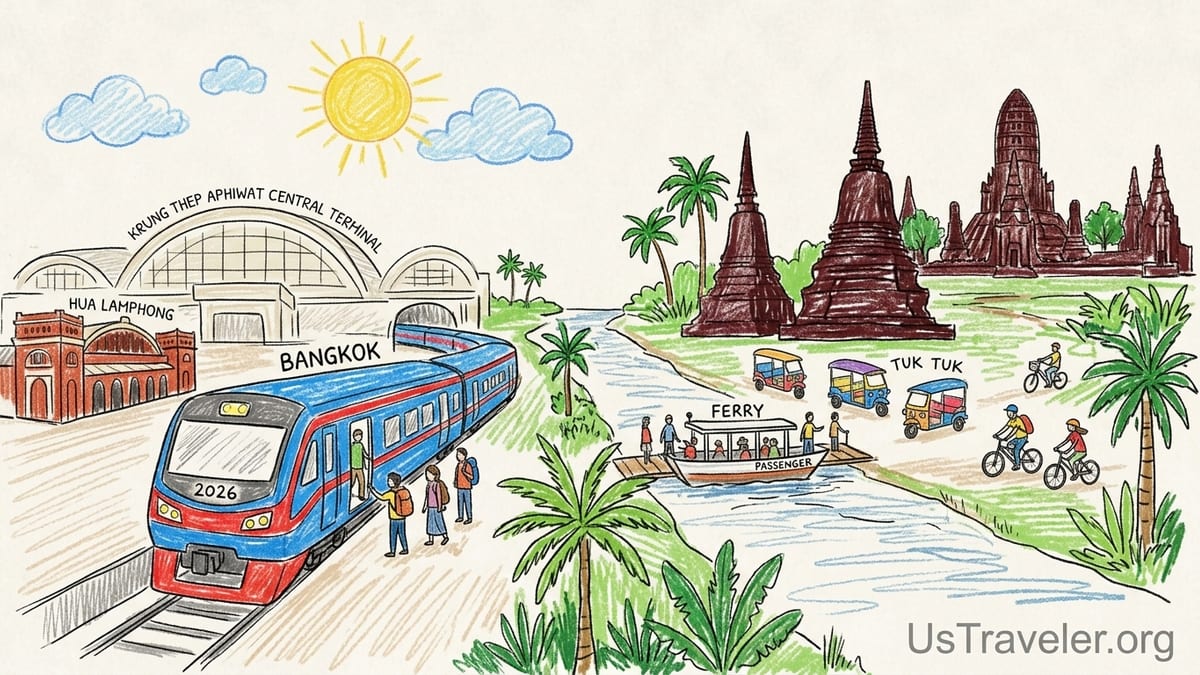
In 2026, many faster Bangkok to Ayutthaya services depart from Krung Thep Aphiwat Central Terminal (also known to many travelers by its older reference, Bang Sue). This is Bangkok’s main hub for many long-distance northbound and northeastbound trains, and it is the station you should try first if you want the widest choice of rapid, express, or special express departures in the morning and evening.
Some slower, local-style services still appear in schedules as departing from Hua Lamphong, the historic central station. If you are staying near Old Bangkok, Chinatown, or the riverside and you see a convenient Hua Lamphong departure time, it can be a perfectly workable choice. The tradeoff is usually journey time and carriage style, with ordinary or commuter-type trains taking longer and often being fan-cooled rather than air-conditioned.
For many travelers, the station decision is really a time-of-day decision. A common “day trip” pattern is to choose an early Krung Thep Aphiwat departure that gets you into Ayutthaya before the heat builds, then return later in the afternoon or early evening. If you are flying in or staying near Don Mueang Airport, it is also worth knowing that trains on this corridor typically call at Don Mueang station, which can save you a cross-city transfer.
Ordinary vs Air-Conditioned Services: What “Fast” Looks Like in 2026
Bangkok to Ayutthaya journey times in current 2026 schedules commonly range from about an hour to around two hours, depending on the service type and how many stops it makes. Faster services may get you there in under an hour, while ordinary trains with frequent stops can push closer to two hours, especially at busy times.
In real terms, this is what “fast” can look like on the board: a morning special express from Krung Thep Aphiwat scheduled around 06:10 arriving about 06:58 is the kind of sub-one-hour run day trippers love. A rapid service around 07:10 can be scheduled to reach Ayutthaya around 08:27, and an express around 08:45 can be scheduled to arrive around 09:41. These examples show why travelers say “one to two hours” and why the train competes well with minivans when road traffic is unpredictable.
“Ordinary” trains are not automatically bad, they are simply different. They are often slower and more local in feel, with more intermediate stops and a larger share of fan-cooled seating. If your priority is the cheapest possible fare and you do not mind a longer ride, an ordinary departure from Hua Lamphong later in the morning can still be a sensible choice, especially if it aligns with your hotel location and you are not chasing an early start at the temples.
Air-conditioning is usually tied to the type of carriage and the type of train. On popular dates and at peak hours, air-conditioned seating can sell out while ordinary third-class can still be available. That is one reason to decide up front whether comfort is essential for you, especially if you are traveling with a child, have heat sensitivity, or plan to be outdoors in Ayutthaya for most of the day.
Ticket Classes and What You Actually Get Onboard
For most independent travelers, the core choice is third class versus second class, and fan-cooled versus air-conditioned. Third class is the classic low-cost option: simple seats, a more local atmosphere, and a ticket you often buy shortly before departure. On some trains this will be fan-cooled; on others, you may see air-conditioned third class on certain services, but you should treat that as train-dependent rather than guaranteed.
Second class typically means a more comfortable seat and, on many services, air-conditioning. If you are planning a tight same-day Ayutthaya itinerary, paying more for an air-conditioned seat can be a practical decision because it helps you arrive less drained, especially in the hotter months when the day in the Historical Park can feel relentless.
It also helps to adjust expectations: this is a short intercity ride, not a luxury rail experience. You are not choosing between lie-flat seats and gourmet dining, you are choosing between “functional and cheap” and “more comfortable and easier in the heat.” If you have large luggage, choosing a quieter, more spacious class can reduce stress, but many day trippers travel with only a small backpack and happily use third class.
If you see “special” services advertised seasonally, such as heritage or steam excursions, read the fare and inclusions carefully before assuming they match regular pricing. For example, the State Railway of Thailand has promoted special steam excursions between Bangkok and Ayutthaya at set round-trip prices, with a basic ordinary-seat option and a higher-priced air-conditioned option that may include extras like snacks. These are occasional experiences, not the everyday commute.
How to Buy Bangkok to Ayutthaya Train Tickets (Online vs At the Station)
For most travelers, you do not need to overcomplicate ticketing on this route. If you are taking an ordinary third-class service, it is often feasible to show up at the station, go to the ticket window, and buy a ticket for the next train. This is part of why Ayutthaya remains a favorite independent day trip: it can be spontaneous and low-friction.
If you want an air-conditioned seat on a specific train, or you are traveling on a weekend morning when Bangkok residents also head out, buying ahead can reduce uncertainty. The State Railway of Thailand’s official D-Ticket platform is the reference point many travelers use for advance purchases, and some tickets can be sold in advance depending on the service. In practice, people most often book ahead when they want a specific train type or class rather than because the route is always sold out.
There is one important “search” detail that repeatedly trips travelers up: when booking or checking timetables online, you typically need to select the correct Bangkok departure station name, which for many long-distance services is Krung Thep Aphiwat rather than a generic “Bangkok.” If you search the wrong origin, you can get confusing results that look like missing trains when the trains are actually departing from a different station.
As a real-world example, a traveler staying near Chatuchak or the Ari area might choose Krung Thep Aphiwat for an early express and buy a second-class air-conditioned seat in advance if available, while a traveler staying near Chinatown might walk or take a quick ride to Hua Lamphong and buy a same-day third-class ticket for a later ordinary train. Both approaches can be correct, depending on your priorities.
Arrival at Ayutthaya Station: The River Crossing and First 10 Minutes
Ayutthaya railway station is not inside the temple zone. It sits on the east bank of the river, while the most-visited ruins and the core of the UNESCO-listed Historical Park are on the island across the water. This is the single biggest “surprise” first-timers mention, especially if they expected to walk straight into the old city from the platform.
The simplest solution is also the local one: walk a short distance from the station area to the small passenger ferry crossing and take the quick boat ride across the river. The crossing itself is very short, and the fare is typically only a few baht, which makes it faster and cheaper than negotiating a longer road ride around a bridge just to reach the same area.
Once you are across, you are in the zone where transportation choices open up quickly: bicycle rental shops, tuk-tuks offering point-to-point rides or half-day loops, and straightforward walking routes to the first temples. If you arrive early, you can be rolling toward your first stop quickly enough to feel like you “beat the crowds,” even though Ayutthaya is popular year-round.
If you have heavy luggage, limited mobility, or you are visiting in extreme heat, consider skipping the “figure it out on the fly” approach. In that scenario, it can be worth paying for a tuk-tuk from the station area, even if it goes around by road, simply to reduce transitions. For most day trippers with light bags, though, the ferry-and-walk approach is the efficient default.
Getting From the Station to the Historical Park: Tuk-Tuk, Bicycle, Walking, and Practical Costs
After you cross the river, you have three common ways to move around the Historical Park area: rent a bicycle, hire a tuk-tuk, or do a hybrid of walking plus short rides. The best choice depends on your heat tolerance, your time window, and whether you want to cover “just the highlights” or include outlying temples.
Bicycles are popular because the terrain on the island is relatively flat and distances between major ruins are manageable. In practice, travelers often rent a bicycle for a day from a shop near the ferry landing and build a simple loop that includes the headline sites. If you are visiting in the hottest months, plan your cycling with shade breaks in mind, because there are stretches that can feel exposed by late morning.
Tuk-tuks are the most visible option outside the station and near the temple entrances. Many drivers will quote a price for a multi-stop circuit, waiting while you explore each site and then continuing. This is a practical choice if you want to pack several temples into a half-day, if you are traveling with a family, or if you want a driver to manage the “in-between” logistics. It is also the easiest way to include temples that are less convenient by bicycle, including those across the river from the island core.
Walking can work well for a focused visit, especially if you pick two or three sites close together and do not try to “collect them all.” A realistic example is arriving in the morning, crossing by ferry, walking to one nearby temple complex, then switching to a tuk-tuk for a longer hop to a second site, and finishing with a bicycle or another short ride. The key is to decide your transport rhythm early so you do not spend your best hours negotiating each move.
Historical Park Access: Tickets, Temple Entry, and What to Expect on a Day Trip
Ayutthaya’s Historical Park experience is not a single gated attraction where one ticket unlocks everything. Instead, the area includes multiple temple sites with individual ticket booths at major complexes. This matters for planning because you may pay at one site, then pay again at the next, unless you choose a combined ticket where available and it fits your plan.
In practical terms, travelers often encounter a per-temple fee at major sites and lower fees at smaller ones. There is also commonly discussed combined ticketing that bundles several key temples for one price. Because ticket rules can change and cash handling can be site-specific, it is smart to carry small bills and be prepared to pay at each major entrance if needed rather than assuming every booth takes cards or that every site is included under one pass.
For a clean, realistic day-trip structure, plan around temple opening hours and heat, not just transport. A strong independent itinerary is to arrive on an early train, cross the river quickly, visit two or three major temples before midday, take a long lunch break in the shade, and then either add one more site or choose a single “sunset-worthy” temple if you are staying overnight. If you are returning to Bangkok the same day, aim to leave the park area with enough buffer to cross back, reach the station calmly, and buy your return ticket without rushing.
If you are comparing the train with minivans and organized tours, this is the honest bottom line: trains give you a predictable station-to-station experience and drop you near the river crossing, minivans can be quicker door-to-door depending on your Bangkok neighborhood and traffic, and organized day tours remove almost all decision-making but reduce flexibility. If you like building your own day, the train is still the most satisfying “independent traveler” option on this route.
The Takeaway
The Bangkok to Ayutthaya train is popular because it matches what travelers actually want in 2026: frequent departures, low prices for basic seats, and journey times that can land in the one-hour range on faster services. The two decisions that matter most are choosing the right Bangkok station for your preferred departure time and deciding whether you care enough about air-conditioning to book ahead.
Once you arrive, remember the key piece of local geography: the station is on the opposite side of the river from the main Historical Park area. The quick passenger ferry crossing is the efficient default, and it puts you in position to rent a bicycle, hire a tuk-tuk, or walk to your first ruins within minutes. Build your day around that transition, and Ayutthaya becomes one of the smoothest and most rewarding self-guided trips you can do from Bangkok.
FAQ
Q1. Which Bangkok station do I use to go to Ayutthaya by train in 2026?
Many faster services depart from Krung Thep Aphiwat Central Terminal, while some ordinary services can still depart from Hua Lamphong depending on the schedule.
Q2. How long is the train from Bangkok to Ayutthaya?
Current 2026 schedules commonly show about 1 to 2 hours, depending on whether you take a special express, express, rapid, or ordinary train.
Q3. Do I need to book Bangkok to Ayutthaya train tickets in advance?
Often no for ordinary third class, but booking can help if you want a specific air-conditioned class or a specific departure time on a busy day.
Q4. Can I buy tickets at the station right before departure?
Yes, many travelers buy same-day tickets at the station, especially for ordinary services, but arrive early if you want time to choose the best departure and class.
Q5. What’s the difference between ordinary and air-conditioned trains on this route?
Ordinary trains are typically slower with more stops and may be fan-cooled, while express-type services are usually faster and more likely to offer air-conditioned classes.
Q6. Where do I arrive in Ayutthaya by train?
You arrive at Ayutthaya railway station on the east side of the river, not inside the main Historical Park zone.
Q7. How do I get from Ayutthaya station to the Historical Park?
Walk to the nearby passenger ferry crossing and take the short boat ride across the river, then continue by bicycle, tuk-tuk, or on foot.
Q8. Are there tuk-tuks at Ayutthaya station?
Yes, tuk-tuks commonly wait outside the station and can quote prices for point-to-point rides or multi-temple circuits.
Q9. Is there one ticket for all Ayutthaya temples?
No single gate covers everything; major temples often have their own ticket booths, and combined tickets may cover a set group of key sites.
Q10. Is the train better than a minivan or an organized day tour?
The train is usually best for independent travelers who want flexibility; minivans can be convenient depending on traffic and pickup points; tours are simplest if you want everything arranged.